The Fear of the White Uniform: Are We Finally Prioritizing Confidence Over Tradition in Sports?
For generations of female athletes, there has been an opponent more formidable than the rival team, and more stressful than the championship clock. It is the opponent known as “The White Uniform.”
Whether it is the pristine whites of a tennis court, the traditional home kit of a soccer team, or the mandatory PE shorts in a high school gym, white fabric has long been a source of silent, paralyzing terror for menstruating girls.
It creates a phenomenon known as the “Psychological Tax” of performance. When a teenage girl takes the field on the heaviest day of her cycle wearing white shorts, her brain is splitting its resources. 80% of her focus might be on the game, but that crucial remaining 20% is constantly scanning for disaster. Did I leak? Can they see it? Do I need to check?
That 20% distraction is often the difference between making the play and missing it. Or, more significantly, it is the difference between staying in the sport or quitting entirely.
The Wimbledon Shift
Ideally, sports should be a meritocracy where skill is the only variable. But biology has always complicated that equation. Recently, however, the tide has turned.
In a historic move, the All England Club—home of Wimbledon and the strictest dress code in sports—relaxed its rules to allow female tennis players to wear dark undershorts. Several national women’s soccer teams have followed suit, abandoning white shorts for darker colors.
These changes are an admission of a truth that every teenage girl already knows: You cannot play your best when you are terrified of bleeding through your clothes.
The Mechanics of “Gym Class Panic”
While professional athletes are leading the conversation, the stakes are arguably higher for the average teenager. Professional athletes have access to luxury locker rooms and unlimited supplies. A 14-year-old in gym class has 45 minutes, a crowded changing room, and a relentless social hierarchy where a visible stain can become a core memory of humiliation.
The issue is mechanical. Standard period protection is often incompatible with high-intensity movement.
- Pads can shift, bunch, or detach during running and jumping, leading to side leakage.
- Tampons, while more secure, can still saturate unexpectedly during the physical exertion of a match, and many young teens are not yet comfortable using them.
This creates a barrier to entry. Studies consistently show that girls drop out of sports at twice the rate of boys during puberty. While there are many reasons for this, the “period panic”—specifically the fear of leakage during physical exertion—is a massive, under-discussed contributor.
The “Double Defense” Strategy
So, how do we keep girls in the game? If we can’t change the school uniform policy overnight, we have to upgrade the gear.
The solution lying at the intersection of technology and textiles is the “Double Defense” strategy. This involves moving away from relying on a single point of failure (just a pad or just a tampon) and adopting a backup system that acts as a safety net.
This is where the revolution in performance fabrics comes in. We are seeing a move toward technical apparel that looks and feels like standard compression gear but functions as a high-capacity barrier.
The Psychology of Security
The benefit of this gear isn’t just about absorption; it’s about the “Mental release.”
Imagine a goalie diving for a save. If she is wearing a standard pad, her subconscious creates a hesitation—a fear that the impact will dislodge her protection. Now, imagine she is wearing specialized leak-proof shorts. The gear is secure; it moves with her body. The hesitation vanishes. She dives.
By integrating protection directly into the clothing, we remove the “foreign object” sensation that plagues traditional products. It allows the athlete to dissociate from her cycle and re-associate with her sport.
Conclusion
The shift away from the tyranny of the white short is long overdue. It represents a cultural maturity that values the mental health and performance of girls over an arbitrary aesthetic tradition.
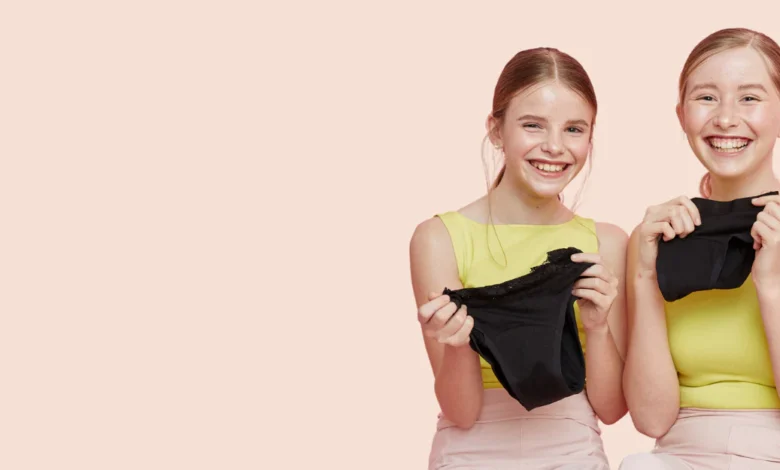
But until every coach and school board gets the memo, parents and teens have to arm themselves. Integrating menstrual underwear for teens into the athletic bag is a practical way to bypass the anxiety. It allows a young athlete to look at her white uniform not with fear, but with the focus of a competitor who knows that her defense is impenetrable—both on the field and off it.