Critical Thinking Exercises: A Practical Guide to Strengthening Your Thinking Skills
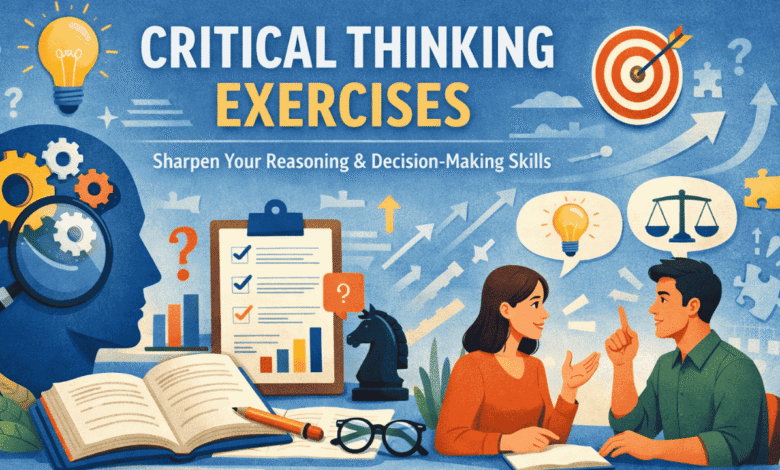
In a world overflowing with information, opinions, and constant distractions, the ability to think clearly and rationally has become more important than ever. This is where critical thinking exercises play a vital role. They help individuals analyze information objectively, question assumptions, evaluate evidence, and make better decisions in both personal and professional life. Whether you are a student, teacher, professional, or lifelong learner, developing critical thinking is not something that happens automatically—it requires practice. This article explores what critical thinking exercises are, why they matter, and how you can use them effectively, along with practical examples you can start using today.
What Are Critical Thinking Exercises?
Critical thinking exercises are structured activities designed to improve reasoning, analysis, evaluation, and decision-making skills. Instead of memorizing facts, these exercises encourage you to question information, identify patterns, spot logical flaws, and consider multiple perspectives.
They can be simple mental challenges, written activities, group discussions, case studies, or real-life problem-solving scenarios. The key purpose of critical thinking exercises is to train your mind to think more deeply and independently.
Why Critical Thinking Exercises Are Important
Critical thinking is an essential skill that underpins effective learning, problem-solving, and communication. Practicing critical thinking exercises regularly can help you:
- Make informed decisions rather than impulsive ones
- Detect bias, misinformation, and weak arguments
- Improve academic performance and comprehension
- Strengthen workplace problem-solving and leadership skills
- Develop intellectual confidence and curiosity
In education, critical thinking exercises help students move beyond rote learning. In the workplace, they improve strategic thinking, collaboration, and innovation. In everyday life, they support better judgment and clearer reasoning.
Core Skills Developed Through Critical Thinking Exercises
Before diving into examples, it helps to understand the core skills these exercises target:
- Analysis – Breaking information into parts to understand structure and meaning
- Evaluation – Judging the credibility and relevance of information
- Inference – Drawing logical conclusions from available evidence
- Reasoning – Connecting ideas logically and consistently
- Reflection – Examining one’s own assumptions and thinking patterns
Effective critical thinking exercises usually engage more than one of these skills simultaneously.
Individual Critical Thinking Exercises You Can Practice Daily
Not all critical thinking exercises require classrooms or teams. Many can be practiced alone and integrated into daily routines.
1The Question Everything Exercise
Take a statement, article, or opinion and ask:
- What is the claim?
- What evidence supports it?
- What assumptions are being made?
- What might be missing?
This exercise trains skepticism and analytical thinking without being cynical.
Pros and Cons Analysis
When making a decision, write down the advantages and disadvantages of each option. Then evaluate which factors matter most and why. This simple exercise improves structured decision-making.
Assumption Hunting
Identify assumptions behind a belief or argument. Ask yourself whether those assumptions are valid, outdated, or biased. This is one of the most powerful critical thinking exercises for improving self-awareness.
Critical Thinking Exercises for Students
Students benefit greatly from targeted critical thinking exercises that align with learning goals.
Open-Ended Questions
Instead of questions with one correct answer, encourage responses that require explanation and justification. For example:
- Why do you think this happened?
- What evidence supports your conclusion?
Compare and Contrast Tasks
Ask students to compare two ideas, theories, or historical events. This exercise develops analytical and evaluative thinking skills.
Debate and Discussion
Structured debates require students to research, reason, and defend positions logically. Even informal discussions can be effective critical thinking exercises when guided properly.
Critical Thinking Exercises for the Workplace
In professional environments, critical thinking exercises support better collaboration and strategic decision-making.
Case Study Analysis
Present a real or hypothetical workplace problem and ask teams to:
- Identify the core issue
- Analyze possible causes
- Propose multiple solutions
- Evaluate risks and benefits
This mirrors real-world decision-making and builds practical reasoning skills.
The “What If” Exercise
Ask teams to explore alternative scenarios:
- What if this plan fails?
- What if our assumptions are wrong?
- What if we reverse our strategy?
This exercise strengthens adaptability and foresight.
Root Cause Analysis
Instead of addressing symptoms, teams dig deeper to uncover underlying causes. Asking “why” repeatedly helps uncover deeper issues and prevents superficial solutions.
Group-Based Critical Thinking Exercises
Group activities add social learning and exposure to diverse perspectives.
Perspective Switching
Participants argue a position they disagree with. This exercise builds empathy, open-mindedness, and deeper understanding of complex issues.
Brainstorm and Evaluate
Groups generate ideas freely, then switch to a critical evaluation mode to assess each idea based on evidence, feasibility, and impact.
Consensus Building
Teams must reach agreement through reasoned discussion rather than authority or majority pressure. This exercise improves communication and logical persuasion.
Using Critical Thinking Exercises in Everyday Life
Critical thinking exercises are not limited to formal settings. You can apply them in daily life by:
- Analyzing news articles for bias and evidence
- Evaluating product reviews before purchases
- Reflecting on personal decisions and outcomes
- Questioning stereotypes and generalizations
The more frequently you apply critical thinking exercises in real-life contexts, the more natural these skills become
Tips for Making Critical Thinking Exercises Effective
To get the most out of critical thinking exercises, keep these best practices in mind:
- Focus on reasoning, not just answers
- Encourage curiosity and questioning
- Accept multiple valid perspectives
- Reflect on mistakes and learning points
- Practice consistently rather than occasionally
Critical thinking improves over time, much like physical fitness—it requires regular training.
Common Mistakes to Avoid
While practicing critical thinking exercises, avoid these pitfalls:
- Treating critical thinking as negativity or fault-finding
- Relying only on opinions without evidence
- Ignoring emotional or contextual factors
- Seeking quick answers instead of thoughtful analysis
True critical thinking is balanced, open-minded, and evidence-based.
Conclusion
Critical thinking is not an abstract academic concept—it is a practical, learnable skill that shapes how we understand the world and make decisions. By practicing critical thinking exercises regularly, individuals can strengthen their ability to analyze information, challenge assumptions, and reason more effectively.
You May Also Read: ELC UGA: Building Skills Beyond the Classroom for Every UGA Student