The Truth About How Junk Car Prices Are Calculated
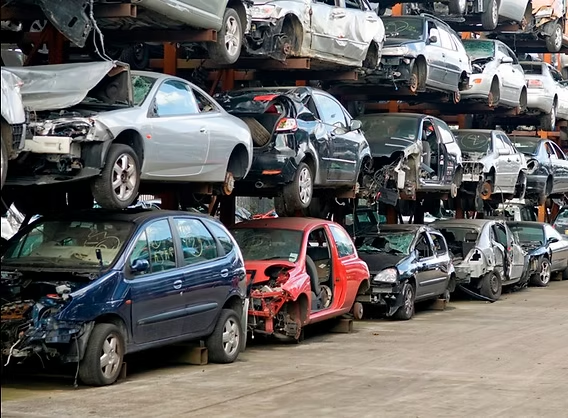
When someone offers to buy a junk car, most owners have the same reaction: How did they come up with that number?
From the outside, pricing can feel random. The car doesn’t run. It might look terrible. It’s been sitting for months or years. Yet companies offering cash for cars still attach real money to it. That leads people to assume junk car pricing is guesswork or negotiation magic. It isn’t. There’s a system behind it. Once you understand how buyers look at a vehicle, the price starts to feel logical instead of mysterious.
Junk car pricing follows a different logic
People often assume a junk car is evaluated the same way as a used car, and that’s where confusion starts.
A drivable vehicle is judged on how attractive it is to the next owner: mileage, condition, maintenance records, and current market demand. A junk car isn’t being measured as transportation anymore. It’s being measured as material and parts, which changes the entire pricing approach.
A junk car is judged on something completely different. It’s evaluated as a resource, not as transportation.
The question isn’t: Can this car drive again? But the real question is: What can still be recovered from it? That includes metal, parts, and materials that can be reused or recycled.
Scrap metal creates the floor price
Every car contains a large amount of recyclable metal. That metal alone guarantees a baseline value.
Steel and aluminum aren’t just junk metal. They’re raw materials bought and sold worldwide, and their value moves with industry demand. Construction trends, factory production, and global supply all influence what those metals are worth at any given time. When a junk car is processed, its metal re-enters that system.
Heavier vehicles usually contain more recoverable metal. That’s why trucks and larger cars often start with higher scrap value than small compact vehicles.
Even a completely dead car still holds that raw material worth. That’s the floor price, the minimum value before parts are considered.
Usable parts add real money
Where prices climb is in salvageable components. Engines, transmissions, catalytic converters, body panels, electronics, wheels, many of these parts can be removed and sold individually. Some are in constant demand because mechanics need them for repairs. Others become valuable simply because replacements are expensive when bought new.
If a junk car still contains strong components, its value increases. This is why two vehicles that look equally broken can receive very different quotes. One may still carry parts people want. The other might only be good for scrap metal.
The model and demand matter
When supply is low and demand is steady, junk vehicles become a source of inventory. In those cases, a car’s model can influence the offer more than its condition.
On the flip side, extremely common cars with oversupplied parts lean more heavily on metal pricing. It’s not about age alone. It’s about what other drivers and repair shops need at that moment. The junk car market follows the same supply-and-demand rules as any other industry.
Damage still plays a role in pricing
A car doesn’t have to be running to have value, but its condition isn’t irrelevant. Water damage, fire exposure, heavy rust, or missing key parts all limit what can be salvaged. The fewer usable pieces left, the more the offer leans toward basic scrap value.
Clear information avoids problems at pickup. When the condition is explained accurately from the start, the quoted price usually stays the same. If key details are missing, adjustments happen after inspection. Being straightforward keeps the process moving smoothly and prevents friction for everyone involved.
Location require cost
If a car is parked in an easy-to-access driveway, removal is simple. If it’s trapped in underground parking, behind locked gates, or far from major routes, logistics become more complex.
Professional car removal services factor transportation into the offer. Difficult access doesn’t stop the deal, it just influences operating cost. The smoother the pickup, the more value can go directly to the owner.
Timing affects value
Junk car pricing isn’t fixed forever. Metal markets fluctuate. Parts demand changes. Recycling supply shifts with economic conditions. A vehicle quoted today might receive a different offer months later simply because the market moved. That’s not manipulation. It’s market reality.
Owners who act while prices are strong protect their return. Waiting doesn’t usually increase value. In most cases, time works against a junk car. That’s one reason many people use cash for cars Sydney services once they know a vehicle won’t be repaired. Selling early preserves more recoverable worth.
Buyers aren’t doing a favour
Some owners think junk car companies are doing charity work, but they are not. It’s a business built around recovery, resale, and recycling. Removal companies pay owners because junk vehicles are raw inventory. They profit by extracting value from materials and parts.
The exchange benefits both sides. You’re not dumping trash. You’re selling supply into an industry designed to reuse it. Understanding that changes the tone of the transaction. It becomes straightforward instead of uncertain.
Why quotes differ between companies
Each company has a different way. Some companies focus heavily on metal recycling. Others have strong resale networks for parts. Some process vehicles more efficiently than others. Those operational differences affect how much value they can extract.
Higher recovery efficiency often means higher offers. That’s why comparing quotes is normal. It’s not about dishonesty, it’s about business models.
The value reflects actual remaining parts
A junk car’s price doesn’t reflect what the car used to be worth, what repairs cost, or how attached the owner feels. It reflects what survives inside the vehicle today like metal, parts, and materials.
Once people understand that, pricing feels less mysterious. It’s not about the car’s past. It’s about its remaining contribution. And in many cases, that contribution is more valuable than owners expect.
Selling sooner protects what’s left
A junk car doesn’t pause while you think about it. It keeps aging. What could have been reused today slowly turns into something unusable tomorrow. Waiting doesn’t protect value. At some point the decision isn’t about the car anymore, it’s about stopping the loss.
Selling earlier captures value before it fades. The moment a car is handed over through cash for cars, the decline ends and the useful parts are preserved instead of wasted. Whatever value is left gets captured right then, before time strips more of it away.
That’s the simple reality of junk car pricing, it favors people who act while something is still there to save.