East Asian Urbanism: N Seoul Tower and Daegu’s Heritage
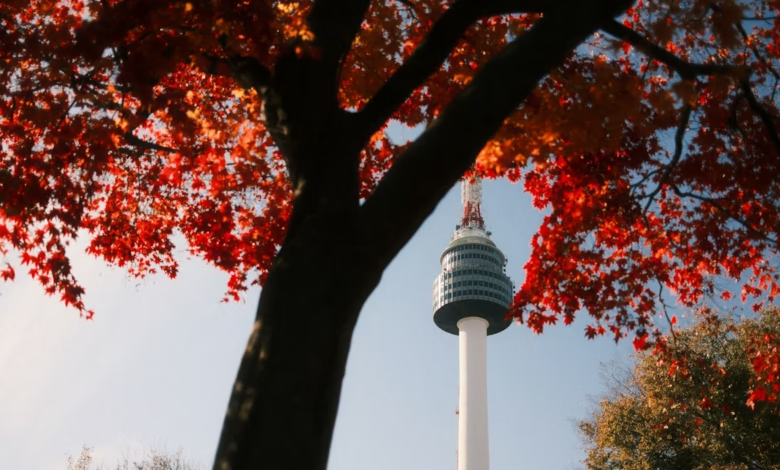
Height Before Direction
Seoul does not arrive as a skyline. It gathers slowly — bridges over the Han, apartment blocks stepping up hillsides, traffic flowing beneath elevated roads that seem to have been added after everything else was already in motion.
From certain streets, N Seoul Tower appears unexpectedly between buildings, thin and pale against sky. Then it disappears again. The city below continues without acknowledging it.
Climbing toward Namsan, the air shifts slightly. Trees interrupt the grid. The sound of traffic thins. From above, the density looks ordered — roads align, districts stretch outward, glass reflecting a uniform wash of light.
But at ground level, nothing feels especially uniform. Markets narrow into alleyways. Signage stacks vertically. Cafés occupy corners that look too small for them.
The city rearranges itself depending on where you stand.
Arrival Without Ceremony
After long corridors and controlled air, somewhere between runway and river the phrase Incheon Airport to Seoul becomes less about transit and more about adjustment — airport glass giving way to expressways, expressways dissolving into clusters of towers that appear gradually rather than all at once.
Inside the train, luggage rests quietly overhead. A phone vibrates once and is silenced. Outside, the skyline thickens in increments. Construction cranes hold still against pale sky.
The tower on Namsan becomes visible again briefly, then vanishes behind apartments. You begin to realise that the city doesn’t frame itself for visitors. It unfolds at its own pace.
Seoul absorbs you without announcement.
Southbound, Without Breaking the Rhythm
Later, the Seoul to Daegu train moves steadily out of the capital’s density, high-rises thinning into lower buildings before giving way to fields and distant hills that rise in soft lines against the horizon.
The transition does not feel dramatic. It lengthens the space between structures. Inside the carriage, the same hum persists. Seats remain aligned. A bottle of water stands untouched on a tray table.
Rice fields arrange themselves in measured rectangles. A river appears and then slides out of view. The city has already loosened its grip before you consciously register the shift.
Distance here feels like dilution rather than departure.

Daegu at Eye Level
Daegu does not rise sharply. It spreads.
Streets widen under warmer light. Market stalls extend into pedestrian space. Awnings soften the sun into diffused colour. Heritage buildings remain embedded within commercial rows — not isolated, not framed, just present.
Temple gates open inward onto courtyards that hold quiet air. Timber beams carry marks from decades of weather. Modern storefronts stand beside them without exaggerating difference.
The scale feels closer to the body. You walk without needing to look up often. The skyline stays low enough to ignore.
Even here, trains continue arriving, departing, stitching the city into the same network that carries you north again.
Between Elevation and Ground
From the observation deck in Seoul, the capital appeared composed — bridges forming arcs, roads drawing lines through districts, glass surfaces catching uniform light.
In Daegu, composition feels smaller. The pattern exists at street level: fabric awnings repeating, steps worn smooth, vendors arranging goods in rows that feel temporary but recur daily.
Neither city feels entirely new or entirely old. Both adjust around what remains.
The train line between them does not dramatise that relationship. It simply maintains it.
After the View Fades
Later, the tower’s outline softens in memory. The market streets in Daegu merge with narrower lanes from elsewhere. Glass reflections and timber shadows overlap without clear separation.
What remains is movement — the faint vibration beneath your feet, the steady forward pull, the way cities rise and lower without needing to explain why.
Somewhere between tower height and courtyard stillness, the track continues south, then north again, and the skyline shifts quietly behind the window before you notice it has done so.
Where the Line Keeps Going
Even after arrival, the sense of transit lingers — not as urgency, but as a low, steady continuation. The skyline no longer needs to be visible to remain present. A tower recalled between buildings. A market remembered in the space between stations. The track extends beyond what you can see from the platform, carrying height and heritage in the same direction, not resolving them, simply allowing them to move alongside each other for a while longer.