Japanese Urban Aesthetics: Osaka Castle and Kyoto’s Gion District
Stone Before Motion
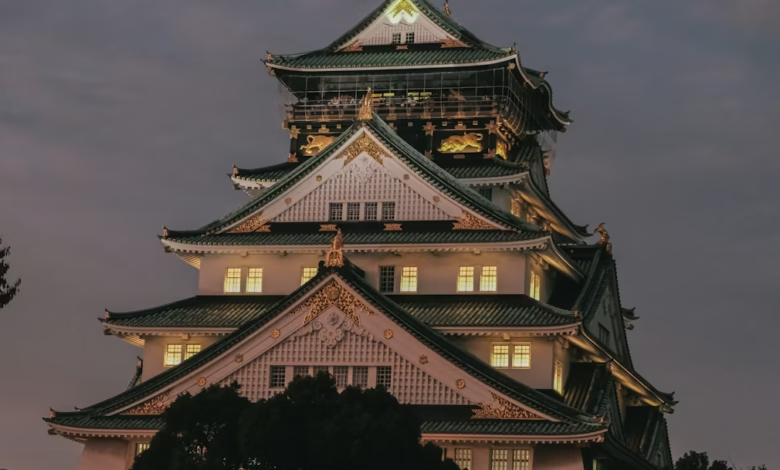
Osaka Castle does not arrive as a spectacle. It sits within the city rather than above it, even though it rises in pale tiers against glass and steel.
The moat holds a flat reflection that shifts only when wind crosses it. Office towers stand behind the walls, close enough to feel contemporary, distant enough to avoid confrontation. Joggers circle the outer paths. A vending machine hums somewhere beneath trees.
Up close, the stone base feels irregular. Massive blocks stacked with the kind of patience that does not rush for symmetry. The upper levels lift gently at their corners, ornamental but not delicate.
You walk around it without urgency. The skyline rearranges itself depending on your angle.
Arrival in Layers
Somewhere after leaving the capital, while the Tokyo to Osaka bullet train carries apartment clusters into view between stretches of low hills, the castle begins to feel less like a monument and more like a pause in the city’s vertical rhythm.
Inside the carriage, nothing feels abrupt. A drink rests steadily on the tray. A phone screen reflects passing sky. Outside, the density thickens gradually — concrete, glass, elevated roads threading between districts.
Osaka does not declare entry. It accumulates. The castle reappears briefly between buildings and then disappears again as if folded into the grid.
The train slows. Doors open. The city absorbs you without announcement.
Between Water and Neon
Beyond the castle grounds, Osaka spreads outward rather than upward. Market streets narrow unexpectedly. Lanterns hang beneath restaurant eaves even in daylight. Reflections collect in shop windows but dissolve quickly as pedestrians pass.
The energy feels constant but not chaotic. Underpasses open into wider plazas. Towers stand in repetition, their surfaces reflecting pale sky by day and neon by night.
The moat remains still somewhere behind you.
Later, the Osaka to Kyoto train shifts the tone almost imperceptibly, carrying you north through districts that loosen their density before tightening again near smaller stations.
The movement feels like adjustment rather than contrast.
Gion at Street Level
Kyoto lowers itself.
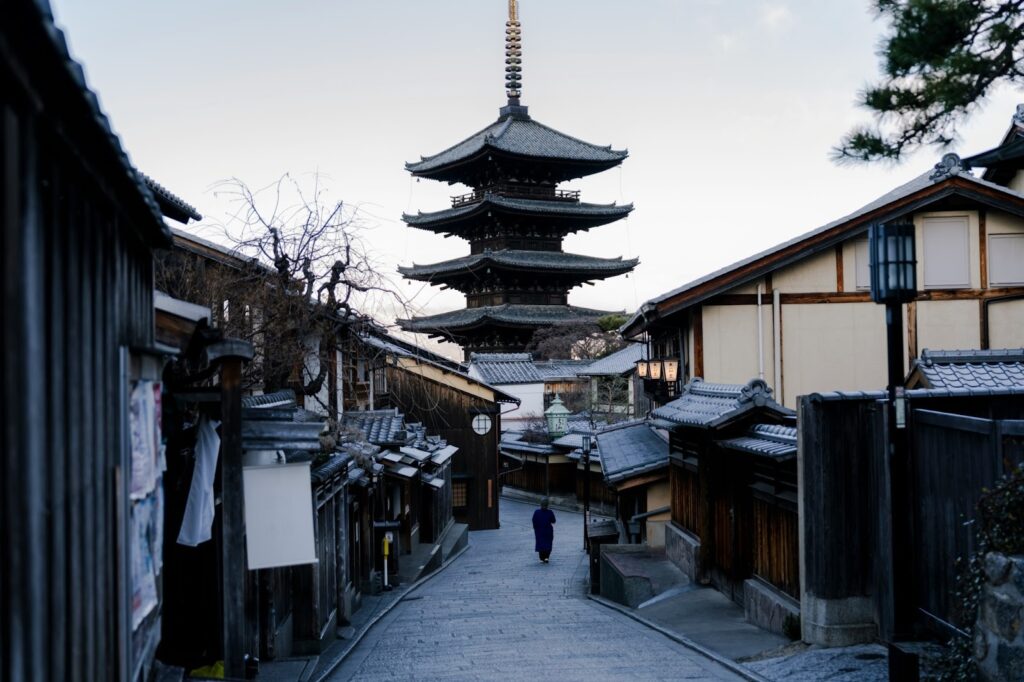
In Gion, wooden façades align closely along narrow lanes. Latticed fronts filter light into soft lines. The pavement feels closer to the body. Eaves extend outward just enough to cast shade without fully enclosing the street.
Footsteps register differently here. Sliding doors open and close with brief restraint. The air seems to hold sound rather than project it.
Electric wires remain overhead. Convenience stores sit beside traditional teahouses. Nothing is removed for aesthetic purity. The layers remain visible.
You walk slowly without deciding to.
Where Height Becomes Memory
Osaka Castle rises in tiers. Gion remains near the ground. Yet the distinction blurs in recollection. A white façade reflects sunlight in Osaka. A wooden beam carries warmth in Kyoto. Water in the moat resembles polished timber in shadow.
The short train ride compresses into something seamless. Platforms open and close. Announcements pass without emphasis.
Urban aesthetics here feel less about preservation and more about proportion — how much sky you see, how much shadow falls beneath a roofline.
The track continues linking them.
After the Roofline Lowers
Later, the castle’s outline softens in memory. Lantern-lit streets overlap with reflections on water. Stone and timber exchange places in recollection without conflict.
What remains is scale — the way your eyes adjusted from upward tiers to low eaves, from wide parkland to narrow lanes. The train moves again somewhere beyond the frame, carrying both forms along the same corridor.
Height settles. Shadow deepens. The city continues rearranging itself long after you stop trying to name the difference.
Where Scale Adjusts
With time, the difference between tiered stone and timber lattice becomes less architectural and more physical — how your neck tilted back beneath the castle rooflines, how your steps shortened along Gion’s narrow paths. The adjustment lingers longer than the image itself. One city asked you to look up. The other asked you to look ahead. The train carried both gestures forward without altering its pace.
Light Settling on Surfaces
In recollection, the moat no longer reflects only stone, and the lantern glow no longer belongs to a single street. Surfaces overlap — water, wood, glass — each catching light in a slightly different way. Somewhere beyond the frame, rails continue threading between them. The skyline lowers. The eaves hold shadow. And the movement remains steady, long after the view has shifted.