Wedding Ring Styles That Will Stay Timeless for Years
The ring you pick this year will still be on your hand at your daughter’s wedding, at a hospital bedside decades from now, in photos your grandkids will look at. Most jewelry you buy gets cycled out as styles move on. A wedding ring doesn’t get that option, which is why the question isn’t really “what’s popular right now” but “what will I still want to look at in 2055.”
There’s a stubborn assumption that timeless means plain, safe, a little boring. The styles that have actually lasted forty or fifty years prove the opposite. A milgrain band from the 1940s still looks sharp today, and a clean platinum court band has outlived every passing fad since.
This article looks at the specific bands, metals, and small design decisions that have already survived multiple decades of changing taste, and why they held up when flashier options didn’t.
Why Timelessness Matters More Than Trends When Choosing a Wedding Ring
A trendy ring carries a risk that a trendy handbag never does. Swap out a bag after three seasons and nobody notices. The ring stays, and the version of “current” it was bought in stays with it. That oversized halo setting everyone wanted around 2015 already reads as a specific year to anyone who knows rings, the same way a particular shade of frosted lipstick pins a photo to a decade.
Fashion jewelry is built to expire. The whole point of a seasonal collection is that you’ll want the next one. Earrings, statement necklaces, the chunky chain that’s everywhere one summer, all of it is priced and designed around being replaced.
Your wedding ring sits outside that cycle entirely. You wear it washing dishes, typing, in the shower, asleep. It’s the one piece of jewelry that’s on your body more hours than it’s off, for years that turn into decades. A design that depends on being current is fighting against the one thing the ring is supposed to do, which is stay.
Classic Wedding Ring Styles That Have Never Gone Out of Fashion
Run your finger along the inside edge of a court-shaped band and you’ll feel why it outlasted everything. The profile is gently rounded on both the inside and outside, so there are no hard edges pressing into the next finger or catching on things. People who’ve worn the same court band for thirty years tend to describe forgetting it’s there, and a ring you forget is a ring you never take off and leave on a sink edge in a hotel. That comfort is also why it photographs the same in 1985 and 2025. There’s nothing in the shape to date.
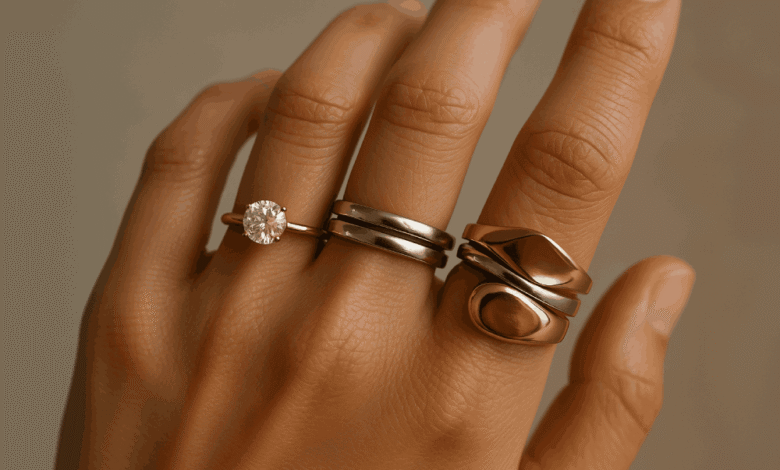
Milgrain is the other one that refuses to age. It’s that tiny row of beaded detail running along the edge of a band, originally made by hand with a knurling tool, and it does something unusual for a decorative element. It reads as vintage to someone who loves old estate pieces and reads as quietly modern to someone who finds plain bands too bare. The detail is small enough that it never dominates, so it never becomes “the milgrain ring” the way a big design feature becomes the whole identity of a piece.
Simple diamond-set bands belong in this group too, with one condition. The setting has to sit low and the stones have to be modest. A row of small flush-set or channel-set diamonds in a slim band has the same staying power as the plain version, because the diamonds add light without adding a silhouette that can go in or out of style. The moment the stones get large or the setting rises up to grab attention, you’re back in trend territory.
If you want to see how these styles look as actual rings you can buy rather than as descriptions, browsing a focused range of wedding rings built around these classic profiles is a faster way to calibrate your eye than scrolling through everything at once.
How Metal Choice Affects the Long-Term Look of Your Wedding Ring
Platinum earns its price over time rather than at the counter. It’s denser and more durable than gold, so when it gets scratched the metal is displaced rather than lost, which means a platinum ring slowly develops a soft, even patina instead of wearing thin. Polish it and it returns. A gold ring worn for twenty years on an active hand will actually lose a measurable amount of material from the band over that span, where platinum mostly just moves around. For someone who works with their hands, that difference shows up by the second decade.
It’s also hypoallergenic in a way that matters for daily wear. Platinum is naturally white and used at very high purity, usually around 95 percent, so there’s almost no alloy content to react with skin. Anyone who’s had a reaction to a nickel-containing white gold knows the daily irritation of a ring you can’t stop noticing, and platinum sidesteps that entirely.
Yellow gold and rose gold sit in a different category. Their case isn’t durability, it’s color that doesn’t drift out of fashion. Yellow gold went through a long stretch of being considered dated, then came right back, which is its own argument for it. A warm metal tone has been worn for thousands of years and tends to flatter warm and olive skin tones the way platinum and white gold flatter cooler ones. Rose gold’s copper content gives it a soft pink warmth that suits a lot of skin tones, though it’s worth knowing it’s the most recent of the three to swing in popularity, so it carries slightly more trend exposure than the other two.
Balancing Personal Style With Timeless Design — What Experts Recommend
Simplicity isn’t a lack of personality, it’s a design decision that buys you decades. A band that does one thing well has nothing in it that can curdle later. The advice jewelers give couples who want both their own taste and longevity usually comes down to limiting the number of “looks at me” features to one, or to none, and letting the quality of the metal and the proportions carry the ring instead.
The personal touches that survive are the ones nobody else sees at a glance. An engraving inside the band, a date or a few words, makes the ring entirely yours without putting anything on the outside that can age. A single small diamond set flush into the inner surface does the same. So does choosing a slightly unusual band profile, like a flat-court or a knife-edge, which changes how the ring feels and catches light without announcing a style era.
Where it goes wrong is when the personal touch lives on the visible top of the ring and ties itself to a current look, a specific cluster arrangement or a setting style that’s having a moment. Keep the expressive part hidden or structural, keep the visible part quiet, and the ring stays both yours and timeless at the same time.