Commercial Solar in BC: How Businesses Are Cutting Electricity Costs With Rooftop Panels

Quick Answer
Commercial solar lets a business generate its own electricity from sunlight, cutting the amount it buys from the grid. In British Columbia, rooftop systems pair with net metering, so extra power earns credits at full retail rates. Combined with provincial tax exemptions and utility rebates, many companies trim a sizable share of their monthly power costs and steady their long-term spending.
Introduction
Picture your power bill arriving every month like clockwork, climbing a little each year while you have no say in the price. For most BC business owners, electricity is a fixed cost they quietly accept. But that roof sitting empty above your warehouse, shop, or office could be doing real work.
That is the appeal of solar panels for business by 604 Go Solar: turning unused rooftop space into a tool that lowers operating costs. Across the province, owners are watching the numbers and realizing the math has shifted in their favour. If you want to see how a tailored system fits a specific operation, resources like commercial solar panel installation walk through the planning process.
The principle is straightforward. Produce your own clean power during daylight hours, lean less on BC Hydro, and lock in savings that grow as rates rise. The sections ahead break down how it works and what to weigh before you commit.
How Rooftop Panels Lower Your Power Bills
The savings from a rooftop system come from a few moving parts working together. Once panels are producing, every kilowatt-hour you generate is one you don’t buy from the grid. For a business running lights, refrigeration, or machinery through the day, that offset adds up fast, because your panels peak at the same hours your demand does.
Net Metering: BC’s Standout Advantage
This is where the province genuinely rewards businesses. Under BC Hydro’s net metering program, any surplus power your panels push back to the grid earns credits. What sets it apart is the rate: you’re credited at the same price you’d pay for grid power, not a fraction of it. Many other regions offer only a partial rate, so this is a real edge for a BC operation.
In practice, your system overproduces on bright summer afternoons and banks credits. Those credits then offset the power you draw on darker winter days, smoothing your costs across the year.
Where the Savings Actually Come From
The economics of commercial solar panels rest on several supports working at once:
- Direct bill reduction — power you generate replaces power you would otherwise purchase
- Net metering credits — surplus energy lowers future bills at full retail value
- PST exemption — eligible solar equipment is exempt from the 7% provincial sales tax
- Utility rebates — BC Hydro’s self-generation program offers business rebates on qualifying systems
- Capital cost allowance — federal rules let businesses write off a large share of the cost quickly
Sizing the System to Your Energy Use
A well-planned project starts with your actual consumption, not a guess. Installers review roughly a year of utility history to size the array correctly. Build too small, and you leave savings on the table; build too large, and you’ve spent capital on power you can’t fully use or credit.
| System scale | Typical fit | What it offsets |
| Small (under 100 kW) | Retail shops, small offices | A solid portion of the daytime load |
| Mid-size (100–500 kW) | Warehouses, light manufacturing | Most daytime demand |
| Large (500 kW and up) | Big facilities, multi-roof sites | The bulk of the total annual usage |
The figures are appealing, but a smart investment depends on whether your building and operation suit solar in the first place.
Picking the Right Roof and Installer
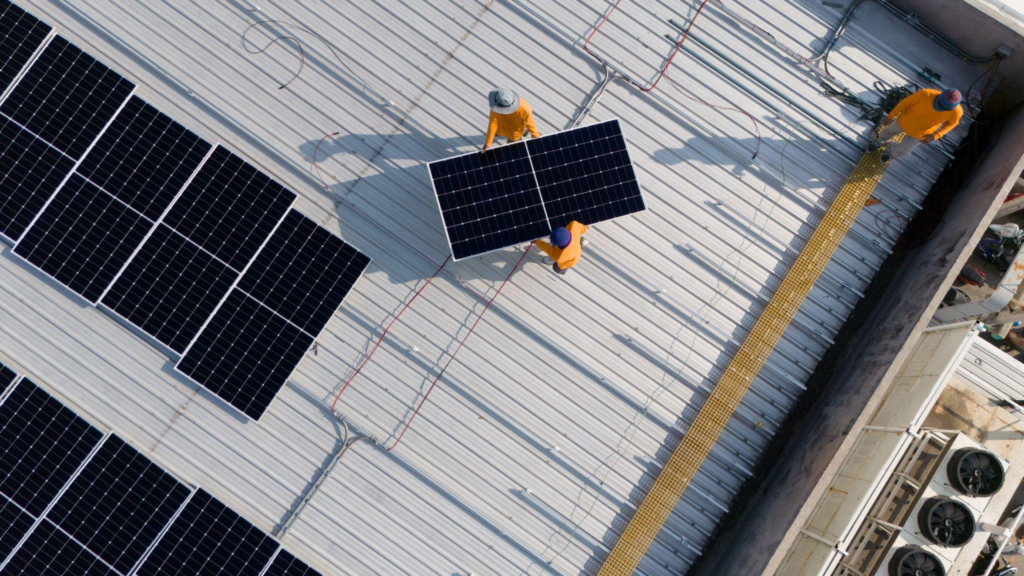
Not every property delivers the same return, so a bit of honest assessment up front saves money later. Many BC commercial buildings already have the features that make rooftop solar work well: wide, flat roofs and steady daytime power use.
What a Site Assessment Checks
Before any panels go up, a proper site review looks at a handful of practical factors:
- Roof age and condition — panels last 25 to 30 years, so the roof beneath them should have plenty of life left
- Available space — large, unobstructed rooftops fit more panels and generate more power
- Shading — nearby buildings, trees, or rooftop equipment can cut output
- Structural capacity — the roof must safely carry the added weight
- Daytime demand — businesses that run during sunlight hours use more of what they produce
Why Roof Condition Comes First
If your roof is nearing the end of its life, replace it before installation. Taking panels down and putting them back later erases much of your savings, so timing the two projects together pays off.
Comparing Commercial Solar Companies
The contractor you pick shapes the whole outcome. Reputable commercial solar companies handle design, permitting, and BC Hydro grid connection in one coordinated process. When comparing providers, weigh these points:
| What to check | Why it matters |
| Licensing and certification | Confirms safe, code-compliant work |
| In-house electricians | Avoids handoffs that delay timelines |
| Monitoring and support | Keeps the system performing for decades |
| Local track record | Shows familiarity with BC permits and climate |
A site assessment also clarifies your realistic payback window, which for many BC businesses lands well before the panels age out. With the fit confirmed and a trustworthy partner lined up, the path from idea to working system gets much clearer.
The Bottom Line for BC Businesses
Empty rooftop space is one of the few overhead costs you can turn into an asset. For BC business owners, the mix of full-rate net metering, the PST exemption, utility rebates, and fast tax write-offs makes the case stronger here than in most parts of the country. A well-sized commercial solar panel installation steadies your power costs for decades while shielding you from the rate hikes everyone else absorbs.
The first step is simple: review your recent power bills, look hard at your roof, and ask a qualified local installer to run the numbers for your operation. The sun is already hitting that roof every day. With the right system in place, it can start paying you back instead of going to waste.