Your Toothbrush Has a Blind Spot. AirJet Found It.
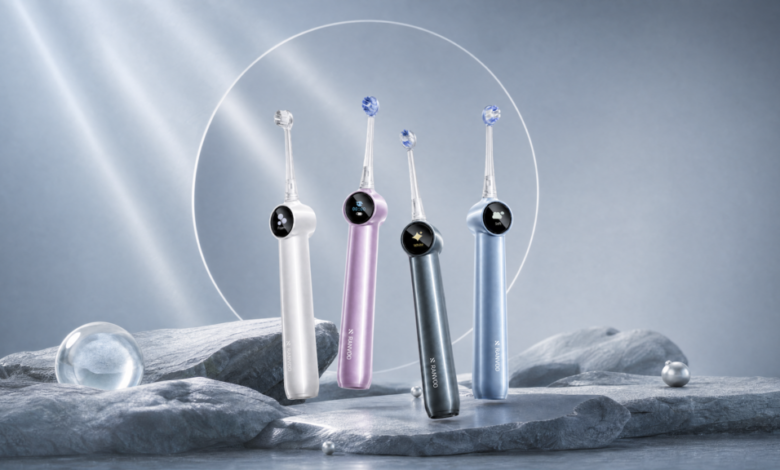
The surfaces your bristles can touch were never the problem. It’s the 40% of your tooth surfaces they can’t reach that change everything.
Here’s a statistic that should make you pause mid-brush: over 80% of cavities originate in the spaces between your teeth — the narrow, hidden gaps where toothbrush bristles, by the laws of physics, simply cannot enter.
You already own an electric toothbrush. It might be sonic. It might be oscillating-rotating. It might have cost you upwards of two hundred dollars. It vibrates, it buzzes, it times your two minutes, and it leaves your mouth feeling reasonably clean. You’ve been told this is enough.
It isn’t.
The fundamental mechanism hasn’t changed in decades: bristles contact tooth surfaces, vibration generates friction, plaque is mechanically scraped away. On flat, accessible surfaces — the buccal, lingual, and occlusal faces of your teeth — this works adequately. But between teeth, in the tight triangular spaces below the contact point, bristles physically cannot penetrate. The geometry of a toothbrush simply doesn’t allow it. No amount of frequency, no premium bristle pattern, no marketing claim about “deep clean” changes the immutable fact that a bristle is wider than an interdental space.
So for decades, the dental industry has offered exactly one supplementary solution: floss. And for decades, the overwhelming majority of people haven’t used it. Only 30% of adults floss daily. Of those who do, a mere 12% employ correct technique. The result is predictable: 40% of adults experience interdental gingivitis, and the space between teeth remains the single most vulnerable real estate in the human mouth.
This is not a brushing problem. It is a fundamental architectural problem in oral care delivery. And it demanded a solution that wasn’t just a better brush — but an entirely different category of cleaning.
Enter AirJet: Cleaning Powered by Fluid Dynamics, Not Friction
RANVOO’s AirJet X5 is not an incremental improvement on the electric toothbrush. It is a category redefinition. The core insight is disarmingly simple: if bristles cannot reach between teeth, stop relying on bristles to do the job. Instead, let fluid dynamics carry the cleaning medium where mechanical contact cannot go.
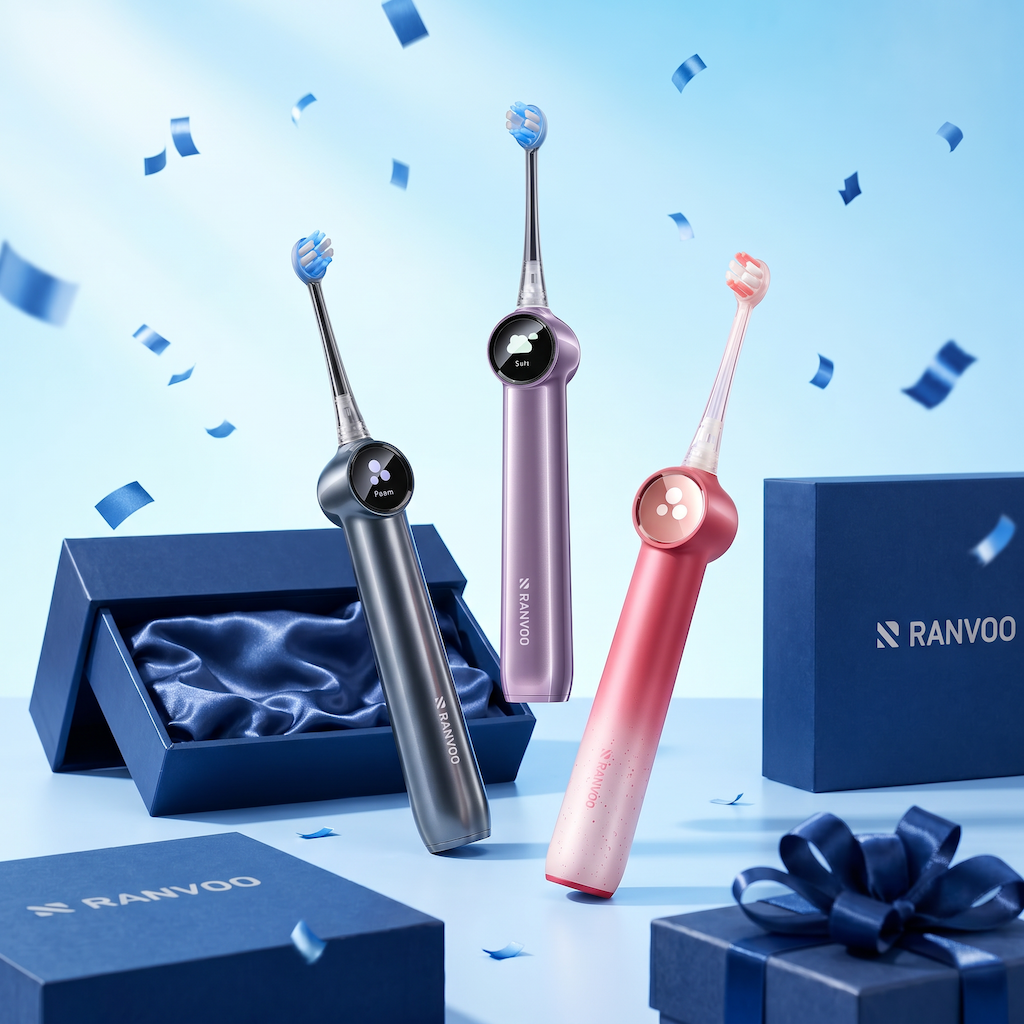
The AirJet 2.0 technology platform — protected by 20 granted patents — replaces friction with flow. It generates a continuous stream of high-density microbubbles, guides them precisely along tooth contours using the Coanda effect, and propels them into interdental spaces through a biomimetic vortex mechanism inspired by one of nature’s most efficient swimmers. Once there, physics takes over.
Here’s how it works, step by step.
Step 1: The Boosted Bubble Chamber — Generating the Cleaning Medium
Hidden inside the AirJet X5’s handle is a pressurization chamber unlike anything in a conventional toothbrush. It employs a precision-engineered Venturi structure — the same fluid-dynamic principle used in high-performance carburetors and industrial aerators — to shear the water-toothpaste mixture at controlled pressure and velocity. The result is not the coarse, uneven foam your current toothbrush creates by mechanically whipping air into toothpaste. It is a continuous stream of microbubbles, each measuring mere tens of microns in diameter, uniformly suspended in liquid. This is not foam. It is an energy-carrying cleaning medium.
At its peak — in the signature Bubble Mode — the system delivers 1,000 milliliters of bubble-infused fluid per minute. Over the course of a two-minute brushing session, approximately two liters of microbubble-laden flow transit your oral cavity, sweeping across every surface and into every crevice. The bubbles are small enough to enter spaces bristles cannot. And they carry a secret weapon.
Step 2: The Coanda Brush Head — Fluid That Finds Its Own Way
The second breakthrough is in the brush head itself. Named for the Coanda effect — the fluid-dynamic phenomenon where a jet of liquid naturally adheres to and follows a curved surface — the AirJet bubble brush head is shaped not merely to hold bristles, but to guide flow.
Computational fluid dynamics simulations informed every curve, every channel width, every outlet port angle on the brush head surface. When the microbubble stream exits the head and contacts a tooth, it doesn’t splash randomly. It attaches to the enamel contour and flows along it — around the curvature of the crown, down toward the gumline, and naturally into the interdental spaces. The fluid follows the anatomy. The user doesn’t need to aim. There is no special technique to learn. The physics handles the targeting.
Step 3: Vortex Cavitation — Inspired by the Great White Shark
This is where AirJet’s engineering philosophy reaches its most ambitious expression. And it begins with a shark.
Nature solved the problem of efficient underwater propulsion millions of years ago. When a great white shark sweeps its tail, it doesn’t just push against water. Each stroke sheds a trail of counter-rotating vortices — a reverse Kármán vortex street. Far from creating drag, these vortices generate sustained forward thrust. It is one of evolution’s most elegant hydrodynamic gifts, bestowed upon an apex predator.
The AirJet X5 borrows this principle. Its engineers recalibrated the coupling between vibration frequency and oscillation amplitude to replicate a reverse Kármán vortex street effect within the fluid environment of your mouth. Each micro-oscillation of the brush head — operating at a deliberately low maximum of 21,600 strokes per minute — becomes a directional forward-propelling fluid pulse. The microbubbles don’t drift passively. They are driven, with purpose, into the depths of every interdental space.
When these bubbles reach the confined geometry between teeth, they encounter plaque biofilm — a sticky, resilient matrix of bacteria and extracellular polymers that adheres tenaciously to enamel. The bubble, now in contact with a solid surface, collapses asymmetrically. This is acoustic cavitation: the same physical principle used in industrial ultrasonic cleaning, scaled precisely to energy levels appropriate for the human mouth.
Each bubble implosion generates a localized high-velocity microjet — a microscopic liquid needle traveling fast enough to disrupt the extracellular polymeric substance matrix that holds plaque together. The biofilm is physically detached from the tooth surface. Not scraped. Not abraded. Dislodged by fluid force at a scale measured in microns.
Two hydrodynamic principles. One to propel. One to rupture. Together, they accomplish what bristles alone never could.
Four Modes, Four Independent Protocols
Most electric toothbrushes offer “modes” that differ in little more than timer duration. The AirJet X5 operates differently. Each of its four modes is defined by an independently tuned set of four parameters: vibration frequency, liquid flow rate, amplitude, and oscillation angle. These are not cosmetic variations. They are distinct cleaning protocols with distinct clinical intentions.
Bubble Mode — 15,600 strokes/min, 1,000 ml/min flow, 1.2–2.5 mm amplitude, 6.8°–14.0° oscillation angle. Maximum cavitation energy, engineered specifically for deep interdental cleaning. This is the signature mode, the one that defines the product’s reason for being.
Sensitive Mode — 15,600 strokes/min, 500 ml/min flow, 3.0–4.5 mm amplitude, 16.7°–24.2° oscillation angle. Reduced fluid pressure paired with gentler mechanical stimulation. Designed for active gingivitis, post-procedure recovery, and periods of heightened sensitivity.
Clean Mode — 21,600 strokes/min, 800 ml/min flow, 0.5–2.2 mm amplitude, 2.9°–12.4° oscillation angle. The balanced everyday default: higher frequency for surface polishing, moderate flow for interdental maintenance, and the tightest amplitude range for minimal soft-tissue engagement.
Whitening Mode — 18,500 strokes/min, 1,000 ml/min flow, 2.5–4.5 mm amplitude, 14.0°–24.2° oscillation angle. Alternating dual-frequency modulation with maximum liquid throughput and extended amplitude, targeting extrinsic stains without relying on abrasive toothpaste additives.
All mode settings, battery status, and a quadrant-paced two-minute timer with 30-second interval prompts are displayed on a crisp 0.79-inch TFT screen built into the handle — visible at a glance, even mid-brush.
Engineered for Gums, Not Just Teeth
The AirJet X5 was designed from inception with a philosophy its competitors have struggled to reconcile: that a toothbrush’s responsibility extends beyond enamel.
Most premium sonic brushes operate between 31,000 and 62,000 strokes per minute — frequencies that, while effective at disrupting plaque on hard surfaces, subject gingival tissue to cumulative mechanical stress. The AirJet X5 deliberately caps its maximum frequency at 21,600 strokes per minute, well below the viscoelastic recovery threshold of healthy gum tissue. This is paired with a 12° micro-oscillating sweep — approximately half the angular displacement of many competitors — which further reduces the mechanical energy delivered to soft tissue.
The bristles themselves tell a similar story. Under a microscope, poorly finished nylon bristle tips resemble hollow needles — jagged edges that act as micro-abrasives against gingival epithelium thousands of times per brushing session. The AirJet X5’s bristles are polished to a 99.99% end-rounding rate: smooth hemispherical domes, 0.01 mm in tip diameter, that glide over soft tissue without micro-laceration. An irregular bristle arrangement with over 50% rounding rate improves conformity to uneven tooth topography.
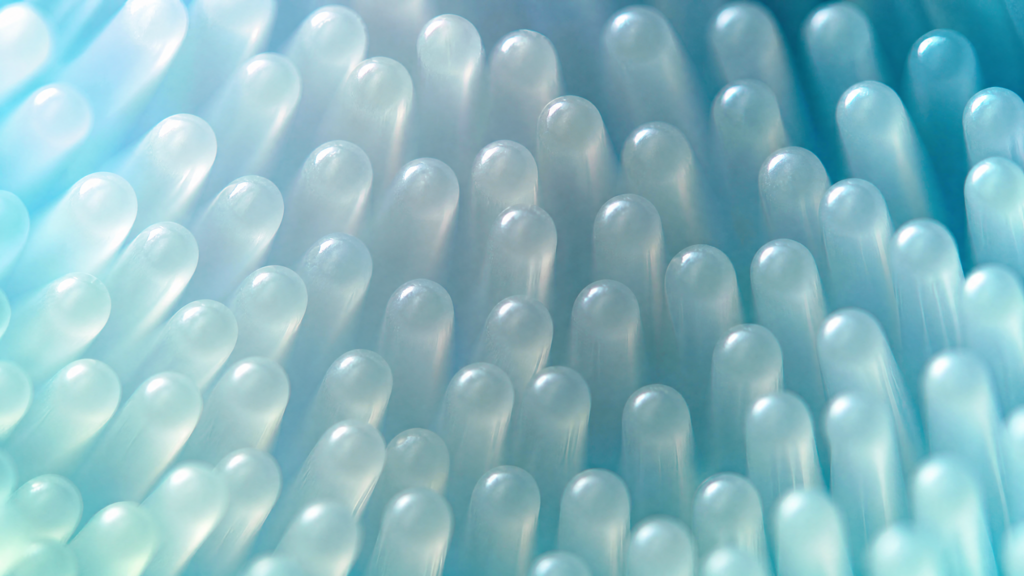
And in a detail most users will never consciously notice but will unconsciously feel, a soft thermoplastic elastomer (TPE) layer coats the back of the brush head. This rubberized backing absorbs residual vibration and eliminates the jarring hard-plastic contact that occurs when the brush head inadvertently strikes an adjacent tooth. For anyone with exposed dentin, cervical abrasion lesions, or general sensitivity, this single design choice transforms a daily moment of discomfort into something you never think about.
The clinical outcome: 97% plaque removal rate. Grade 1 cleaning efficiency — the highest classification achievable in standardized testing.
Hygiene by Design: A Bathroom Device That Belongs in a Bathroom
The bathroom is arguably the most hostile environment for an electronic device: constant humidity, temperature fluctuation, and an ecosystem of microorganisms that thrive on moisture. The AirJet X5 was engineered accordingly.
The handle carries an IPX7 waterproof rating — submersion-safe at one meter for 30 minutes. It can be rinsed fully, used in the shower, and exposed to water without compromise. A silicon carbide (SiC) anti-mold coating, applied to both the ABS handle and the ABS+PC magnetic wall mount, achieves Grade 0 certification under mold-resistance testing standards — the highest classification available. This is not a superficial treatment; it is a microscopic surface structure that inhibits microbial colonization at the physical level.
Storage, too, has been rethought. The included magnetic wall mount serves triple duty: it holds the brush securely via a nickel-plated iron plate, it charges the brush wirelessly whenever docked, and — perhaps most importantly — it stores the brush vertically. Gravity drains residual moisture away from the handle. Air circulates on all sides. The brush dries completely between uses. There is no pooled water at the base, no biofilm accumulation in a charging cradle, no clutter on the countertop. It is a storage solution that is simultaneously a hygiene solution.
Power That Doesn’t Demand Attention
A 1,600 mAh lithium-ion battery — 5.92 Wh of capacity — powers the AirJet X5 for up to 39 days on a single charge in Bubble Mode, with battery life ranging from 26 to 39 days depending on the mode selected, based on two brushing sessions of two minutes each per day. A full recharge takes approximately six hours via the included USB-A to USB-C cable or the wireless magnetic mount. You will charge this device roughly once a month. It will not add to your mental load.
Operating noise stays at or below 65 decibels across all modes — quieter than most premium electric toothbrushes, and roughly equivalent to the ambient sound level of a normal conversation. The brush does not announce itself to your entire household.
Who the AirJet X5 Is For
The AirJet X5 is not for everyone, and that is by design. It is for people who have recognized the limits of their current oral care routine. For those whose dentists have mentioned “interproximal” in a tone of concern. For the 40% of adults who experience interdental gingivitis despite diligent brushing. For orthodontic patients navigating the impossible geometry of brackets and wires. For implant and restoration patients who need to maintain scrupulous plaque control around abutments and margins. For anyone who has been told they have sensitive gums and responded by brushing more gently — when the real issue was never pressure, but mechanism.
This is not a toothbrush for people who believe brushing is a solved problem. It is for people willing to accept that the bristle-based model — however refined, however premium, however many tens of thousands of vibrations per minute — reached its ceiling long ago. The next frontier in oral care isn’t faster bristles. It’s no longer relying on bristles at all.
The Bottom Line
The AirJet X5 from RANVOO represents a genuine paradigm shift in daily oral care. It is built on 20 granted patents spanning bubble chamber architecture, Coanda-effect brush head surface engineering, and cavitation energy modulation systems. It delivers a verified 97% plaque removal rate with Grade 1 cleaning efficiency, operates with deliberate restraint at a low 21,600 strokes per minute, and protects gums through a comprehensive safety system encompassing frequency control, micro-oscillation, ultra-fine end-rounded bristles, and TPE shock absorption.
It replaces the coarse, uneven foam of conventional brushing with a precisely engineered stream of microbubbles. It replaces the hope that bristles might somehow reach between teeth with the certainty that fluid dynamics will. It replaces the accumulated compromise of decades-old technology with a clean-sheet reimagining of what it means to clean your teeth.
Your bristles have done what they can. It’s time to let physics do the rest.