Your Aging Electrified Car Is Worth Keeping — Here’s the Math Nobody Shows You
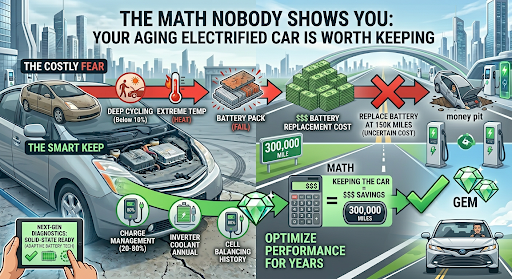
Somewhere around year eight, every owner of a hybrid or electric car has the same 2 a.m. thought: the battery’s going to die, and I should sell before it does. Dealers encourage the anxiety — trade-ins are their business. Forums amplify it with horror-quote screenshots. And yet the actual data tells a stranger story: electrified drivetrains, on average, age more gracefully than the gasoline cars they replaced, and the repair economy that grew up around them has quietly cut the cost of the scariest failure by half or more.
This is a guide to the second decade of electrified ownership — what genuinely wears out, what almost never does, how the independent repair world actually prices things now, and how to run the keep-versus-sell math like an accountant instead of a worried forum reader.
The 200,000-Kilometer Question
Start with what a decade of real fleets has proven. Hybrid taxis crossing 400,000–500,000 km on original high-voltage packs stopped being newsworthy years ago. EV fleet studies consistently show capacity fading around 1.8–2.5% per year and slowing with age, not accelerating. Out-of-warranty catastrophic pack failures, outside a handful of recalled designs, affect a low single-digit percentage of vehicles.
Meanwhile, the parts of a car that historically forced retirement — transmission rebuilds, head gaskets, exhaust systems, endless brake jobs — are either absent from electrified drivetrains or dramatically reduced. An electric motor has one moving part. Regenerative braking means friction pads often last 100,000–150,000 km. There’s no timing belt to snap at the worst possible moment.
So the honest picture of an aging electrified car looks like this: one large, well-understood risk (the pack), surrounded by a machine that’s mechanically simpler than anything the used market has ever priced. The owners who win are the ones who treat that one risk as a number to be measured and budgeted — not a monster to be fled.
What Actually Wears Out (And What Almost Never Does)
Knowing where the money goes lets you inspect and budget like a fleet manager.
The genuine wear items
The 12V battery. Ironically, the tiny conventional battery fails far more often than the big one — every 3–5 years, $100–300 — and its death mimics scary high-voltage faults, stranding cars and triggering warning-light christmas trees. Rule one of old-electrified ownership: when weirdness strikes, test the 12V first.
Cooling system components. Pumps, valves, and coolant for pack and inverter cooling wear like any plumbing. A failed coolant pump ($200–600) is routine; ignoring it and cooking the pack is not. Coolant changes at manufacturer intervals are the cheapest pack insurance sold.
Suspension and tires. Packs add 200–500 kg, and instant torque chews rubber. Expect tires to last ~20% fewer kilometers and bushings/shocks to age a bit faster than a lighter gasoline equivalent.
Charge port and connectors. Ten years of plugging cycles wears latches and pins. Usually a cheap fix, occasionally a corroded harness surprise on cars from salty-road regions.
What rarely fails
Drive motors, inverters, and reduction gears routinely outlast the vehicle. Onboard chargers occasionally fail ($500–1,500 refurbished) but at rates comparable to gasoline-car alternators. And the pack itself, as covered — fading gradually is its normal old age; sudden death is the exception.
The inspection priority list for any high-mileage electrified car, then: 12V health, coolant condition and service records, cell-balance readout, tires and suspension, charge port function. Twenty minutes, mostly free.
The Repair Economy Nobody Told You About
Here’s what’s changed since the horror-quote era: an entire independent ecosystem now exists between “dealer replacement” and “scrap the car,” and its prices bear no resemblance to the numbers that still circulate in comment sections.
At the top sit dealer packs — new, warrantied, and priced accordingly ($3,000–5,000 installed for most hybrids; $8,000–20,000 for full EVs). One tier down, the market gets interesting. Independent rebuilders test, rebalance, and reassemble packs from donor vehicles and fresh modules; a warrantied replacement hybrid pack from a reputable rebuilder typically runs $1,500–2,800 installed for popular models, often with mobile installation in your driveway and a 1–3 year warranty that undercuts the dealer quote by 40–60%. For full EVs, module-level repair has become the standard play: a specialist diagnoses the one or two weak modules dragging the pack down and swaps them for $1,500–4,000 — a fraction of full replacement.
Below that, DIY module swaps serve the wrench-confident (with real high-voltage safety training, not a YouTube afternoon — 200–400 volts DC is genuinely lethal). And running parallel to all of it, a healthy used-pack market feeds off crash-totaled vehicles whose batteries survived intact, supplying rebuilders and independent shops with tested donor modules.
Three rules for buying in this market. First, warranty length is the honesty signal — a rebuilder confident enough to warranty 24–36 months has tested properly; 90-day coverage on a “reconditioned” pack often means old modules with a fresh label. Second, ask whether all modules were cycled and matched or just the failed ones swapped; unmatched modules drag each other down within a year. Third, demand the post-install balance report. A shop that can’t produce one didn’t measure.
Fix, Refurbish, or Walk Away: A Decision Framework
When a high-voltage fault finally appears — or health simply fades below usefulness — run this sequence before making any decision:
1. Get a cell-level diagnosis, not a code read. A generic scanner says “hybrid system malfunction.” A specialist’s report says “module 9 is 0.4V below its siblings under load.” The second costs $100–200 and changes everything, because a single weak module is a $500–1,500 problem masquerading as a $4,000 one.
2. Price all three repair tiers. Dealer new, independent refurbished, module-level fix. Get real quotes; the spread on the same car is routinely 3–4x.
3. Compare against the car’s kept value, not its trade value. The question isn’t “is the repair more than the trade-in offer?” — dealers lowball faulty-pack cars brutally, sometimes by more than the repair costs. The question is “is the repair less than what replacing this car’s transportation would cost me?” A $2,000 refurbished pack that buys 5+ more years beats any car payment in existence.
4. Check warranty and recall status one more time. Capacity-floor warranties (typically 70% at 8–10 years) and extended coverage from past recalls rescue more owners than realize it. Ten minutes with the VIN before spending anything.
5. Factor your timeline honestly. Keeping the car three more years? The cheapest tier that carries a matching warranty wins. Keeping it ten? The refurbished full pack or new unit amortizes better than repeated module whack-a-mole.
The framework’s quiet lesson: the worst financial move is the panicked one — trading in a car with a diagnosable, mid-hundreds fault because a warning light and a scary forum thread arrived the same week.
The Upgrade Temptation: What’s Coming Shouldn’t Rush You
There’s a psychological trap specific to aging-tech ownership: the feeling that tomorrow’s spec sheet makes today’s car obsolete. Battery tech feeds it constantly — every month brings a headline chemistry, a density record, a charging miracle.
Take the loudest current example. Development of the extreme fast charging battery — cells built to sustain 4–6C rates and refill to 80% in roughly ten minutes — is real and moving quickly, with the first production examples already shipping in some markets. It’s genuinely impressive engineering. It’s also almost completely irrelevant to whether your eight-year-old car should stay in your driveway, because your car’s economics were set the day you bought it, and it competes only against the cost of replacing it — not against a spec sheet.
Run the actual comparison. A new vehicle with cutting-edge charging costs, say, $40,000+, depreciates $4,000–6,000 in its first year alone, and saves you — what, exactly? Fifteen minutes on the occasional road trip? Meanwhile the depreciation your old car was ever going to suffer has already happened. Its cost per remaining kilometer is likely the lowest of any vehicle you’ll ever own.
The rational posture toward battery progress as an existing owner is gratitude, not envy: every improvement in new cells flows into the refurbished and replacement market a few years later, cutting your future repair costs. New tech makes keeping old cars cheaper. That’s the part the headlines never mention.
Myths That Retire Perfectly Good Cars
“Once the battery light comes on, the car is finished.” High-voltage warnings usually indicate a specific, diagnosable fault — a weak module, a sensor, a cooling issue — not pack death. Cars are scrapped over $800 problems every week because the owner never got past the light.
“An old pack means the car is unsafe.” Degraded packs lose capacity, not stability. Battery management systems monitor every cell continuously and derate or disable long before anything hazardous develops. Age alone isn’t a fire risk; physical damage and botched repairs are.
“Nobody will insure or buy a high-mileage electrified car.” Insurers price them normally, and the resale market has matured fast — buyers armed with health-report dongles increasingly pay fair prices for verified packs. The cars that sell badly are the ones with unverified batteries, which is a documentation problem, not an age problem.
“Replacing modules is throwing good money after bad.” Sometimes true after the third round — chasing weak modules through a uniformly tired pack is a losing game. But a single failed module in an otherwise balanced pack is closer to replacing one bad spark plug than rebuilding an engine. The diagnosis report tells you which situation you’re in.
“Old hybrids should be converted or retired for the climate’s sake.” A functioning hybrid already achieves most of its lifetime emissions savings by staying in service; manufacturing a replacement vehicle carries a large upfront carbon cost. The greenest car is very often the one already built, kept running well.
The Keep-Versus-Sell Spreadsheet, Filled In
Numbers make the decision honest. Consider a ten-year-old hybrid worth $6,000 healthy, showing early pack-fade symptoms:
Scenario A — panic trade. Dealer offers $2,500 citing the battery. You buy a $28,000 replacement. First-year cost: $25,500 plus higher insurance, plus first-year depreciation of $3,500+. Real cost of fear: roughly $29,000.
Scenario B — diagnose and repair. $150 diagnosis finds two weak modules. Module-level fix: $1,200 with a 2-year warranty. The car runs 4–6 more years. Annual cost of the scare: $200–300. Even a worst-case full refurbished pack at $2,200 amortizes to under $450/year over five years — less than two months of an average car payment.
Scenario C — sell healthy and informed. Repair for $1,200, document it with the balance report, sell for $5,500–6,000 to a buyer who values the fresh warranty. You exit cleanly, losing only the repair delta instead of the fear discount.
Notice what decides between B and C: your life plans, not the battery. That’s the position the diagnosis buys you — choice. The owners who lose money are exclusively the ones who transact before measuring, selling fear at fear prices to buyers and dealers who measure afterward and pocket the spread.
One more line for the spreadsheet: every year kept is a year of avoided payments, avoided first-owner depreciation, and avoided registration/insurance premiums on a pricier vehicle — typically $4,000–7,000 annually for an average household. Against that, budgeting $500–800 a year for the aging-electrified maintenance fund (12V batteries, coolant service, the eventual pack event) still leaves the kept car winning by thousands, every single year it stays useful.
Measure First, Decide Second
If this whole guide compresses to one habit, it’s this: never make a keep-or-sell decision about an electrified car until a cell-level diagnosis is sitting in front of you. The $150 report converts the largest unknown in the car into a line item — and line items can be repaired, warrantied, negotiated, or amortized. Fear can’t be any of those things, which is why fear is the most expensive component in the entire used-vehicle market.
Your aging electrified car isn’t a time bomb. It’s a mechanically simple machine with one measurable risk and a maturing repair industry competing to solve it cheaply. Treat it that way, and the second decade of ownership is very often the most profitable driving you’ll ever do.
Frequently Asked Questions
How do I find a trustworthy independent battery specialist? Look for shops that publish warranty terms (24+ months is the confidence signal), provide cell-level diagnostic reports, and specialize in your platform. Owner clubs and model-specific forums maintain vetted shop lists that are far more reliable than general review sites.
What does a proper battery diagnosis cost and include? Typically $100–200. It should include individual module voltages under load, internal resistance readings, balance data, and cooling system checks — a specific written finding, not just a fault code. If the shop can’t name which module is weak, keep looking.
Is it safe to keep driving with a hybrid system warning light? Briefly and gently, usually yes — the car protects itself by limiting the system. But diagnose promptly: some faults (cooling failures especially) cause compounding damage if ignored, turning a $600 fix into a full pack problem.
How many years does a refurbished pack actually last? Quality rebuilds with matched, cycled modules routinely deliver 4–8 years. The spread depends almost entirely on the rebuilder’s matching process and your climate — which is exactly why the warranty length and the balance report matter more than the price.
Does a failing high-voltage pack affect anything else in the car? Mainly fuel economy and drivability — hybrids lean harder on the engine, EVs lose range and power. Secondary stress on the 12V system and cooling components is common, so have those checked during any pack repair.
When is walking away genuinely the right call? When the diagnosis shows uniform degradation across all modules and the body, suspension, or interior is also tired and your timeline is long. A worn pack in a worn car with a ten-year horizon is the one combination where replacement economics honestly favor moving on.
Will repair records help or hurt resale value? Help, significantly. A documented pack repair with a transferable warranty and balance report sells faster and higher than an unverified original pack of the same age. Buyers fear the unknown, not the repaired.