The Hidden Cost of Bathroom Falls in America — And Why a U Shaped Shower Chair Is a $50 Solution to a $30,000 Problem
Every year, hundreds of thousands of Americans are treated in emergency rooms following falls that occurred in the bathroom. A significant portion of these incidents happen in the shower — a space that combines wet surfaces, limited grip, and the physical demands of standing for extended periods. For older adults, individuals recovering from surgery, or anyone managing a chronic condition that affects balance or strength, the shower is one of the most consistently dangerous places in a home.
What makes this problem particularly difficult is that it does not look like a problem until it becomes one. Bathrooms in most American homes are not designed with fall prevention in mind. They are designed for convenience and aesthetics. The gap between how a bathroom is built and how it is actually used by someone with reduced mobility creates a quiet, persistent risk that is rarely addressed until an injury forces the conversation.
Understanding the real cost of bathroom falls — financially, medically, and personally — helps explain why small, functional interventions matter far more than they are typically given credit for.
What Bathroom Falls Actually Cost — In Financial and Human Terms
A single fall-related injury, according to data published by the Centers for Disease Control and Prevention, can result in medical costs that range from emergency transport and hospitalization to rehabilitation and long-term care — expenses that frequently exceed tens of thousands of dollars before accounting for indirect costs like lost wages, home modifications, and ongoing nursing support. For older adults especially, a fall is rarely a single event with a clean recovery. It often triggers a cascade: a hip fracture leads to surgery, surgery leads to a hospital stay, a hospital stay leads to a temporary or permanent move to a care facility.
The financial weight falls on families, on the healthcare system, and on individuals who often had no warning that the risk was building. But the financial figure, as striking as it is, does not fully represent what is lost. An injury that limits mobility changes how a person lives. It can remove independence, alter family dynamics, and shift the entire trajectory of someone’s later years in ways that no insurance settlement can account for.
This is why the conversation about bathroom safety is not purely a medical or financial one. It is a conversation about maintaining the conditions that allow people to live on their own terms. A u shaped shower chair — a simple, accessible piece of adaptive equipment — sits directly in the middle of that conversation, not as a medical device with clinical connotations, but as a practical tool that reduces risk in one of the most reliably dangerous environments in a home.
Why the Shower Specifically Presents Elevated Risk
The shower concentrates several risk factors into a small, enclosed space. Standing on a wet surface requires constant micro-adjustments in balance that most people make unconsciously. For someone whose balance is compromised by age, medication side effects, neurological conditions, or post-operative recovery, those micro-adjustments are less reliable. Add the act of washing — which involves shifting weight, reaching, bending, and lifting arms — and the physical demand increases considerably.
The enclosed nature of a shower also means that when a fall does occur, there is little space to catch oneself. Grab bars help, but they require installation and are only useful if the person can reach them in time. The problem with falls, by definition, is that they happen faster than a person can respond.
Shower chairs interrupt this dynamic by removing the need to stand throughout the entire bathing process. When someone is seated, their center of gravity is lower and more stable, the reach required for most washing tasks is reduced, and the risk associated with sudden balance shifts drops substantially.
The Design Logic Behind U Shaped Seating for Bathing
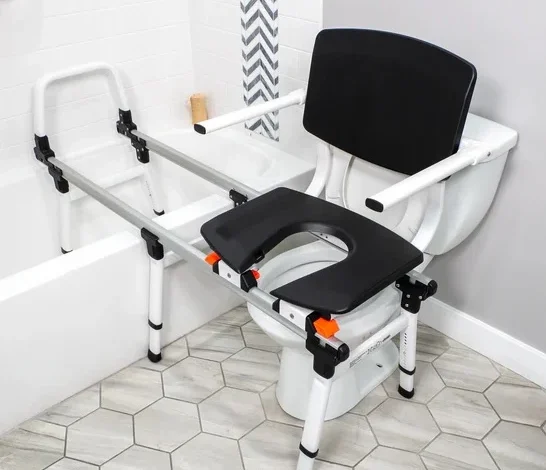
Not all shower chairs function in the same way, and the distinction matters for people who need genuine utility rather than a basic place to rest. A standard shower chair supports the body from below but does not allow easy access to all areas of the body that need to be cleaned. A u shaped shower chair addresses this limitation directly through its open-front design, which creates an unobstructed access point that allows the user — or a caregiver — to assist with hygiene tasks that a fully enclosed seat would block.
This design is particularly important for individuals who cannot stand at all during bathing, or who require caregiver assistance for personal care. In those situations, a seat that does not provide full access creates its own practical problems: awkward positioning, incomplete hygiene, and physical strain for both the person bathing and anyone assisting them. The open front resolves this without requiring the user to move or reposition repeatedly.
Who Uses This Type of Chair — and Why That Population Is Larger Than Expected
The image most people hold of adaptive bathing equipment is a narrow one: an elderly person in a long-term care facility. The actual population using shower chairs and u shaped shower chair configurations is considerably broader. It includes adults recovering from joint replacement surgery, people managing multiple sclerosis, Parkinson’s disease, or stroke-related weakness, individuals with obesity-related mobility limitations, and younger adults with temporary injuries that make standing in the shower unsafe.
It also includes family caregivers who are assisting a spouse, parent, or sibling with bathing at home — a role that millions of Americans take on without formal training or adequate equipment. For that population, the right chair is not just about the comfort of the person being cared for. It is about making the caregiving task physically manageable and reducing the risk of injury to the caregiver as well.
When framed in this way, adaptive bathing equipment stops being a niche product and becomes a mainstream safety tool for a large and growing portion of the population.
Why Most Families Delay Acting — And What That Delay Costs
There is a well-documented pattern in how families respond to mobility and safety concerns at home. Most people delay making modifications or acquiring adaptive equipment until after something has gone wrong. The reasons for this are understandable: acknowledging that a family member needs a shower chair carries emotional weight that can feel premature, even when the risk is already present.
This delay has a measurable cost. In the period between when a fall risk becomes real and when it is addressed, injuries can occur that change the entire trajectory of care. A fall that could have been prevented by a chair purchased weeks earlier can result in months of recovery, permanent functional loss, or a transition out of independent living entirely.
The economics here are genuinely difficult to ignore. The cost of an appropriate shower chair is a fraction of a single emergency room visit, let alone the cost of hospitalization, rehabilitation, or long-term care. The return on that investment — in terms of injury prevention and sustained independence — is substantial. But it only materializes if the equipment is in place before the fall, not after it.
The Role of Proactive Assessment in Home-Based Care
Occupational therapists, home health aides, and discharge planners who work with patients returning home from hospital stays are often the first professionals to flag bathroom safety as an immediate concern. Their recommendations typically include grab bars, non-slip mats, adequate lighting, and seated bathing options. These are not expensive interventions individually, but they require someone to act on the recommendation promptly.
The gap between professional recommendation and household action is where many preventable injuries occur. Part of the reason for this gap is that families often do not understand how significant the risk is during the transition period following illness, surgery, or a period of reduced activity. Muscles weaken during bed rest more quickly than most people expect, and balance does not return immediately. The shower — often one of the first independent tasks a person attempts after returning home — is exactly where that weakened state becomes dangerous.
Evaluating Adaptive Equipment as an Investment, Not an Expense
Most purchasing decisions for home safety equipment are made reactively, under pressure, and without much information. That context tends to produce choices based on price alone, which does not always result in equipment that actually meets the user’s needs. A chair that is the right size, offers the right support configuration, and is stable on the specific shower surface in the home performs a different function than one that is simply cheap and available.
When evaluating any adaptive bathing product, the relevant questions are about fit and function rather than cost. Does the design accommodate the user’s specific limitations? Is it stable on the surface where it will be used? Does it allow for the level of caregiver access that the situation requires? Can it be cleaned easily in a way that supports hygiene rather than compromising it?
These questions matter because adaptive equipment that does not function correctly for the user provides a false sense of security. A chair that is unstable, poorly sized, or difficult to use in practice does not reduce fall risk — it may even introduce new risks by giving someone confidence in a piece of equipment that does not actually support them reliably.
• Weight capacity must correspond to the user’s actual needs, not a general average, to ensure the chair remains stable under real-world conditions.
• Seat height should allow the user’s feet to rest flat on the shower floor, which supports stability and reduces the effort required to stand from the seated position.
• Non-slip feet are a basic requirement, not an upgrade — any chair used on a wet surface needs adequate grip to prevent movement during use.
• Open-front designs provide meaningful functional advantages for users who require caregiver assistance or have limited flexibility in their lower body.
• Ease of cleaning directly affects whether the chair will actually be used consistently over time, which is the factor that ultimately determines its safety impact.
Closing Perspective
The scale of bathroom fall injuries in the United States is not a hidden statistic — it appears regularly in public health reporting and medical literature. What remains underappreciated is how often those injuries are preceded by an identifiable and addressable risk that was simply never acted upon. The shower, in most American homes, is not designed to accommodate the full range of human physical capacity across a lifetime. It is designed for a baseline of health and strength that does not apply to everyone who uses it.
Adaptive equipment — particularly seated bathing options — closes the gap between that design assumption and real-world need. The cost of a quality shower chair is real but modest. The cost of the injury it prevents is orders of magnitude larger, measured not just in dollars but in functional independence, family stability, and quality of life.
The decision to act before an injury occurs rather than after it is, in practical terms, one of the most straightforward risk-reduction choices available to families navigating mobility challenges at home. The equipment exists, the evidence for its effectiveness is consistent, and the barrier to access is low. What remains is simply the decision to treat a known risk as something worth addressing today rather than after it becomes a crisis.