Why Does the Government Redact Documents? Reasons, Rules, and What It Means
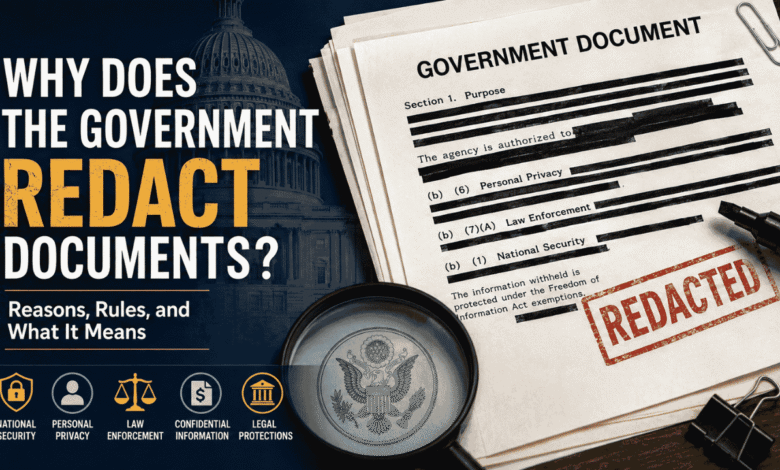
Government documents often contain information that is made available to the public. Still, readers may notice that certain words, sentences, names, numbers, or entire sections have been covered with black boxes. This process is known as redaction. It is commonly used when an agency determines that particular information cannot legally or appropriately be released.
If you have ever wondered why does the government redact documents, the answer is usually connected to privacy, national security, law enforcement, confidential information, or other legal protections. Redaction does not necessarily mean that an entire document is secret. In many cases, an agency releases as much information as possible while removing only the portions protected from disclosure.
In the United States, the Freedom of Information Act (FOIA) establishes a general presumption of openness while also allowing agencies to withhold information under specific exemptions. Federal agencies are generally expected to consider whether non-exempt portions can be released even when some information must be withheld.
What Does Redacted Mean?
A redacted document is a document from which specific information has been concealed or removed before it is released to someone else or made publicly available.
A redaction may appear as a black box, blank space, or another form of masking. In government records, the redacted section is generally accompanied by an indication of the legal exemption or reason for withholding the information.
According to FOIA.gov, agencies may redact information that falls within one of the law’s exemptions. The agency typically places a box over protected information and identifies the applicable exemption.
For example, a government report could contain 50 pages of information. If only a person’s home address and certain investigative details are protected, the agency may release the rest of the report while covering those specific details.
Therefore, redaction is different from withholding an entire document.
Why Does the Government Redact Documents?
The main reason the government redacts documents is to balance transparency with legally protected interests.
Government agencies collect and create enormous amounts of information. Some of that information can be made public, while other information could cause harm if disclosed. FOIA contains nine exemptions that allow agencies to withhold certain categories of information.
Federal law states that agencies should withhold information when disclosure would foreseeably harm an interest protected by an exemption or when disclosure is prohibited by law. Agencies must also consider whether partial disclosure is possible.
The most common reasons include national security, personal privacy, confidential business information, law enforcement concerns, and privileged government communications.
Redaction to Protect National Security
One of the most recognizable reasons for government redactions is national security.
FOIA Exemption 1 protects information that is properly classified under applicable rules when disclosure could affect national defense or foreign relations.
Government records involving intelligence operations, military capabilities, sensitive diplomatic matters, intelligence sources, or other classified information may therefore contain redactions.
The purpose is not simply to keep information away from the public. Certain details could potentially reveal sensitive capabilities, intelligence methods, sources, or strategic information.
A document can consequently contain both publicly releasable material and classified information. Instead of automatically withholding the entire document, an agency may release the portions that can safely be disclosed and redact the protected sections.
Protecting Personal Privacy
Another major reason for government redaction is personal privacy.
Government records may contain names, addresses, telephone numbers, medical information, employment information, identifying details, or other sensitive personal data.
FOIA Exemption 6 protects certain personnel, medical, and similar files when disclosure would constitute a clearly unwarranted invasion of personal privacy.
For instance, an investigation report might be released to the public, but the private contact information of an individual mentioned in the report could be removed.
This approach allows the public to learn about government activity without unnecessarily exposing someone’s private information.
Protecting Law Enforcement Investigations
Law enforcement records are another common source of redactions.
FOIA Exemption 7 covers certain records compiled for law enforcement purposes. Depending on the circumstances, information may be withheld if releasing it could interfere with an investigation or proceeding, affect someone’s right to a fair trial, invade personal privacy, reveal a confidential source, expose investigative techniques, or endanger an individual’s safety.
Imagine that a police or federal investigative report identifies a confidential witness. Releasing the person’s identity could potentially expose that individual to harassment or retaliation.
Similarly, releasing certain investigative methods could make it easier for people to avoid detection.
For these reasons, law enforcement documents can sometimes contain substantial redactions even when other portions of the records are publicly available.
Protecting Confidential Sources
Government agencies sometimes rely on people who provide information confidentially.
These sources can include witnesses, informants, employees, or other individuals who cooperate with investigators. Revealing their identities may put them at risk or discourage others from cooperating with authorities in the future.
FOIA’s law-enforcement exemptions include protections for confidential sources and information that could reveal their identities.
This is one reason a document may identify that information was withheld without publicly revealing exactly who provided it.
Protecting Investigative Techniques
Some government agencies use specialized methods and procedures to investigate violations of law.
If those techniques were fully disclosed, individuals attempting to evade law enforcement could potentially use that information to their advantage.
FOIA Exemption 7(E) can protect information concerning law enforcement techniques, procedures, and certain guidelines when it is reasonable to assume that disclosure will increase the likelihood of breaking the law.
This means that a document describing an investigation might be partially released while details about particular investigative methods remain hidden.
Protecting Confidential Business Information
Government agencies also receive information from private companies.
This can include financial information, trade secrets, business strategies, proprietary data, and other commercially sensitive material.
FOIA Exemption 4 protects trade secrets and certain confidential or privileged commercial and financial information obtained from a person.
For example, a government agency reviewing a company’s application might possess detailed financial or technical information. Releasing every detail could potentially harm the company’s competitive position.
Redaction can therefore protect legitimate commercial interests while allowing other parts of the government record to be disclosed.
Protecting Privileged Government Communications
Government officials and agencies frequently exchange internal communications while developing policies, making decisions, reviewing legal issues, or evaluating proposed actions.
Some of these communications may receive protection under FOIA Exemption 5.
The exemption can cover certain privileged communications, including deliberative-process, attorney-client, and attorney-work-product protections.
The purpose of these protections is partly to preserve certain forms of candid internal discussion and legal analysis.
However, Exemption 5 does not mean that every internal government email or document is automatically protected. The applicable legal requirements determine whether the exemption can be used.
Information Protected by Other Laws
Sometimes an agency cannot release information because another federal law specifically prohibits or restricts disclosure.
FOIA Exemption 3 covers information that is specifically protected from disclosure by another federal statute meeting the requirements of the exemption.
This demonstrates that government redaction does not always originate from FOIA itself. Other federal laws can establish separate confidentiality requirements.
Why Are Some Government Documents Heavily Redacted?
Some documents contain much more protected information than others.
A record involving an active investigation, classified information, sensitive intelligence, confidential sources, or extensive personal information may require numerous redactions.
In some cases, the exempt and non-exempt information can be so closely connected that releasing the remaining material would provide little useful information or could indirectly reveal the protected information.
Courts have considered whether agencies have properly released all reasonably segregable information, and agencies may have to explain why additional portions cannot be disclosed.
Therefore, a page filled with black boxes does not automatically establish that the government has improperly withheld information. The agency must have a legal basis for the withholding, although those decisions can sometimes be challenged.
Why Doesn’t the Government Just Keep the Whole Document Secret?
A key principle of FOIA is that agencies should release non-exempt information whenever reasonably possible.
The law specifically requires agencies to consider partial disclosure and take reasonable steps to segregate and release non-exempt portions of a record.
This is why someone requesting a government record might receive a document containing a mixture of ordinary text and redacted sections.
For example, a report could contain:
- The date of an investigation
- A description of a government action
- Publicly available facts
- A redacted person’s identifying information
- A redacted confidential-source reference
- A redacted investigative technique
The agency may be able to release the first three categories while protecting the last three.
Does a Redacted Document Mean the Government Is Hiding Something Wrong?
Not necessarily.
A redacted document indicates that some information has been withheld. The existence of a redaction by itself does not prove corruption, misconduct, secrecy for improper purposes, or wrongdoing.
There can be entirely legitimate reasons for withholding information, such as protecting someone’s privacy or preventing an active investigation from being compromised.
At the same time, government redactions can be challenged. FOIA requires agencies to follow applicable legal standards, and courts have examined cases where agencies failed to justify withholding adequately or failed to demonstrate that all reasonably segregable information had been released.
Consequently, the appropriate question is not simply whether a document contains blacked-out sections. The more important question is why the information was withheld and whether the claimed exemption legally applies.
Can Redacted Government Documents Be Unredacted?
Sometimes, but it depends on why the information was originally withheld.
Information may become releasable if circumstances change. For example, an investigation could end, a classification could change, or a legally protected interest could no longer apply.
A person who disagrees with a FOIA withholding may also have administrative appeal rights and, in appropriate circumstances, may seek judicial review.
However, not every redaction will eventually be removed. Information protected by privacy laws, confidential-source protections, classified information rules, or other statutes may remain protected.
The possibility of future disclosure therefore depends heavily on the specific exemption and circumstances involved.
What Are the Nine FOIA Exemptions?
The nine major FOIA exemptions provide a useful overview of the categories that may justify withholding information:
- Exemption 1: Classified national-security information.
- Exemption 2: Certain internal personnel rules and practices.
- Exemption 3: Information protected from disclosure by another federal statute.
- Exemption 4: Trade secrets and confidential commercial or financial information.
- Exemption 5: Certain privileged interagency or intra-agency communications.
- Exemption 6: Certain personal privacy information.
- Exemption 7: Certain law-enforcement records.
- Exemption 8: Certain information concerning financial institutions under regulatory supervision.
- Exemption 9: Certain geological and geophysical information concerning wells.
Not every exemption is used in every case. The applicable exemption depends on the type of information contained in the record and the legal circumstances surrounding its release.
How Are Redactions Identified?
Government agencies generally indicate that information has been withheld and identify the exemption being used.
FOIA guidance explains that agencies should mark released-in-part documents so that requesters can understand the amount and location of information withheld and the exemption supporting the redaction.
This can help a requester determine whether the agency has relied on a privacy exemption, a national security exemption, a law enforcement exemption, or another legal basis.
In other words, a black box on a document is not supposed to be completely unexplained.
Can You Challenge a Government Redaction?
Yes, depending on the circumstances, a requester can challenge a government agency’s withholding.
A requester can generally use the agency’s administrative appeal process after receiving a FOIA determination. If the dispute remains unresolved, judicial review may be available.
Courts can examine whether the agency properly applied the claimed exemption and whether it adequately considered segregating non-exempt material.
Federal FOIA litigation has included cases where courts required agencies to provide additional explanations concerning redactions or demonstrate that non-exempt information could not reasonably be separated from exempt information.
This oversight is an important part of maintaining the balance between government transparency and legitimate confidentiality.
Redaction vs. Classification: What Is the Difference?
Redaction and classification are related but different concepts.
Classification generally refers to information formally protected because its disclosure could damage national security under applicable classification rules.
Redaction refers to removing or concealing particular information before a document is released.
A document can therefore contain classified information that is redacted before the remainder of the document is released. But redactions can also be used for many reasons unrelated to classification, including privacy and law enforcement.
This distinction is important because seeing a blacked-out section does not automatically mean that the entire document is classified.
Why Government Redaction Matters for Transparency
Redaction can appear to conflict with government transparency, but it can also help make transparency possible.
Without redaction, agencies might have to withhold certain sensitive documents completely. By removing protected details, agencies can sometimes release meaningful portions of records that would otherwise remain unavailable.
FOIA.gov describes the law as providing a presumption of openness while requiring agencies to protect information when an exemption applies, or disclosure is prohibited by law.
The goal is therefore not simply maximum secrecy or maximum disclosure. The system attempts to balance both objectives.
Conclusion
So, why does the government redact documents? Government agencies redact documents primarily to protect information that cannot legally or safely be disclosed while releasing the portions that can be made public.
Under the U.S. FOIA framework, agencies are generally expected to consider partial disclosure and release reasonably segregable non-exempt information.
You May Also Read: FC-2024-015847 Federal Court: Understanding the Case Number, Legal Process, and How to Find Court Records