Anagrams: Meaning, Examples, Types, and How to Solve Them
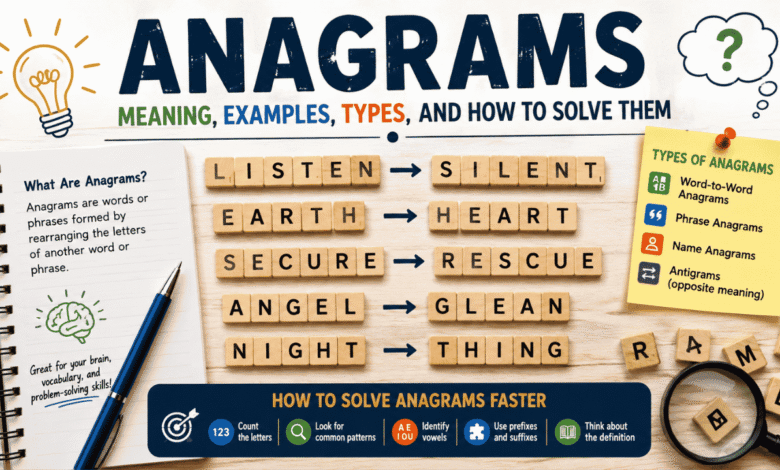
Anagrams are one of the most fascinating forms of wordplay. They turn ordinary words and phrases into something new simply by rearranging their letters. From simple classroom puzzles to challenging cryptic crosswords, anagrams have remained popular because they combine vocabulary, creativity, logic, and problem-solving.
At their simplest, anagrams involve taking the letters of one word or phrase and changing their order to create another word or phrase. For example, “listen” can become “silent,” while “earth” can become “heart.” The letters remain the same; only their arrangement changes. Merriam-Webster defines an anagram as a word or phrase created by transposing the letters of another word or phrase.
Whether you enjoy word games, crossword puzzles, vocabulary challenges, or language-based brain teasers, understanding anagrams can make these activities much more enjoyable. This guide explores what anagrams are, how they work, their different types, examples, solving techniques, and their role in modern word games.
What Are Anagrams?
Anagrams are words or phrases formed by rearranging the letters of another word or phrase. In a traditional exact anagram, every letter from the original expression must be used, with no letters added or removed.
For example:
- Listen → Silent
- Earth → Heart
- Race → Care
- Rescue → Secure
- Angel → Glean
- Night → Thing
- Elbow → Below
- State → Taste
The relationship between the two words comes entirely from their letters. Although the resulting word can have a completely different meaning, it contains the same collection of letters.
The word anagram has been used in English for centuries. Merriam-Webster records its first known use as 1589, while the verb form refers to rearranging letters to create an anagram or, in some contexts, to uncover a hidden message.
How Do Anagrams Work?
The basic principle behind anagrams is straightforward: identify the letters and rearrange them into a meaningful word or phrase.
Consider the word “stone.” Its letters are:
S – T – O – N – E
By changing their order, you can create “notes.”
The letters have not changed. There is still one S, one T, one O, one N, and one E. Only their positions are different.
This is what makes anagrams interesting. A collection of familiar letters can suddenly produce a word that is difficult to recognize at first glance.
For longer words, the process can become considerably more challenging because there are many possible arrangements. Most arrangements will not form English words, so the solver has to combine letter recognition with vocabulary knowledge.
Common Examples of Anagrams
Learning through examples is one of the easiest ways to understand anagrams.
Here are some simple examples:
| Original Word | Anagram |
|---|
| Listen | Silent |
| Earth | Heart |
| Secure | Rescue |
| Angel | Glean |
| Race | Care |
| Night | Thing |
| Save | Vase |
| Below | Elbow |
| State | Taste |
| Brag | Grab |
| Dormitory | Dirty room* |
| The eyes | They see* |
The final examples illustrate phrase-based wordplay. Phrase anagrams can be especially entertaining because rearranging letters across several words can produce an entirely different expression.
When creating exact anagrams, spaces and punctuation are generally treated differently from letters. The important element is the letter inventory.
Different Types of Anagrams
Not every anagram appears in the same form. Wordplay enthusiasts use several categories to describe different kinds of letter rearrangements.
Word-to-Word Anagrams
These are the most recognizable type. One word is rearranged to produce another word.
For example:
“evil” → “vile”
Both words contain the same four letters.
Phrase Anagrams
Phrase anagrams rearrange letters across multiple words to produce a new phrase.
These are often more difficult because the solver must consider multiple word boundaries instead of looking for a single word.
Name Anagrams
Names can also be rearranged into words or phrases. This type of wordplay is sometimes used for humor, puzzles, creative projects, and fictional character naming.
Antigrams
An antigram is a special kind of anagram in which the resulting word or phrase has an opposite or contrasting meaning to the original. These can be particularly clever because the connection is semantic as well as alphabetical.
Multiple Anagrams
Some words have several possible anagrams. A group of letters may produce two, three, or many valid words depending on the vocabulary being used.
This is one reason anagram puzzles can have multiple possible answers until the puzzle’s clues or letter restrictions establish the intended solution.
Anagrams in Crossword Puzzles
Anagrams have an important place in crossword culture, particularly in cryptic crosswords.
A cryptic crossword clue usually contains both a definition and a wordplay mechanism. In an anagram clue, certain words indicate that another group of letters needs to be rearranged.
For example, a simplified clue might look like:
Goat dressed in a robe (4)
Here, GOAT provides the letters, while “dressed” indicates that they should be rearranged. The result is TOGA, which matches the definition “a robe.”
Common anagram indicators include words such as:
- mixed
- confused
- broken
- chaotic
- strange
- rearranged
- disrupted
- spinning
- rebuilt
- modified
These words suggest that the solver should stop reading the letters in their original order and instead experiment with different arrangements.
How to Solve Anagrams Faster
Solving anagrams becomes easier with practice. Instead of randomly moving letters around, you can use a systematic approach.
Count the Letters
Start by identifying exactly how many letters you have. This prevents you from accidentally adding or removing a letter.
For example, with “listen,” you know the answer must contain six letters.
Look for Common Letter Combinations
English has many common combinations, such as:
- TH
- SH
- CH
- ST
- TR
- ING
- ED
- ER
- RE
Recognizing these patterns can help you form possible words more quickly.
Identify Vowels
Count the vowels before rearranging everything. Knowing how many A, E, I, O, and U letters you have can immediately eliminate many possibilities.
Look for Prefixes and Suffixes
Potential beginnings such as un-, re-, dis-, and pre-, and endings such as -ing, -ed, -er, and -tion can provide useful clues.
Think About the Definition
In puzzles, the clue often tells you what kind of word you’re searching for. If the answer must mean “a large building,” for example, you can use that definition to narrow down the possibilities.
Rearrange Strategically
Instead of trying every possible letter combination, experiment with likely word structures.
Verify Every Letter
Once you think you’ve found the answer, compare its letters with the original set. An answer isn’t a valid exact anagram if even one letter is missing, duplicated, or added.
Anagrams and Word Games
Anagrams are central to many word games. Players may receive a collection of letters and compete to find as many words as possible.
Tile-based games built around rearranging letters are a particularly familiar example. Different versions of anagram games use letter tiles and varying rules, with some related games using tiles from games such as Scrabble or Bananagrams.
Digital word games have expanded this concept even further. Players can now solve scrambled words on phones, computers, and tablets, often with timed challenges, scoring systems, hints, and progressively difficult levels.
This makes anagrams suitable for both casual entertainment and serious word-game competition.
Why Are Anagrams Good Brain Teasers?
Anagrams require several mental processes at once. A solver has to recognize individual letters, recall vocabulary, consider possible word structures, and test potential solutions.
They can also encourage flexible thinking. A familiar word may look completely different when its letters are scrambled, forcing the solver to stop relying on the original visual pattern.
For students, anagram exercises can be incorporated into vocabulary activities and spelling practice. For adults, they provide a simple form of recreational wordplay.
It is important, however, not to make exaggerated claims about specific health benefits from solving anagrams. While word puzzles are widely used as mental exercises, evidence about particular cognitive outcomes varies by activity and study.
Anagrams for Students and Children
Anagrams can be adapted to different ages and skill levels.
For younger learners, teachers can use short and familiar words:
- CAT → ACT
- DOG → GOD
- EAT → TEA
- TOP → POT
- RAT → ART
As students develop stronger vocabularies, longer words can be introduced.
For example:
EARTH → HEART
Students can be asked to identify both words, explain their meanings, and create sentences using them.
This turns an anagram exercise into a broader vocabulary activity rather than simply a spelling game.
Anagrams and Vocabulary Building
One reason anagrams are useful for language learners is that they encourage people to think carefully about individual letters and word structures.
Suppose a learner knows the word “listen” but has not yet encountered “silent.” Discovering the relationship between the two can make both words more memorable.
Anagram activities can also introduce learners to prefixes, suffixes, spelling patterns, and less familiar vocabulary.
The technique works especially well when the puzzle includes definitions. Instead of merely asking someone to rearrange letters, the activity can require them to understand what the resulting word means.
Anagram Solvers and Online Tools
Technology has changed how people approach anagrams. Online anagram solvers allow users to enter a collection of letters and receive possible word combinations.
These instruments may prove advantageous when an individual is stuck on a crossword, studying vocabulary, or playing a word game.
However, using a solver can also remove part of the challenge. If the goal is to improve your word-solving skills, it can be more beneficial to attempt the puzzle independently before checking a tool.
A good strategy is to use online resources as a learning aid rather than immediately relying on them for every answer.
Creating Your Own Anagrams
You don’t have to be an experienced puzzle setter to create anagrams.
Start with a word that has at least one recognizable alternative arrangement. “Listen” and “silent” are a good example because they have the same six letters but very different meanings.
For a puzzle, scramble the letters and provide a clue.
For example:
Scrambled letters: N T E S I L
Clue: “Quiet”
The answer is SILENT.
As you become more experienced, you can create longer puzzles and eventually experiment with phrase anagrams and cryptic-style clues.
Common Mistakes When Solving Anagrams
Several mistakes can make anagram solving more difficult than necessary.
One common mistake is ignoring the exact number of letters. Another is assuming that the answer must be a familiar word. Some puzzles intentionally use less common vocabulary.
Another mistake is focusing too heavily on the first arrangement that appears possible. If a puzzle includes a definition, always check whether the candidate answer actually matches it.
Finally, don’t forget that anagram indicators in cryptic puzzles have a specific purpose. The words indicating rearrangement are not normally part of the letters being scrambled.
The Lasting Appeal of Anagrams
Anagrams have remained popular because they are simple to understand but can become extremely sophisticated.
A three-letter anagram can be solved in seconds, while a long cryptic clue may require considerable vocabulary, reasoning, and patience. This flexibility allows anagrams to work for children, casual players, crossword enthusiasts, language learners, and experienced puzzle solvers.
They also demonstrate something fascinating about language: changing the order of letters can completely change meaning.
The same collection of letters can hide multiple possibilities, and finding one of those possibilities can create a satisfying moment of discovery.
Conclusion
Anagrams are a timeless form of wordplay based on rearranging letters to create new words or phrases. From simple examples such as “listen” and “silent” to complex cryptic crossword clues, they offer an accessible but surprisingly deep puzzle experience.
You May Also Read: FYI Meeting Crossword: A Fun and Informative Office Jargon Puzzle