A Simple Guide to Picking The Right Snuff Kit
Picking a snuff kit for the first time is one of those decisions that seems straightforward until you start looking into it. There are more options than you’d expect, more opinions from enthusiasts than you’d want, and a genuine lack of clarity about what actually matters versus what’s just preference dressed up as principle. This guide cuts through most of that.
The honest starting point is this: a snuff kit doesn’t need to be expensive, elaborate, or historically authentic to do its job well. What it needs is to be assembled with some care for how you actually use snuff, not how you imagine you might use it one day.
Start With How You Actually Use Snuff
Before looking at any specific items from https://nysberry.com/, it’s worth being clear about the context in which you use snuff most often. The right kit for someone who takes snuff primarily at home, at a desk, in a deliberate and unhurried way, is a different configuration from the right kit for someone who takes snuff throughout the working day, in varied settings, often quickly and without much ceremony.
This isn’t a trivial distinction. A beautiful antique snuffbox and a matching silver spoon is a wonderful home setup and a slightly impractical carry kit for a busy person who needs to manage a discrete dose on a commute. Conversely, a compact snuff bullet optimised for one-handed use on the go feels like a missed opportunity when you’re sitting somewhere comfortable with time to spend on the experience properly.
Most people eventually end up with something for both situations. But when you’re starting out, it’s more useful to pick one and build around it than to try to cover every scenario with a single purchase.
The Snuffbox: Where Most Kits Should Start
For the majority of snuff enthusiasts, the snuffbox is the right foundation for a kit, and it’s worth spending the most time on this choice.
What you’re looking for is a box that seals properly, is the right size for your usage patterns, and is made from a material you’re happy handling every day. That last point sounds obvious but it matters: a snuffbox that you find annoying or unsatisfying to hold gets used less, and the whole point of a kit is having something you’ll actually reach for.
Seal Quality
A snuffbox that doesn’t seal properly lets moisture in and out, which dries out finer snuffs and can make moister ones go stale faster. The lid should close with definite resistance. Not so tight that you’re struggling to open it one-handed, but tight enough that there’s no rattle or play when it’s closed. If you’re buying an antique box, test the seal before committing. Many old boxes have hinges that have loosened over time, which is fixable but worth knowing about.
Size
The most common sizing mistake is going too large. A snuffbox that holds 20 to 30 grams of snuff sounds practical in theory, but if you’re only using 2 to 3 grams a day, the snuff at the bottom is sitting in that box for a week or more before you get to it. For daily carry, something that holds 10 to 15 grams tends to be the right balance between not refilling constantly and keeping the snuff reasonably fresh.
Material
Silver is the traditional choice and remains a good one. It’s easy to clean, doesn’t interact with the snuff, and ages well. Antique silver boxes are widely available at accessible prices and have the appeal of proven longevity. Brass and copper are warmer in tone and develop a patina that many people enjoy, though they require more maintenance if you want to keep the finish consistent. Machined aluminium is the modern practical choice: lightweight, durable, and indifferent to moisture.
Avoid anything with a strong internal coating or lining that might affect the flavour of the snuff. Some decorative boxes use lacquers or resins internally that are fine for their intended purpose but noticeably affect the character of whatever snuff you put in them.
Snuff Delivery: Spoon, Bullet, or Fingers
How you take the snuff from box to nose is the second main variable in kit design, and the options have genuinely different strengths.
The Snuff Spoon
A snuff spoon delivers a measured, consistent dose and keeps the snuff clean in environments where you’d rather not use your fingers. The shallow bowl of a properly proportioned snuff spoon holds roughly the right amount for a single nasal application without requiring any estimation. For finer-ground snuffs that scatter easily with a pinch, the spoon is particularly useful.
Good spoons exist in bone, horn, antler, and silver, and the price range is wide. An antique bone or ivory snuff spoon can often be found for a few pounds at antique markets; a contemporary hand-turned horn spoon from a craftsperson might cost more but will last indefinitely. The functional requirements are minimal: a shallow, smooth bowl and a handle that’s comfortable to hold. Nearly any small spoon that meets these criteria will do the job.
The Snuff Bullet
For situations where discretion, speed, or single-handed operation matters, a snuff bullet is a better solution than a box and spoon. The device loads with a small amount of snuff, meters a dose through a rotating mechanism, and delivers it directly to the nostril without any spillage.
The quality range in snuff bullets is significant. A well-machined metal bullet with a tight-tolerance mechanism will operate consistently and cleanly for years. A cheap plastic alternative will develop slop in the moving parts relatively quickly, leading to inconsistent doses and eventual leakage. Given that the price difference is not large, the metal option is almost always the right call.
One thing worth knowing: different snuffs behave differently in a bullet. Drier, finer snuffs flow through the mechanism more easily than moist, coarser ones. If you use a variety of snuffs, it’s worth checking whether a specific bullet design is better suited to your preferences before purchasing.
Taking Snuff Without Tools
The thumb-and-forefinger pinch is the oldest method and still used by a significant number of enthusiasts. It works perfectly well for many snuffs and many situations. The case for a spoon or bullet isn’t that they’re necessary, it’s that they solve specific problems (consistency, cleanliness, discretion) that matter more in some contexts than others. If none of those problems apply to how you use snuff, you don’t need to solve them.
The Snuff Handkerchief: Practical and Underrated
Most people assembling their first snuff kit either skip this entirely or assume any handkerchief will do. Both approaches create minor but regular irritations.
A dedicated snuff handkerchief is separate from your regular handkerchief, made from a heavyweight cotton or linen, and in a dark colour. Burgundy, dark brown, and deep navy have been the traditional choices for a straightforward reason: snuff stains are visible on light fabric and essentially invisible on dark fabric. A good snuff handkerchief in regular use will stain over time regardless of how often it’s washed, and having that staining on a designated handkerchief rather than a good linen pocket square is obviously preferable.
Size matters more than people expect. Something around 14 to 16 inches square is the practical minimum for comfortable use. Smaller handkerchiefs require more precise handling than the situation usually allows.
A Storage Case to Hold Everything Together
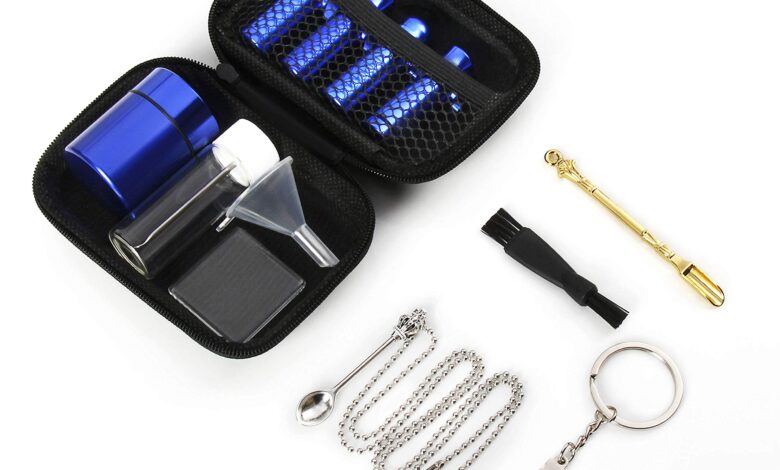
Individual items become a kit when they’re kept together in something designed for the purpose. A storage case is what makes a collection of related items into an actual kit rather than a handful of things you’re constantly looking for separately.
A leather roll with individual pockets is the most practical option for a portable kit. It folds open to give immediate access to everything, rolls closed and ties securely, and fits into a coat pocket or bag without bulk. Quality leather rolls are widely available at modest prices, and a well-made one will last for many years.
For a home kit that doesn’t need to travel, a small fitted case or a compartmentalised box works well. The requirements are the same: everything should have a place, that place should be secure enough to prevent things shifting, and the case should be easy to open and close without fuss.
Assembling a Kit for Different Budgets
A functional snuff kit doesn’t require significant investment. A secondhand silver snuffbox from an antique market, an antique bone spoon, a good cotton handkerchief, and a small leather roll to keep them together can be assembled for less than most people spend on a dinner out. The materials are honest, the items are well-made, and the experience of using them is considerably better than the equivalent in new, cheaply made alternatives.
At the other end, there are contemporary craftspeople making beautifully designed snuffboxes, hand-turned wooden spoons, and bespoke leather cases that are genuinely worth the price if the quality and aesthetics matter to you. The functional difference between a £20 antique box and a £200 contemporary one is real but not transformative. The experiential difference is more subjective.
What doesn’t scale with price is the handkerchief. A good linen handkerchief at any price point does the job; an expensive one does exactly the same job. Buy something you don’t mind staining and wash it regularly.
The Kit as a Reflection of the Practice
Assembling a snuff kit is, in a small way, a statement about how seriously you take the practice. Not seriously in a pompous sense. Seriously in the sense of having decided that something worth doing is worth doing with the right tools.
The right kit for you is the one that fits how you actually use snuff, not an idealised version of how a connoisseur might. If that means a simple snuffbox and a handkerchief, that’s a complete kit. If it means a full set with antique accessories and a fitted leather case, that’s equally valid. The point is that the kit serves the habit, not the other way around.