HEPA vs Activated Carbon Filters: What Each One Actually Removes (And Why Most Purifiers Run Both)
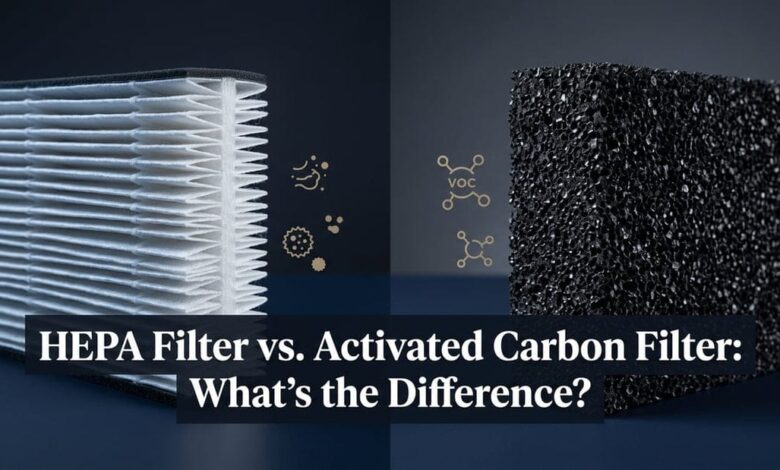
Short version, so you don’t have to scroll: a HEPA filter catches particles you can’t see — dust, pollen, dander, smoke soot down to 0.3 microns. Activated carbon catches smells and gases — cooking odor, VOCs off new furniture, the cigarette smell that soaks into a room. They’re not competing. They fix different problems, and if you buy one expecting it to do the other’s job, you’ll be disappointed. That’s the mistake I watch buyers make most.
I’ve spent years on the filtration side, cutting open competitor filters and testing media on a scale, and the confusion almost always comes from product listings. “True HEPA,” “activated carbon,” “multi-stage,” “odor removal” — all stacked in one bullet list like they’re interchangeable features. They’re not.
Quick verdict: which one do you actually need?
Buy for HEPA-grade particle capture if your problem is allergies, pets shedding dander, dust, pollen season, or you just want visibly cleaner air in a bedroom or nursery.
Buy for a serious carbon layer if your problem is smell — cooking, cat litter, cigarette or wildfire smoke lingering, paint and off-gassing after a renovation.
Buy both (most people) if your air has particles and odor, which describes basically every real home with a kitchen and a living thing in it.
At a glance
| HEPA-grade media | Activated carbon | |
| Catches | Solid/liquid particles | Gases, vapors, odor molecules |
| How | Physical trapping in dense fiber | Adsorption onto porous surface |
| Smallest target | ~0.3 microns (99.97% at H13) | Individual gas molecules |
| Good for | Pollen, dust, dander, mold spores, smoke soot | Cooking smell, VOCs, smoke odor, off-gassing |
| Useless against | Smells and gases | Pollen, dust, dander |
| Typical life | 6–12 months | 3–6 months (saturates faster) |
Notice the “useless against” row. That’s the whole article. Each one has a blind spot the other covers.
What a HEPA filter is built to catch
HEPA — High Efficiency Particulate Air — is a performance spec, not a brand. To earn the label, a filter has to trap at least 99.97% of particles at 0.3 microns, which is the hardest size to catch. Bigger particles get intercepted, smaller ones get bounced around and stuck by diffusion. 0.3 is the annoying middle. If a filter nails that, it nails everything else too.
In a home purifier, that means it pulls out:
- Household dust and the fine stuff carpets and fabric shed
- Pollen (the reason spring wrecks you)
- Mold spores
- Pet dander — not the fur, the microscopic skin flakes that trigger allergies
- Fine smoke particles, the soot part
- A chunk of bacteria that ride on larger particles
The catch: it only works on things with physical size. Air pushes through a wall of dense pleated fiber and particles stick. But a smell isn’t a particle — it’s gas-phase molecules far smaller than anything the fiber can grab. Run a pure HEPA machine in a kitchen full of fried-fish smell and it’ll clear the greasy haze and leave the stink hanging there. People assume the filter failed. It didn’t. You just asked it to do carbon’s job.
What activated carbon is built to catch
Carbon works on a completely different principle. It’s not a mesh — it’s a sponge at the molecular level. Activated carbon is processed so a single gram has a surface area measured in hundreds of square meters, all folded into microscopic pores. Gas and odor molecules drift in and stick to that surface. That’s adsorption (with a d — they adhere to the surface, they aren’t absorbed into it).
What that clears:
- Cooking odors
- Pet and litter-box smell
- Cigarette and campfire/wildfire smoke smell (not the soot — that’s HEPA’s half)
- VOCs off paint, adhesives, and new furniture
- Musty, stale-air funk
Here’s what listings won’t tell you, and it’s the number that actually matters: carbon performance scales with how much carbon is in there. A thin black-coated screen weighing a few grams is a deodorizer — fine for light daily smell. A real carbon filter holds hundreds of grams of pellets and gives the air enough contact time to strip odor. Two purifiers can both say “activated carbon” and differ by 20x in actual carbon mass. When smoke or renovation fumes are the problem, weight and thickness beat the marketing word every time.
And carbon is not a particle filter. A carbon-only machine will freshen a room and leave the pollen circulating. Same blind spot, opposite direction.
Head to head, by what you’re fighting
Allergies → HEPA wins, clearly. Pollen, dust mite debris, mold spores, dander are all particles. Particle capture is the whole game. Carbon is a nice-to-have here only if smells or chemical irritants also set you off — some allergy-sensitive people react to fragrance and VOCs, not just pollen, and carbon helps that edge.
Odor → carbon wins, clearly. No amount of particle filtration removes a smell. But odors usually travel with particles — smoke is soot plus gas, cooking is grease aerosol plus smell — which is exactly why single-function machines underdeliver on real-world messes.
Smoke → genuine tie, you need both. This is the cleanest example of why the “vs” framing is a trap. Smoke is fine particles and odor gases in one cloud. HEPA takes the soot, carbon takes the smell. Drop either half and the room still tells you something’s off — either a haze or a stink.
So why do purifiers stack them? Because air isn’t one problem.
Open up a decent multi-stage purifier and you’ll find three layers in sequence, each with one job:
Pre-filter grabs the big stuff first — hair, lint, visible fluff. Cheap, often washable, and its real purpose is protecting the expensive layers behind it so they last longer.
HEPA-grade layer takes the fine particles the pre-filter missed. This is the allergy layer.
Carbon layer handles the gases and smells the other two can’t touch.
Together they cover the actual mix in a lived-in home: a house with a dog, a stovetop, open windows in pollen season, and a new couch is throwing dander, cooking smell, pollen, and off-gassing at you simultaneously. A single-function filter fixes a quarter of that and you smell the rest.
Two things nobody puts in the spec sheet
Sealing matters as much as the media. The best filter on earth does nothing if air sneaks around it instead of through it. This bites hardest with cheap replacement filters — right media, wrong frame, and air takes the easy path around the gasket. When you buy a replacement, the fit and the sealing edge matter as much as the rating printed on it. A filter that’s technically H13 but leaks at the frame performs like a filter two grades lower.
Airflow is a trade-off. Denser filtration means more resistance. If the motor wasn’t built for it, packing in more layers actually cleans the room slower because less air moves through per minute. A well-matched purifier balances filtration against airflow — that’s why a thoughtfully built two-layer machine often beats a cheap five-layer one.
When to replace (and how to tell)
Both layers wear out, but they don’t announce it the same way.
Particle filters clog. As they load with dust the machine gets louder, works harder, and cleans slower — the airflow drops before the filtration does. In a normal home, plan on 6–12 months; with pets, heavy dust, or wildfire season, sooner.
Carbon saturates silently. Once every pore is occupied it just stops adsorbing, and there’s no visible sign — the machine still blows air, the room just stays smelly. Carbon usually taps out faster than the particle layer, roughly 3–6 months under real odor load. If a purifier suddenly stops handling smells it used to handle, the carbon’s full even if the HEPA looks fine.
Your mileage depends entirely on your air. A smoker’s apartment burns through filters in a fraction of the time a low-use spare bedroom does. The printed schedule is a starting point, not a rule.
FAQ
Does a HEPA filter remove smells? No, not really. It catches the particle part of smoke (the soot) but leaves the odor gas behind. Odor removal is carbon’s job. If your machine has HEPA but little or no carbon, expect it to leave smells in the room.
Can activated carbon replace a HEPA filter for allergies? No. Carbon handles gases and smells, not pollen, dust, or dander. For allergies you specifically need particle capture. Carbon on its own leaves the allergens circulating.
Do I really need both filters? For most homes, yes — because most homes have both particles and odors. A purifier that runs a HEPA-grade layer and a real carbon layer covers the full range. If your only issue is strictly allergies or strictly smell, you can prioritize one.
Why does my purifier still smell even though it has a “carbon” layer? Two usual reasons: the carbon layer is a thin deodorizing screen with too little carbon for the job, or it’s saturated and needs replacing. Carbon mass and contact time are what actually control odor performance — not the presence of the word on the box.
How often should I replace each filter? Rough guide: HEPA-grade layers every 6–12 months, carbon every 3–6 months, adjusted for your load. Pets, smoke, and heavy cooking shorten both.
Bottom line
HEPA and activated carbon get sold as a pair and read as rivals, but they never actually compete — one traps particles, the other adsorbs gases, and a real home throws both at you at once. Match the filter structure to your actual problem: particle capture for allergies, carbon mass for odor, both for smoke and for most lived-in spaces. And before you compare filtration types at all, it’s worth being clear on the fundamentals of how a HEPA filter works — once that clicks, the rest of the spec sheet stops being marketing noise and starts being a real buying decision.