How RayNeo Air 4 Pro Makes Impossible Gaming Scenarios Real
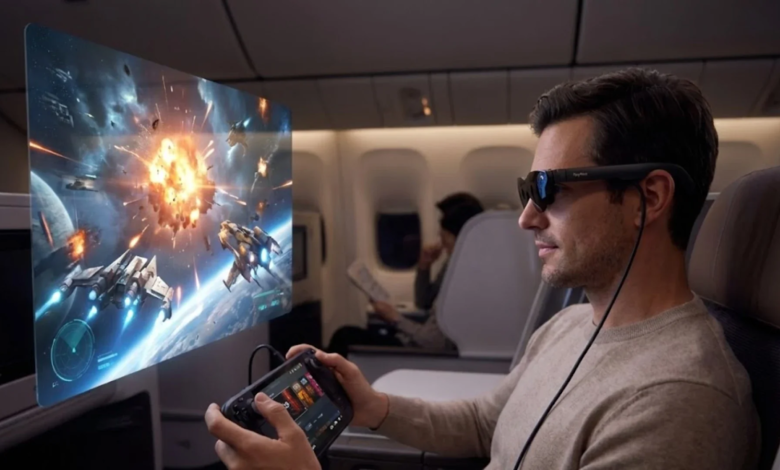
Playing a horror game with true HDR blacks while lying in bed. Running Baldur’s Gate 3 on a 135-inch screen during a red-eye flight. A year ago, these scenarios were fantasy for portable gamers. Smart glasses have rewritten the rules.
The RayNeo Air 4 Pro debuted at CES 2026 as the world’s first HDR10-enabled AR glasses. Priced at $299, it packs a cinema-grade Micro-OLED display and Bang & Olufsen audio into a 76-gram frame.
Here is what that combination actually means for gamers who refuse to settle for a downgraded portable experience.
Why Portable Gaming Still Feels Compromised
Handheld consoles like the Steam Deck and Nintendo Switch deliver console-quality games anywhere you go. But their small screens force trade-offs most gamers have learned to accept as inevitable.
Three limitations define the portable gaming ceiling today:
- Screen size keeps RPG interfaces cramped, strategy maps unreadable, and cinematic games visually compressed on displays under eight inches.
- Most portable displays lack HDR, meaning you rarely see games with the lighting, contrast, and color grading that developers actually designed.
- Audio compromises force a choice between isolation headphones that block surroundings and built-in speakers with no spatial depth at all.
AR smart glasses have targeted that gap for years without success. None managed to deliver the screen size and display quality to rival a proper gaming setup. That shifted at CES 2026.
The HDR10 Difference in Smart Glasses Gaming
Most AR glasses produce standard dynamic range output, which limits contrast, mutes colors, and loses shadow detail in darker scenes. The evolution of Smart Glasses toward HDR10 changes this entirely, and the RayNeo Air 4 Pro is the first to make it a consumer reality.
True Blacks and Real Contrast
With a 200,000:1 contrast ratio paired with Micro-OLED panels and a tinted visor, the RayNeo Air 4 Pro produces near-true blacks in dimmed environments instead of the washed-out grays that standard AR displays deliver. In horror titles like Resident Evil Village, shadow detail stays visible without crushing the image.
Bright highlights remain vivid without clipping or blooming. This kind of contrast performance has been standard on living room TVs for years but is new territory for smart glasses.
The Vision 4000 Processor
The custom Vision 4000 visual processor handles real-time image processing beyond simple HDR passthrough. According to RayNeo, it upscales SDR content to near-HDR quality, converts 2D video into stereoscopic 3D, and optimizes frames for clarity. Older games without native HDR support may still benefit from noticeable visual enhancement.
Color Accuracy That Matters
The display covers 98 percent of the DCI-P3 color gamut with Delta E values under 2 and 145 percent sRGB coverage. Smart glasses with this level of accuracy reproduce neon lighting in Cyberpunk 2077 and environmental gradients in Red Dead Redemption 2 the way developers intended.
A 201-Inch Screen in Your Glasses Case
Turning smart glasses into a viable gaming display requires more than resolution. The screen needs to be large enough for complex UIs, responsive enough to handle fast action, and comfortable enough for sessions that last longer than a single match.
Key Display and Comfort Specs
| Feature | Specification |
|---|---|
| Display | Dual SeeYa 0.6-inch Micro-OLED |
| Resolution | 1920×1080 per eye (2D), 3840×1080 (3D) |
| Refresh Rate | 60/120Hz adaptive |
| Brightness | 1,200 nits peak (8-level adjustment) |
| Virtual Screen | 135–201 inches (varies by viewing distance) |
| Weight | 76 grams (2.7 oz) |
| Eye Protection | 3840Hz PWM mixed dimming |
Built for Extended Play
At 76 grams, the RayNeo Air 4 Pro weighs less than many regular sunglasses. A 46.7-to-53.3 percent front-to-rear weight distribution prevents the nose-bridge pressure that heavier wearables cause during extended sessions. Magnetic prescription lens attachments support corrections up to minus 8.00 diopters.
The 120Hz refresh rate is lower than some competitors that now reach 240Hz. For most console titles that cap at 60 or 120 fps, this is unlikely to be a limiting factor, but competitive PC gamers chasing maximum frame rates should be aware of the ceiling.
Gaming Audio Without the Isolation
Smart glasses for gaming live or die by more than their screens. Audio drives immersion in ways that visuals alone cannot match. The RayNeo Air 4 Pro addresses this with a four-speaker system developed in collaboration with Bang & Olufsen.
How B&O Sound Engineering Changes the Experience
The four speakers use directional sound tube fittings that, according to RayNeo, reduce sound loss by 80 percent compared to conventional open-ear designs. In practice, this means more audio energy reaches your ears and less escapes to people nearby.
The system offers two modes tuned for different environments:
- Whisper mode minimizes high-frequency output for quiet settings like planes and shared spaces, keeping your gaming session private.
- Surround mode expands the spatial audio field for a more cinematic, immersive experience when privacy is less of a concern.
Tom’s Guide noted during their CES hands-on that the “boosted bass and clear audio delivered a proper gaming experience” even in a crowded convention hall.
Impossible Scenarios, Now Playable
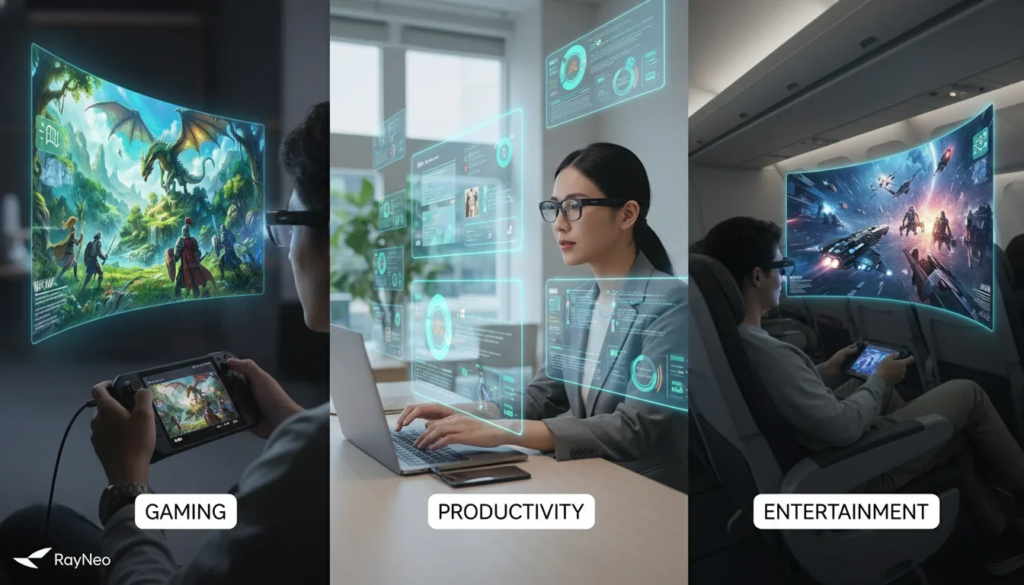
This is where the technology stops being a spec sheet and starts being a gaming tool. The RayNeo Air 4 Pro connects via USB-C to devices with display output, including the Steam Deck and iPhones from the 15 series onward. The Nintendo Switch 2 works through the JoyDock accessory, and HDMI consoles like the PlayStation 5 require a separate adapter.
The Red-Eye Flight Gamer
Plug the Steam Deck into the RayNeo Air 4 Pro via USB-C and you get an HDR gaming screen rated at 135 to 201 inches depending on viewing distance, all at 35,000 feet. At 76 grams, most users should find the weight manageable on long flights, though comfort varies by individual. The glasses draw power from the connected device, so pack accordingly.
The Living Room Escape
Instead of fighting for TV time, connect a PS5 to the RayNeo Air 4 Pro via an HDMI adapter and game from any room. ZDNET’s editor-in-chief described the experience as good enough to “easily replace my living room TV.” HDR10 support means compatible content can be displayed at a higher dynamic range, though results depend on the source material and device settings.
The Prescription Gamer
Gamers who wear corrective lenses have long been shut out of wearable display hardware. The RayNeo Air 4 Pro supports magnetic prescription lens attachments up to minus 8.00, paired with a nine-level adjustment system designed to accommodate different head shapes and face structures comfortably.
What This Means for Wearable Gaming
Streaming platforms like Netflix, Disney+, and Apple TV+ are expanding their HDR libraries every quarter. Game developers increasingly master titles for HDR output. Smart glasses that support HDR10 are positioned as a forward-looking investment, not just a novelty for early adopters.
RayNeo captured 24 percent of the global AR glasses market in Q3 2025 according to Counterpoint Research, securing the top position worldwide that quarter. The RayNeo Air 4 Pro suggests that momentum will continue.
If your priority is a large HDR display for console and handheld gaming on the go, and you can work within the constraints of open-ear audio and device power draw, the RayNeo Air 4 Pro at $299 is worth a serious look.
READ ALSO: How Long Does a Meta Glasses Charge Last? Real-World Usage Explained