OEM vs ODM vs White Label: Which Hair Brush Manufacturing Model Fits Your Brand?
Launching a haircare product line is exciting — but before you place your first order, there’s a foundational question every brand founder must answer: how will your brushes actually get made? The three most common paths in the hair brush manufacturing industry are OEM (Original Equipment Manufacturing), ODM (Original Design Manufacturing), and White Label. Each model carries a different tradeoff between cost, control, speed, and brand identity.
Understanding the distinctions isn’t just a supply-chain detail — it shapes your pricing power, your intellectual property, and how fast you can move from idea to shelf.
What Is OEM (Original Equipment Manufacturing)?
In an OEM arrangement, you own the design. You bring detailed specifications — the bristle type, handle material, paddle shape, ergonomic curve — and the factory builds exactly to your blueprint. The finished product carries your brand name, and often your proprietary tooling stays with you.
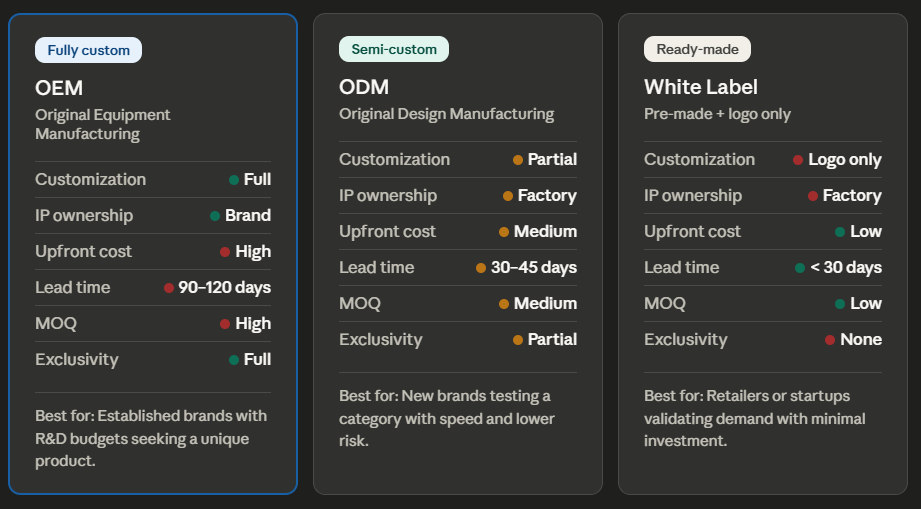
Best for: Established brands with R&D budgets, brands seeking a truly unique product, or companies that want to protect a novel design.
Tradeoffs: Higher upfront tooling costs, longer lead times (often 90–120 days), and minimum order quantities (MOQs) that can run into the thousands of units. You also carry more risk if the design doesn’t resonate with consumers.
What Is ODM (Original Design Manufacturing)?
With ODM, the factory owns the design. You choose from their existing portfolio of proven product designs, then customize elements — color, branding, packaging, perhaps some materials — to make it feel like yours. The factory handles R&D; you handle marketing.
Best for: Newer brands, fast-to-market strategies, or companies testing a new category before committing to full custom development.
Tradeoffs: Less exclusivity (other brands may sell nearly identical brushes), limited differentiation, and the factory retains the intellectual property on the core design. However, MOQs tend to be lower and timelines much faster — often 30–45 days.
What Is White Label?
White label is the simplest model. A factory produces a standardized, pre-made product, and you apply your logo and packaging. There is virtually no customization beyond branding.
Best for: Retailers launching in-house lines, subscription box companies, or brands testing demand with minimal upfront investment.
Tradeoffs: Maximum competition risk — any brand can sell the same brush with a different label. Margins are tight because there’s no moat around the product itself.
Side-by-Side Comparison
Which Model Is Right for Your Brand?
The honest answer depends on where you are in your brand’s lifecycle:
If you’re pre-launch or early stage — White label or ODM gets you to market fast, lets you validate price points and customer demand, and keeps your capital risk low. Many successful haircare brands started here and migrated to OEM once they had proof of concept.
If you’re scaling with a differentiated positioning — ODM with meaningful customization (bristle grade, handle ergonomics, proprietary colorways) can create enough distinction to build brand recognition without full OEM investment.
If you’re building a category-defining brand — OEM is ultimately the only path to true product exclusivity. It’s where long-term margin power lives, because your product can’t be directly replicated.
A Note on Vetting Your Partner
Regardless of which model you choose, the quality of your manufacturing partner matters enormously. When evaluating factories for hair brush manufacturing, always request: ISO or BSCI audit certifications, material safety data sheets (especially for bristle compounds), production samples across multiple batches, and clear terms around tooling ownership in your contract.
The wrong factory on the right model is still the wrong outcome.
Final Thought
OEM, ODM, and white label aren’t a hierarchy — they’re a spectrum. The right entry point is the one that matches your brand’s current resources, risk tolerance, and competitive ambition. Start where you can execute well, and build toward the model that protects your product long-term.