Precision Cultivation Around Barriers: The Obstacle Offset Rotary Side Tiller for Industrial Grounds
Introduction
In the management of industrial sites—warehouse perimeters, logistics yards, pipeline corridors, and utility rightsofway—maintaining vegetation and preparing soil near fixed obstacles is a persistent challenge. Trees, fence lines, signposts, and building foundations create narrow strips that standard tillers cannot reach, leaving rough, uneven ground that can harbor weeds, impede drainage, and create tripping hazards. The obstacle offset rotary side tiller addresses this gap with a design that shifts the tilling mechanism laterally, allowing operators to cultivate soil directly adjacent to obstructions while the tractor remains on a safe, clear path. This article explores the technical features, operational benefits, and safety considerations of using such equipment in Canadian industrial environments.
An example of this equipment category can be referenced here:
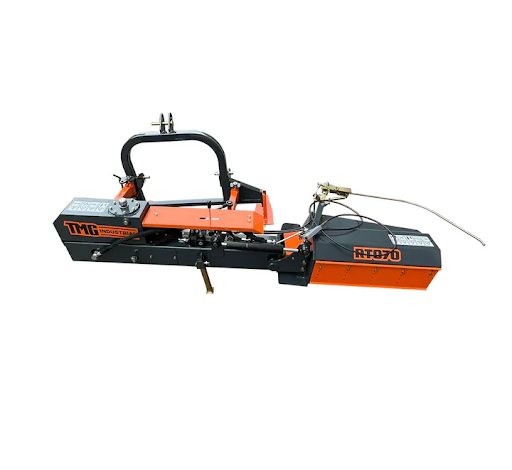
TMG Obstacle Offset Rotary Side Tiller, 28″ Working Width for 40-60 HP Tractors, TMG-RTO70
Applications and Core Functions
Typical Use Cases for an Offset Side Tiller
· Perimeter maintenance – tilling strips along fences, walls, and hedges to create firebreaks or prepare for seeding.
· Ditch and embankment cultivation – working on slopes and along drainage channels where standard implements cannot operate.
· Utility corridor upkeep – maintaining clear, welltilled soil around pipelines, power poles, and guy wires.
· Orchard and vineyard management – cultivating between tree rows without damaging trunks.
· Landscaping around industrial buildings – preparing soil for new plantings or erosion control mats.
How Offset Tillage Improves Safety and Productivity
Traditional methods for cultivating near obstacles involve manual labor—hoes, shovels, or string trimmers—which are slow, physically demanding, and expose workers to repetitive strain injuries and close proximity to machinery. An offset tiller mounted on a tractor allows one operator to complete in hours what would take a crew days, while staying safely in the cab away from blades and debris. The ability to work close to fixed objects reduces the need for subsequent handfinishing, ensuring uniform soil preparation. For logistics sites, wellmaintained borders improve drainage and reduce standing water, which in turn minimizes mudrelated accidents and pest habitats.
Technical Fundamentals of the Offset Rotary Side Tiller
Design and Operation
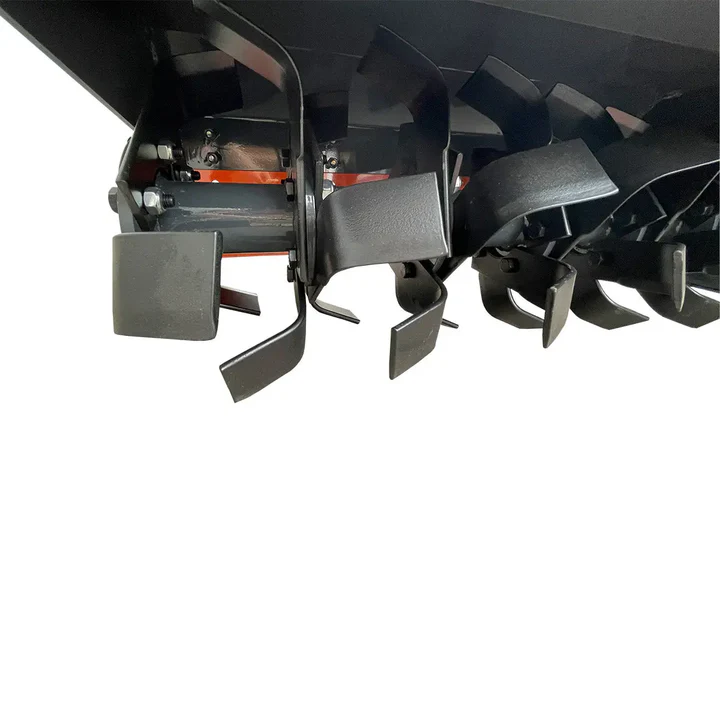
The offset tiller features a gearbox and rotor assembly that can be shifted laterally (typically up to 5070 cm) relative to the tractor’s centerline. This offset is controlled manually or hydraulically; the referenced model includes a manual avoidance feature and a remotecontrolled directional valve, allowing the operator to adjust the working position without leaving the seat. The rotor is equipped with 33 durable knives (flailstyle or Cblades) that rotate at high speed to break up soil and incorporate organic matter. A working width of 28 inches (71 cm) strikes a balance between coverage and maneuverability in tight spaces. The unit is designed for tractors in the 4060 horsepower range and includes a 13liter tank for lubrication or optional hydraulic fluid.
Power Transmission and Control
The tiller is powered by the tractor’s PTO via a shielded driveshaft. The remotecontrolled directional valve enables the operator to shift the tiller sidetoside hydraulically, providing precise placement. The manual avoidance feature may include a breakaway mechanism that allows the tiller to deflect if it strikes an immovable object, protecting both implement and tractor.
Factors Affecting Performance and Safety
· Soil conditions – hard, dry, or rocky soil may require slower forward speed and sharp knives; wet soil can clog the rotor.
· Obstacle proximity – the operator must judge the offset distance accurately to avoid collisions; markings or guides can help.
· Tractor stability – operating with a heavy offset load can affect steering and balance; slower speeds and caution on slopes are necessary.
· Maintenance of knives and gearbox – dull or damaged knives reduce tillage quality and increase fuel consumption; regular lubrication extends gearbox life.
· Hydraulic system condition – for models with hydraulic offset, leaks or low fluid levels impair control and safety.
Safety Best Practices for Offset Tiller Operation
Before each use, inspect all bolts, knife retainers, and driveline shields. Ensure the PTO shaft is properly guarded. When offsetting the tiller, verify that no bystanders are within the swing radius. Always engage the PTO at low engine speed and increase gradually. Avoid operating near underground utilities without prior locates. On slopes, work across the contour if possible, and never exceed the tractor’s stability limits. After use, lower the tiller to the ground, shut off the tractor, and remove the key before inspecting or cleaning. Store the implement with the rotor off the ground to prevent knife damage.
Comparison with Other Tillage Equipment
Options for Industrial Soil Preparation
· Standard rotary tillers (rearmounted) – lower cost but cannot reach beside obstacles; leave uncultivated strips.
· Disc harrows – good for breaking up soil but less precise near fixed objects; may damage fences or posts.
· Handheld cultivators – suitable for small areas but slow and laborintensive; high injury risk.
· Offset tillers – specifically designed for edge work; increase usable cultivated area and reduce manual labor.
Useful Accessories
Replaceable knife sets in various styles (e.g., flail, Cblade) for different soil types. A depth control roller or skid shoes to maintain consistent working depth. Hydraulic hoses and quick couplers for easy attachment.
Advantages and Limitations
Advantages
· Precision cultivation – reaches areas inaccessible to standard tillers, eliminating manual rework.
· Operator safety – remote offset control keeps the operator away from hazardous proximity to obstacles.
· Versatility – can be used for initial soil preparation, weed control, and incorporating amendments.
· Durability – 33 durable knives and robust construction withstand demanding conditions.
Limitations
· Power requirement – requires a tractor of at least 40 hp, which may not be available in all facilities.
· Offset stability – heavy offset loads can make the tractor feel unbalanced; operator training is essential.
· Initial cost – higher than standard tillers, but justified by expanded capability and time savings.
RealWorld Example: Pipeline Corridor Maintenance in Northern Alberta
A pipeline operator in northern Alberta manages a 50kilometer rightofway that passes through wooded areas. Vegetation control near fence lines and signposts was previously done by crews with brush cutters, a slow and risky task. The company acquired an obstacle offset rotary side tiller mounted on a 50hp tractor. The offset feature allowed the operator to till a 28inch strip directly alongside fence posts without damaging them, while the tractor remained on the mown path. The time required for routine vegetation maintenance along obstacledense sections was reduced by 70 percent, and no injuries were reported during the first season. The site supervisor noted that the uniform tilled surface also improved drainage and reduced standing water near the fence line.
For broader land management and equipment solutions, industrial suppliers such as: TMG Obstacle Offset Rotary Side Tiller, 28″ Working Width for 40-60 HP Tractors, TMG-RTO70 for reliable options.
Conclusion and Future Outlook
The obstacle offset rotary side tiller fills a critical niche in industrial grounds maintenance, enabling safe and efficient cultivation right up to the edge of fixed structures. For Canadian warehouse managers, equipment operators, and logistics professionals, this tool translates into cleaner, safer perimeters and reduced reliance on manual labor. As technology progresses, we can expect increased automation in offset control—sensors that detect obstacles and adjust the tiller position automatically—and integration with GPS for precision corridor management. Hybrid or electric tractors paired with efficient tillers may further reduce emissions and noise on sensitive sites. Investing in such specialized equipment demonstrates a commitment to both operational excellence and worker safety.