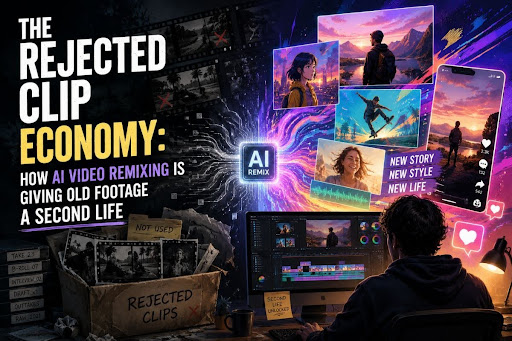
The Rejected Clip Economy: How AI Video Remixing Is Giving Old Footage a Second Life
Every creator I know has a folder full of clips that never became anything. I have one too. Some clips are too slow. Some are badly framed. Some belong to videos that changed direction halfway through editing. A few were good ideas on the day of filming and looked forgettable the next morning.
For years, that kind of footage had a simple fate: keep it “just in case,” forget about it, and eventually delete it when storage gets annoying.
That habit is starting to change. AI video remixing has made old footage feel less like waste and more like unfinished material. I think of it as the rejected clip economy: the growing value hidden inside clips that creators once considered unusable.
GoEnhance AI is an AI creative platform that helps users generate, edit, and transform visual content through workflows such as image-to-video, video-to-video, animation, and other AI-powered creative formats. In this context, a video to animation converter is not just a novelty tool. It can be a way to take an ordinary or unused clip and give it a visual reason to exist again.
Why So Much Footage Gets Abandoned
Most abandoned footage is not completely bad. That is the interesting part.
A clip may have a useful movement but poor lighting. It may have a good expression but weak background. It may show the right product but feel too plain for social media. It may be from a campaign that ended, a vlog that was never finished, or a tutorial where only one section turned out well.
I have noticed that creators usually reject footage for one of these reasons:
| Reason a Clip Gets Rejected | What Might Still Be Valuable |
| The pacing feels slow | The motion or scene structure may still work |
| The visual style looks plain | The subject or action may be useful |
| The clip no longer fits the original video | It may fit another topic later |
| The footage looks dated | It may be refreshed with a new treatment |
| The idea was unfinished | A shorter remix may still be publishable |
The mistake is assuming that rejected footage has no future value. More often, it just has not found the right format yet.
AI Video Remixing Changes the Role of Old Clips
Traditional editing works mostly with what the footage already contains. You can cut, crop, color grade, add captions, change music, or rearrange scenes. Those techniques are still important, and good editing judgment has not disappeared.
AI video remixing adds another layer. It allows creators to use the original clip as a foundation while changing the way it looks, feels, or functions.
That matters because a rejected clip may still provide useful structure. The camera angle is there. The gesture is there. The scene rhythm is there. The subject may already be in the right place. Even if the original version is not strong enough to publish, it can still guide a new version.
This is why I do not see AI remixing as a shortcut around creativity. Used well, it is closer to salvage work. It helps creators recover value from material they already spent time making.
Animation Can Turn Ordinary Clips Into Something Shareable
A lot of old footage fails because it looks too ordinary. Not bad. Just not interesting enough to stop a scroll.
Animation can change that. A simple person-walking clip may become a stylized short. A product shot can feel more playful. A behind-the-scenes moment can become part of a creator’s visual identity. A plain tutorial section can be turned into something that feels more like an explainer than a leftover recording.
The point is not to animate everything. That would become tiring fast. The better use is selective. If a clip has good movement, a clear subject, or a useful story beat, animation can make it feel intentional.
That is where old footage starts to behave like raw material again. A rejected clip no longer has to be judged only by how it looked in its original form.
AI Video-to-Video Is More Than a Filter
The phrase “video-to-video” can sound like a fancy filter, but that undersells the workflow. A filter sits on top of a clip. A video-to-video workflow uses the existing clip as a creative base and rebuilds the visual direction around it.
For creators, that opens up a different way of thinking. Instead of asking, “Is this clip good enough to post?” the better question becomes, “Does this clip contain enough structure to become something else?”
With an AI video to video workflow, creators can explore new visual styles while keeping the original motion, composition, or scene logic as the starting point. That is especially useful when the clip has a good idea trapped inside weak execution.
A creator might use this for:
| Old Clip Type | Possible Remix Direction |
| Plain talking-head footage | Stylized creator intro |
| Old product demo | Short promotional visual |
| Travel B-roll | Animated story clip |
| Tutorial footage | More visual educational snippet |
| Unused vlog scene | Social media short |
| Event footage | Recap or teaser version |
This is not about pretending bad footage was secretly perfect. Some clips should still be abandoned. But fewer clips need to be thrown away immediately.
The New Creator Skill Is Rebuilding, Not Just Shooting
The creator economy has trained people to shoot constantly. More clips, more posts, more angles, more versions. That pressure is real, especially on platforms where content ages quickly.
But I think the next practical creator skill is not only filming more. It is learning how to rebuild.
A good creator will know which old clips are worth saving. They will understand which footage has movement, emotion, or structure. They will keep a cleaner archive. They will label clips in a way that makes them searchable later. They will test multiple visual directions before deciding something is dead.
That sounds less glamorous than filming, but it can be a serious advantage. Creators who understand their own archive can produce more without constantly starting from zero.
What Kinds of Rejected Clips Are Worth Keeping?
Not every clip deserves storage space. I have become more selective about this. A blurry clip with no subject and no movement is probably not worth saving. A clip with a useful action, however, might be valuable even if the original lighting is not ideal.
The clips I would keep usually have one of these qualities:
| Keep the Clip If It Has… | Why It May Matter Later |
| Clear human movement | Useful for remixing or animation |
| A recognizable product | Can support future ads or demos |
| A strong expression | Good for storytelling or thumbnails |
| Interesting background motion | Useful as B-roll or stylized visuals |
| A simple scene structure | Easier to rebuild into another format |
| A moment that feels real | Authenticity is hard to recreate |
The best archive is not the biggest one. It is the one that makes future creative decisions easier.
There Are Still Boundaries
It is worth being careful here. AI remixing should not become an excuse to misuse other people’s footage, imitate someone’s identity without permission, or create misleading versions of real events.
Creators should work with material they own, licensed footage, or content they have permission to use. If a clip includes another person’s face, voice, or private setting, consent matters. A remixed video may feel playful, but it can still affect real people.
That part is not optional. The rejected clip economy only works if creators treat source material responsibly.
Delete Less, Remix More
I no longer see unused clips as simple failures. Some are failures, of course. But many are unfinished assets.
That shift changes how creators should look at their archives. A clip that did not work last year might work today in a different format. A video that felt too boring for YouTube might become a short animated post. A rough piece of B-roll might become the base for a stylized campaign.
AI video remixing does not remove the need for taste. It actually makes taste more important. The creator still has to choose what deserves a second life.
The difference is that old footage now has more possible futures. In a content world obsessed with newness, that may be one of the more underrated advantages: knowing how to find value in the clips everyone else would delete.