Why Construction Crews Keep Calling the Wrong Number: The Contact Data Problem No One Is Solving
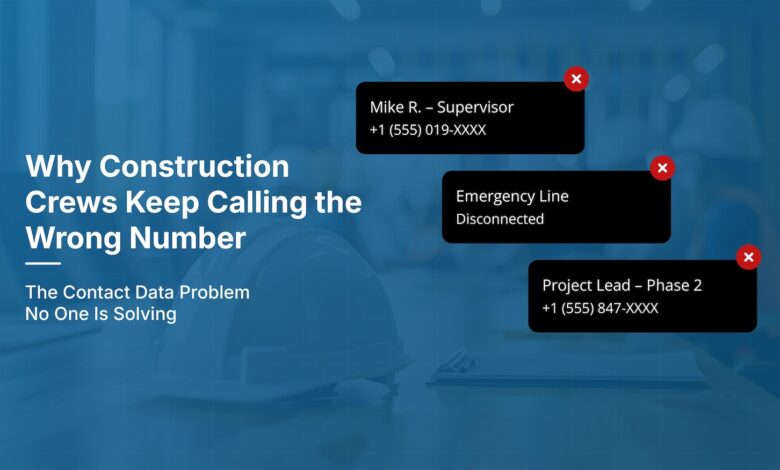
At 6:45 a.m., a superintendent reaches the site to sort out a concrete truck that showed up early. He calls the project coordinator to reroute it. No answer. He tries again. Nothing. Ten minutes later a foreman mentions the coordinator rolled off the job two weeks ago. Her number is still the one saved in everyone’s phone. The truck waits. The pour backs up. The day is behind before the first crew clocks in.
Some version of this plays out on jobsites every week, and almost nobody tracks it. Contractors have spent the past decade digitizing plans, schedules, RFIs, and daily reports. The people behind that information still live in a tangle of spreadsheets, group texts, and whatever contacts a worker happened to save on a personal phone. That gap has a name worth taking seriously: contact data decay.
The workforce is in constant motion
No other industry churns its rosters like construction. Crews rotate by phase. Subcontractors come and go by trade. A single commercial project can run through a long list of coordinators, supers, and vendor reps before closeout. The demographic math makes it harder. By 2031, about 41 percent of the current construction workforce is expected to retire, and only roughly one in ten workers today is under 25, according to NCCER data cited in Deloitte’s 2026 engineering and construction outlook. Every departure, promotion, and new hire is a contact someone is supposed to update by hand. On a busy job, that rarely happens on time.
The result is a slow drift between who a foreman thinks he is calling and who is actually assigned to the work. Most firms manage that risk with a shared spreadsheet and good intentions, which is to say they do not really manage it at all.
The hidden cost of a wrong number
The cost of poor jobsite communication is well documented. What gets missed is how much of it starts with a wrong or missing phone number.
Project Management Institute research found that ineffective communication is the primary contributor to project failure about a third of the time, and that roughly $75 million of every $1 billion spent on projects is put at risk by it (PMI, 2013). On large builds, the delivery record is worse. KPMG’s global construction survey found that only 25 percent of projects came within 10 percent of their original deadline. McKinsey’s analysis of megaprojects, meaning those valued above $1 billion, found that 98 percent run over budget by more than 30 percent and 77 percent finish at least 40 percent late.
A single five-minute scramble to find the right number looks trivial. Repeat it across dozens of handoffs a day, hundreds of workers, and a schedule that runs for months, and the lost hours stop being trivial. Foremen burn time chasing people instead of running crews. Subcontractors sit idle waiting on an approval that went to the wrong person. Vendors act on instructions from someone who left the job, and the rework starts.
The safety dimension
The stakes are not only financial. Construction is consistently among the most dangerous industries in the United States. It recorded 1,075 worker fatalities in 2023, more than any other industry, along with about 173,000 nonfatal injuries and illnesses, according to the Bureau of Labor Statistics. Its fatality rate runs well above the all-industry average.
Now put a stale contact list inside that environment. A supervisor needs the site safety lead during an incident. A foreman needs a worker’s emergency contact after a fall. A signal person needs the crane operator’s coordinator mid-lift. If the saved number is two rotations out of date, the seconds spent finding the right one are seconds that matter. Firms pour money into fall protection, training, and PPE, then hand the same crews a phone tree that went out of date the week it was printed.
Connected everything, disconnected people
Construction has no shortage of communication tools: project management platforms, messaging apps, field reporting systems, mobile device programs. Yet plenty of breakdowns happen before anyone sends a message, because the worker does not know who to call or is working from a different version of the list than the trade standing next to him.
The problem is not too few channels. It is bad underlying data. Field crews run on their phones, but most organizations still expect each worker to save, update, and clean up contacts alone. Predictably, every phone ends up with a slightly different roster. People who left months ago linger in address books. New hires never make it in. The directory fragments across hundreds of devices, and no one owns it.
Treating the directory as infrastructure
Closing this gap does not require another app for crews to learn. It requires treating the workforce directory the way firms already treat project data: as shared infrastructure that updates from a single source and lands on the device where field teams actually work.
In practice, that means maintaining one authoritative contact list in the directory IT already runs and pushing it into the native address book on each worker’s phone, so the right number appears without anyone typing it. When a coordinator rolls off, the change propagates. When a sub joins, their lead shows up on the crew’s phones the same day. Project-specific lists go only to the teams that need them. This is unglamorous plumbing, which is probably why it stays a blind spot in construction IT management long after schedules and drawings have been digitized.
A few platforms now handle this directly. CiraSync, for example, can sync the company directory to every worker’s phone on a set schedule, and pull subcontractor and vendor contacts from a CRM into that same address book, so crews reach the right coordinator without anyone keeping a list up to date by hand. The specific tool matters less than the principle: project data already gets synchronized, and the workforce directory should too.
The takeaway
Calling the wrong number on a jobsite used to be a nuisance. On a project with rotating crews, stacked trades, and a tight schedule, it becomes a coordination failure that cascades across the site, and occasionally a safety one. It is also among the most solvable problems out there. The contact list is the part of the job nobody wants to think about. It is also the part that quietly decides whether the next call connects.