Why Your Used Yamaha Motorcycles Might Need a TPS Learn Procedure
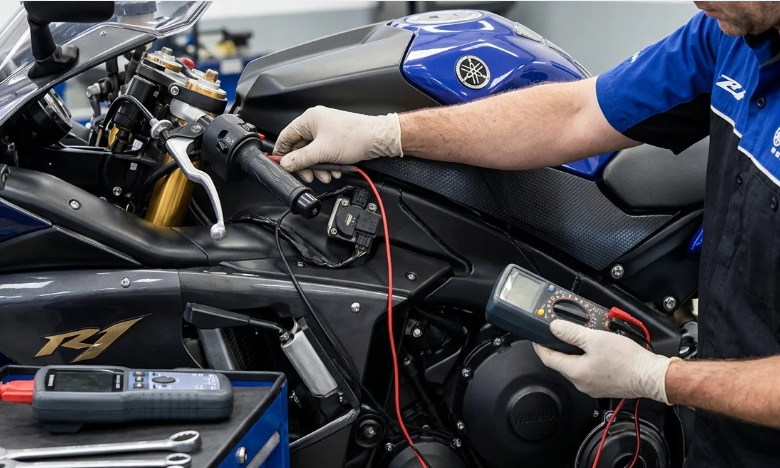
If you own or are planning to buy used Yamaha motorcycles, there’s one small but important maintenance step many riders overlook: the TPS learn procedure.
Modern Yamaha bikes use advanced electronic throttle systems, and when these systems fall slightly out of calibration, the riding experience changes dramatically.
A bike that once felt smooth and responsive may start showing strange symptoms, like a wandering idle, jerky throttle response, or inconsistent acceleration. In many cases, the fix is surprisingly simple: recalibrating the electronic throttle system.
Let’s break down why and how.
The Digital Brain: YCC-T and the TPS Learn
The YCC-T system is essentially a fly-by-wire setup. Your right hand moves the Accelerator Position Sensor (APS), the ECU processes that data, and then it tells the Throttle Position Sensor (TPS) how much to open the butterflies. Over thousands of miles, heat cycles, and battery swaps, these sensors can “drift.”
This is why used Yamaha motorcycles often benefit from a “TPS Learn” procedure. It’s a digital handshake that recalibrates the zero-point of your throttle.
How to Perform a Quick Electronic Learn (Key-On Only)
- Ensure the engine is stopped and the key is OFF. Fully close the throttle.
- Hold down the TCS and Reset buttons on your dash.
- Turn the Key ON (but don’t start the engine). Keep holding the buttons. After a few seconds, you should hear two distinct beeps.
- The TFT display should show “TPS Learn OK” or “APS Calibration Complete.”
The Red Flag: If you get an “ERROR” message or no beep, you’re likely looking at an APS sensor drift. On many used Yamaha motorcycles, this is a $400 part. Catching this during a pre-purchase inspection can be the difference between a fair deal and a financial pitfall.
The Mechanical Heart: Throttle Body Sync
While the computer handles the “request,” the mechanical throttle bodies still have to deliver the air. On multi-cylinder models like the Tracer 900, FJR1300, or the MT-09, those throttle bodies need to pull the exact same amount of vacuum.
When they are out of sync, the engine fights itself. You’ll feel increased vibration through the pegs and a sluggish response from the Traction Control System (TCS) because the ECU is getting “noisy” torque data.
For most four-cylinder Yamahas, a mechanical sync is recommended every 26,000 miles. It involves using a manometer to ensure all cylinders are within ±20 mm Hg of each other.
A seller who can show you a photo of the gauges perfectly leveled at idle is someone who truly knows how to maintain used Yamaha motorcycles.
Don’t Forget the EXUP Valve
If you are eyeing an R1 or R6 from the pre-2015 era, there is one more mechanical gremlin to watch for: the EXUP (Exhaust Ultimate Power) valve. This butterfly valve in the exhaust headers is designed to maximize mid-range torque.
The Audible Test
When shopping for Yamaha motorcycles, always perform the “click-whirr” test. Turn the key to the ON position and listen near the exhaust or under the tank. You should hear the actuator cycling.
If the valve is seized (a common issue due to road grime and heat), you’ll experience a massive “flat spot” between 4,000 and 6,000 RPM. It feels like the bike is choking until it suddenly clears its throat and screams toward the redline. Fixing a seized butterfly or a stripped servo gear usually costs around $250 in parts alone.
Turning Maintenance into Market Value
If you are selling one of these machines, documentation is your best friend. Because the YCC-T system and throttle body synchronization are specialized tasks that often scare off casual “garage mechanics,” having proof that they’ve been done can justify a 10% price premium.
A solid Buyer Documentation Package should include:
- TPS Learn: A photo of the “OK” screen on the dash.
- TB Sync: A photo of the gauge readings (e.g., #1: 200, #2: 202, #3: 201 mmHg).
- EXUP Test: A quick video of the actuator cycling or a linear dyno pull.
Key Takeaways
- Many Yamaha motorcycles use the YCC-T, which relies on electronic sensors instead of a throttle cable.
- If the TPS and APS sensors lose calibration, you may notice surging throttle, unstable idle, or delayed acceleration.
- A TPS learn procedure can recalibrate the system in minutes using a simple key-on reset, no tools required.
- Multi-cylinder models like the Yamaha MT-09 and Yamaha FJR1300 may also need throttle body synchronization for smooth performance.
- Older sport bikes, such as the Yamaha YZF-R1, should also have the EXUP Valve checked to ensure strong mid-range power.
- Proper calibration and documentation can increase the value of Yamaha motorcycles and prevent costly repairs.