9 Emerging Technology Trends Shaping the Future of Tech Startups
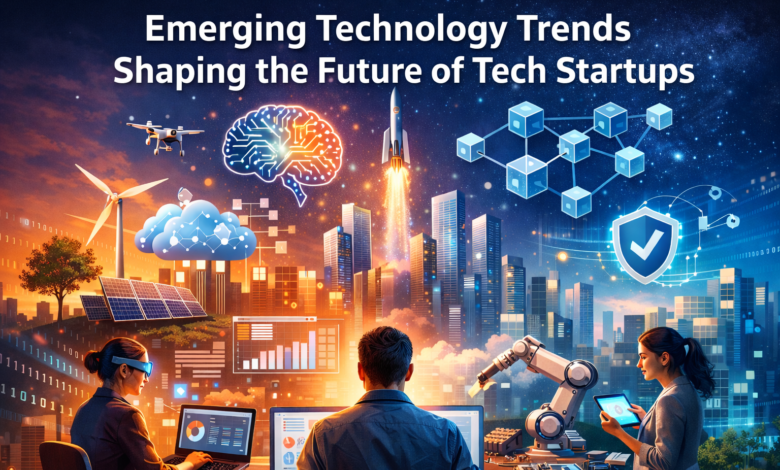
Let’s be honest, technology has always been changing. But 2026 feels different.
The gap between startups that “experiment with tech” and those that build their business around it is widening fast. AI is no longer impressive on its own, cloud is assumed, and trust has become just as important as speed.
Founders who understand where technology is heading, and why, will have a serious advantage. Those who don’t risk building products that already feel outdated.
Here’s a grounded, startup-focused look at the trends shaping the future of the list of tech startups in 2026, without the hype.
Generative AI Is Becoming the Backbone, Not the Bonus
A few years ago, adding AI to a product felt innovative. In 2026, not having it built in will feel strange.
Startups are increasingly designing products where AI sits at the core, helping teams build faster, personalize better, and make smarter decisions by default.
McKinsey estimates that generative AI could contribute up to $4.4 trillion annually to the global economy, showing just how big this shift really is.
For tech startups, this means:
- Faster product development
- Smarter user experiences
- Leaner teams doing more work
The real winners won’t “add AI later”, they’ll start with it.
Responsible AI Is No Longer Optional
As AI becomes more powerful, people naturally start asking tougher questions.
- Where does the data come from?
- Can the decisions be explained?
- Is this system fair?
These questions aren’t slowing innovation, they’re shaping it. Building responsible AI early is much easier than fixing it later.
Key priorities include:
- Clear explanations of how AI decisions are made
- Guardrails against bias
- Strong privacy protections
In 2026, trust won’t be a legal checkbox, it’ll be a selling point.
Cloud-Native and Composable Tech Keeps Startups Flexible
Startups don’t fail because they move too fast. They fail because they can’t change direction fast enough.
That’s why cloud-native, composable architectures are becoming the default. Instead of one giant system, startups are building modular setups where parts can be swapped, upgraded, or scaled independently.
The upside?
- Less technical debt
- Faster iteration
- Easier pivots when the market shifts
Flexibility is becoming one of the most underrated competitive advantages.
Security Is Built In From Day One
Security used to be something you worried about after growth. That mindset doesn’t work anymore.
Data breaches are expensive, and damaging to reputation. IBM reports that the average cost of a data breach reached $4.45 million.
That reality is pushing many early-stage companies to adopt cybersecurity essentials, where basic protections like access control, staff awareness, and secure system design reduce risk long before scale introduces complexity.
As a result, startups are embedding security directly into product design:
- Zero-trust access models
- Identity-first systems
- Continuous monitoring
In 2026, users won’t ask if your product is innovative, they’ll ask if it’s safe.
Decentralized Tech Is Finally Getting Practical
Blockchain and decentralization have been through the hype cycle. What’s left now is something far more useful: real-world applications that solve trust problems.
Startups are using decentralized tech for:
- Digital identity verification
- Smart contracts
- Tamper-proof records
Instead of replacing everything, decentralization is quietly strengthening the parts that need transparency the most.
Vertical AI Is Where Real Differentiation Happens
Generic AI tools are everywhere. What’s harder, and far more valuable, is building AI that truly understands a specific industry.
In 2026, we’re seeing strong momentum behind vertical AI in areas like healthcare, fintech, logistics, and legal tech.
Why startups love it:
- Faster product-market fit
- Clearer value propositions
- Stronger long-term defensibility
Depth beats breadth when markets get crowded.
Data Isn’t Just Insight, It’s Decision Power
Collecting data is easy. Using it well is where most companies fall short.
By 2026, startups are leaning into decision intelligence, systems that don’t just show dashboards, but actively guide decisions in real time.
The opportunity is massive. Statista projects the global big data and analytics market will reach $745 billion by 2030. Tech startups are using this approach for:
- Predicting customer demand
- Managing risk automatically
- Optimizing pricing and operations
The fastest-growing startups won’t rely on gut feeling alone.
Sustainability Is Becoming a Design Requirement
Sustainability used to be a “nice to have.” It’s becoming a baseline expectation.
Tech founders are paying closer attention to:
- Energy-efficient cloud usage
- Carbon-aware infrastructure choices
- Responsible supply chains
Building sustainably from the start is cheaper, and smarter, than retrofitting later.
Humans and AI Are Working Together, Not Competing
Despite the headlines, AI isn’t replacing people en masse. It’s changing how work gets done.
Tech startups are using AI copilots to:
- Help developers write cleaner code
- Support decision-making
- Automate repetitive work
The focus is shifting toward human-centered design, where technology supports creativity rather than overwhelms it.
How a List of Tech Startups Can Prepare for 2026
For founders navigating the next wave of innovation, a few principles stand out:
- Build AI, security, and governance early
- Choose flexible, modular systems
- Treat data as a decision engine
- Earn trust through transparency and ethics
Technology choices made today will shape how competitive your startup is tomorrow.
Final Thoughts
The future of tech in 2026 isn’t about chasing shiny tools. It’s about making smart, intentional decisions around AI, data, trust, and sustainability.
For any Tech Startup looking to grow, the opportunity is clear: build responsibly, stay flexible, and keep humans at the center of innovation. That’s how tomorrow’s category leaders are being built, right now.