Priority Infrastructure Plan: Planning, Funding, and Delivering Essential Infrastructure
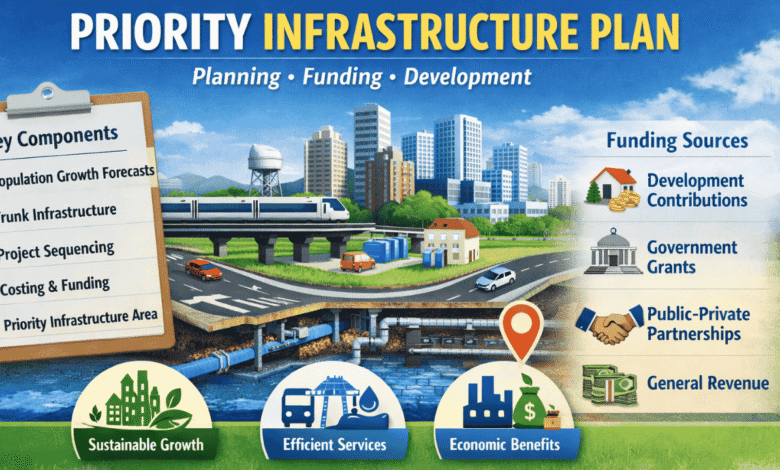
A Priority Infrastructure Plan (PIP) is a strategic planning framework used by governments and planning authorities to identify, prioritize, fund, and deliver essential infrastructure needed to support population growth and economic development. As cities expand and communities evolve, infrastructure planning becomes critical to ensure sustainable growth, efficient service delivery, and long-term financial viability. From roads and water supply systems to parks, transport corridors, and sewer networks, a priority infrastructure plan ensures that infrastructure investment aligns with projected growth and community needs. This comprehensive guide explains what a priority infrastructure plan is, why it matters, its key components, benefits, implementation process, and real-world applications.
What Is a Priority Infrastructure Plan?
A priority infrastructure plan is a formal planning document that identifies the infrastructure required to support future development within a defined area. It establishes:
- The type of infrastructure required
- The location of infrastructure networks
- The timing and sequencing of delivery
- The estimated cost of infrastructure
- The funding mechanisms to finance projects
In many jurisdictions, particularly in structured planning systems such as those in Australia, a priority infrastructure plan is embedded within a local government’s broader planning scheme.
The main objective is to integrate land-use planning with infrastructure planning, ensuring that development occurs only where adequate services can be provided efficiently.
Why Is a Priority Infrastructure Plan Important?
Supports Sustainable Growth
Without structured planning, rapid development can overwhelm existing infrastructure. A priority infrastructure plan ensures that roads, utilities, and public facilities expand in line with population growth.
Reduces Infrastructure Gaps
It identifies current infrastructure shortfalls and future demand, preventing service bottlenecks.
Provides Certainty to Developers
Developers gain clarity on where development can occur and what infrastructure contributions may be required.
Improves Financial Planning
Local governments can forecast infrastructure costs and plan budgets more effectively.
Enhances Community Outcomes
Proper infrastructure planning improves transport efficiency, environmental sustainability, and access to services.
Key Components of a Priority Infrastructure Plan
A well-developed priority infrastructure plan typically includes the following core elements:
Planning Assumptions
Planning assumptions are the foundation of the plan. They include:
- Population growth forecasts
- Employment projections
- Housing demand estimates
- Land-use distribution
These projections typically cover a 10–15-year horizon, though some plans extend to 20 years or more.
Priority Infrastructure Area (PIA)
The Priority Infrastructure Area defines the geographic zone where infrastructure will be provided to support planned growth. Development inside this area is generally supported, while areas outside may face infrastructure constraints.
The PIA ensures:
- Efficient infrastructure servicing
- Avoidance of urban sprawl
- Better return on infrastructure investment
Trunk Infrastructure Networks
Trunk infrastructure refers to major networks that service multiple developments or large geographic areas. Common infrastructure networks identified in a priority infrastructure plan include:
- Transport networks (roads, public transit corridors)
- Water supply systems
- Sewerage systems
- Stormwater drainage
- Parks and community facilities
Each network is mapped and described in detail.
Infrastructure Project List
The plan outlines specific infrastructure projects, including:
- New infrastructure construction
- Upgrades to existing assets
- Capacity expansions
- Replacement or renewal projects
Each project typically includes:
- Location
- Estimated cost
- Delivery timeframe
- Responsible authority
Sequencing and Timing
Infrastructure delivery is usually staged to match development demand. Projects may be categorized as:
- Short-term (0–5 years)
- Medium-term (6–10 years)
- Long-term (10+ years)
This sequencing ensures financial sustainability and efficient capital allocation.
Costing and Funding Mechanisms
A priority infrastructure plan includes detailed cost estimates and funding strategies, such as:
- Infrastructure charges or development contributions
- Government grants
- Public-private partnerships (PPPs)
- General revenue funding
Transparent funding frameworks improve investor and community confidence.
How a Priority Infrastructure Plan Is Developed
Developing a priority infrastructure plan typically involves several stages:
Data Collection and Analysis
Authorities collect demographic, economic, and land-use data to forecast future demand.
Infrastructure Capacity Assessment
Existing infrastructure capacity is assessed to identify gaps and constraints.
Growth Scenario Modeling
Different growth scenarios are evaluated to determine infrastructure requirements.
Step 4: Project Identification
Specific projects are identified to address projected demand.
Financial Modeling
Cost estimates and funding mechanisms are developed.
Public Consultation
Stakeholders, including residents and developers, provide feedback.
Formal Adoption
The plan is approved and integrated into the statutory planning framework.
Benefits of Implementing a Priority Infrastructure Plan
Economic Benefits
- Encourages private investment
- Reduces uncertainty for developers
- Supports job creation
Environmental Benefits
- Promotes compact urban development
- Reduces environmental degradation
- Supports sustainable transport
Social Benefits
- Improves access to healthcare, education, and recreation
- Enhances quality of life
- Reduces congestion and travel time
Governance Benefits
- Improves transparency
- Strengthens long-term planning
- Supports evidence-based decision-making
Priority Infrastructure Plan vs. Infrastructure Strategy
Although often used interchangeably, these terms differ:
| Local or regional focus | Often national focus |
| Detailed project-level mapping | High-level policy direction |
| Linked to land-use planning | Broader economic focus |
| Includes funding mechanisms | May not include detailed costing |
A priority infrastructure plan is typically more detailed and operational.
Real-World Applications of a Priority Infrastructure Plan
Urban Growth Management
Fast-growing cities rely on priority infrastructure plans to coordinate residential development with the expansion of transport and utilities.
Regional Development
Rural and regional governments use PIPs to prioritize investment in essential services such as water supply and transport corridors.
Climate Resilience
Modern infrastructure plans increasingly incorporate climate adaptation measures, such as flood mitigation systems and sustainable drainage networks.
Infrastructure Funding Reform
Some jurisdictions link infrastructure charges directly to the priority infrastructure plan, creating a transparent cost-recovery system.
Challenges in Implementing a Priority Infrastructure Plan
While highly beneficial, implementing a priority infrastructure plan comes with challenges:
Funding Constraints
Limited budgets may delay infrastructure delivery.
Changing Growth Patterns
Population projections can shift due to economic or social changes.
Political Influence
Infrastructure priorities may change with political leadership.
Regulatory Complexity
Aligning multiple agencies can be administratively complex.
Community Opposition
Some projects face resistance due to environmental or social concerns.
Effective governance and strong stakeholder engagement are essential to overcome these challenges.
Best Practices for an Effective Priority Infrastructure Plan
To ensure long-term success, a priority infrastructure plan should:
- Use accurate and regularly updated data
- Align with broader regional and national strategies
- Incorporate sustainability and climate resilience
- Maintain financial transparency
- Include measurable performance indicators
- Be reviewed periodically (every 3–5 years)
The Future of Priority Infrastructure Planning
Infrastructure planning is evolving rapidly due to:
Digital Technology
Smart city technologies allow real-time infrastructure monitoring and predictive planning.
Data Analytics
Advanced modeling improves demand forecasting accuracy.
Sustainability Goals
Carbon reduction and green infrastructure are becoming central priorities.
Public-Private Partnerships
Collaborative funding models are increasing the efficiency of infrastructure delivery.
As cities become more complex, the role of a priority infrastructure plan will continue to grow in importance.
Frequently Asked Questions (FAQs)
What is the main purpose of a priority infrastructure plan?
The primary purpose is to ensure that essential infrastructure is planned, funded, and delivered in alignment with projected population and development growth.
Who prepares a priority infrastructure plan?
Typically, local governments or planning authorities prepare and adopt the plan.
How long does a priority infrastructure plan cover?
Most plans cover a 10–15-year horizon, though some extend beyond that.
Is a priority infrastructure plan legally binding?
In many jurisdictions, it forms part of the statutory planning scheme, making it legally significant.
How is infrastructure funded under a PIP?
Funding may come from development contributions, government grants, public-private partnerships, and general revenue.
Conclusion
A Priority Infrastructure Plan is a powerful strategic tool that aligns growth, infrastructure investment, and financial planning. By clearly identifying infrastructure needs, defining service areas, prioritizing projects, and establishing funding mechanisms, it ensures sustainable, coordinated development.
You May Also Read: AutocarTrends.com: The Go-To Hub for the Future of Mobility, Automotive News & Sustainable Transport