Aimee Bock $5.2M Restitution: The Feeding Our Future Fraud Case
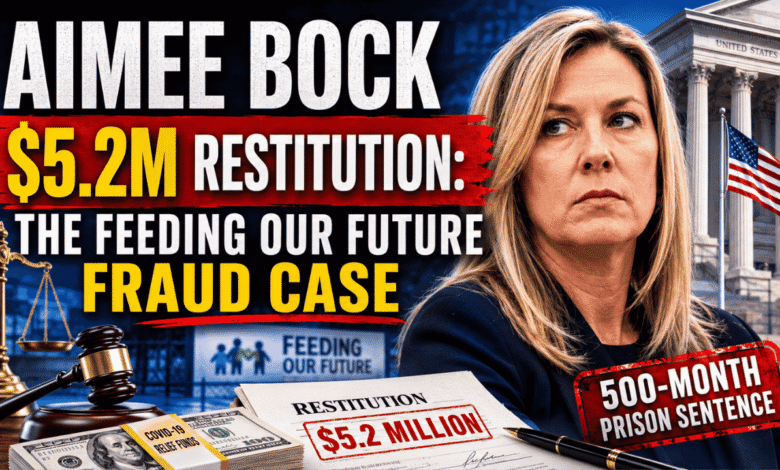
The Aimee Bock $5.2M restitution order has become one of the most talked-about developments in the massive Feeding Our Future fraud case. After years of investigation, federal prosecutors secured convictions against numerous individuals involved in what authorities described as one of the largest COVID-19 relief fraud schemes in United States history. As the founder and executive director of Feeding Our Future, Aimee Bock received a lengthy federal prison sentence and was ordered to pay $5.2 million in restitution. The restitution order represents more than a financial penalty—it reflects the federal government’s effort to recover taxpayer money that prosecutors argued was fraudulently obtained through pandemic-era child nutrition programs. The case has attracted national attention because of its scale, the number of defendants involved, and the significant impact on public trust in emergency relief programs. This article explains the background of the case, why Aimee Bock was ordered to pay $5.2 million, how restitution differs from fines, and what the ruling means moving forward.
What is the Aimee Bock $5.2M Restitution?
The phrase Aimee Bock $5.2M restitution refers to a federal court order requiring Aimee Bock to repay $5.2 million following her conviction in the Feeding Our Future fraud case.
Restitution is a legal requirement that compels a convicted defendant to repay losses suffered by victims. In this case, the victim is the federal government, which funded child nutrition programs intended to provide meals for children during the COVID-19 pandemic.
The restitution order accompanies Bock’s prison sentence and remains legally enforceable even after incarceration.
Who Is Aimee Bock?
Aimee Bock is the founder and former executive director of Feeding Our Future, a Minnesota nonprofit organisation that participated in federally funded child nutrition reimbursement programs.
Before the criminal investigation, Feeding Our Future served as a sponsoring organisation that approved numerous meal distribution sites seeking reimbursement through federal nutrition initiatives.
According to federal prosecutors, Bock abused this position by approving fraudulent meal sites and enabling false reimbursement claims worth hundreds of millions of dollars.
Throughout the investigation and trial, prosecutors portrayed Bock as the central organiser of the scheme. She denied the allegations during the legal proceedings, but a federal jury ultimately found her guilty on multiple criminal counts.
Understanding the Feeding Our Future Fraud Case
The Feeding Our Future case began after investigators identified suspicious reimbursement claims submitted during the COVID-19 pandemic.
Emergency pandemic programs were designed to ensure that children continued to receive meals while schools were closed. To quickly secure funding, oversight procedures were temporarily relaxed.
Federal prosecutors alleged that this environment created opportunities for widespread fraud.
Authorities claimed numerous organisations submitted false documentation showing:
- Millions of meals were allegedly served that never existed
- Fake attendance records
- Fraudulent invoices
- Fabricated vendor relationships
- False reimbursement requests
According to prosecutors, much of the money was diverted into luxury homes, expensive vehicles, commercial real estate, businesses, and personal expenditures rather than feeding children.
The investigation ultimately resulted in charges against dozens of individuals.
Why was Aimee Bock Ordered to Pay $5.2 Million?
The Aimee Bock $5.2M restitution order reflects the court’s determination that she should repay a portion of the financial losses directly associated with her criminal conduct.
Restitution serves a different purpose than imprisonment.
While prison is intended to punish criminal behaviour, restitution seeks to compensate victims for measurable financial harm.
In this case, the court concluded that Bock was financially responsible for millions of dollars connected to the fraudulent operation.
The $5.2 million order does not necessarily represent the total losses caused by the broader conspiracy. Instead, it represents the amount the court determined Bock should repay under the restitution judgment.
Federal Conviction
Following a lengthy trial, a federal jury convicted Aimee Bock on multiple felony charges.
The convictions included offences such as:
- Conspiracy to commit wire fraud
- Wire fraud
- Federal programs bribery conspiracy
- Other related financial crimes
The prosecution argued that Bock knowingly approved fraudulent meal sites and enabled false reimbursement requests while benefiting from the scheme.
Her conviction marked one of the most significant outcomes in the broader Feeding Our Future prosecutions.
The 500-Month Prison Sentence
In addition to the restitution order, Aimee Bock received a 500-month federal prison sentence, equivalent to approximately 41½ years.
The sentence immediately attracted national attention because of its length.
Federal judges consider numerous factors when determining criminal sentences, including:
- The amount of financial loss
- Leadership role in the offence
- Number of victims
- Complexity of the scheme
- Abuse of public trust
- Need for deterrence
The court concluded that the seriousness of the fraud justified one of the longest sentences imposed in a pandemic-related financial crime.
How Restitution Works
Many people confuse restitution with fines.
However, they serve different legal purposes.
Restitution
Restitution is intended to repay victims.
Money collected is directed toward compensating those harmed by the offence.
Criminal Fine
A fine is a financial punishment paid to the government.
Its purpose is punitive rather than compensatory.
A defendant may receive:
- A prison sentence
- Restitution
- Criminal fines
- Supervised release
All of these penalties can be imposed simultaneously.
Why the Case Received National Attention
The Feeding Our Future investigation became one of the largest fraud prosecutions connected to COVID-19 relief funding.
Several factors contributed to widespread media coverage:
Historic Financial Losses
Federal prosecutors alleged that approximately $250 million in fraudulent claims flowed through the conspiracy.
Large Number of Defendants
Dozens of individuals faced criminal charges.
The investigation expanded over several years, resulting in numerous guilty pleas and trials.
Public Program Abuse
The alleged fraud targeted taxpayer-funded child nutrition programs intended to serve vulnerable children during the pandemic.
Because the funds were designed for emergency humanitarian assistance, misuse generated widespread public concern.
Timeline of Major Events
COVID-19 Pandemic
Emergency child nutrition funding expands nationwide.
Investigation Begins
Federal investigators identify suspicious reimbursement claims.
Indictments Issued
Multiple defendants, including Aimee Bock, are charged.
Federal Trial
Evidence is presented over several weeks.
Guilty Verdict
A federal jury convicts Bock on multiple criminal charges.
Sentencing
The court imposes:
- 500 months in federal prison
- $5.2 million restitution
Prosecutors’ Allegations
Federal prosecutors alleged that Feeding Our Future became the organisational hub for numerous fraudulent meal providers.
According to prosecutors, participants:
- Created fake meal sites
- Invented attendance numbers
- Submitted fabricated invoices
- Claimed reimbursement for nonexistent meals
- Shared proceeds among conspirators
Authorities argued that Bock played a leadership role by approving organisations that should have been rejected under federal oversight requirements.
Defense Position
Throughout the proceedings, Bock maintained that she did not intentionally participate in fraud.
Her defence argued that Feeding Our Future was responsible for administering programs rather than independently verifying every reimbursement request submitted by participating organisations.
The jury ultimately rejected those arguments after reviewing the evidence presented during the trial.
Why the Restitution Amount Matters
The Aimee Bock $5.2M restitution order demonstrates that financial accountability continues beyond criminal imprisonment.
Restitution judgments can remain enforceable for many years.
Collection methods may include:
- Wage garnishment is legally permitted
- Asset seizure
- Payment plans
- Liens on qualifying property
- Other lawful collection procedures
Actual recovery depends on the defendant’s available assets and income over time.
Impact on Federal Oversight
The Feeding Our Future case prompted renewed discussion regarding oversight of emergency assistance programs.
Government agencies have since emphasised stronger safeguards, including:
- Enhanced documentation requirements
- Improved auditing
- Better data analysis
- Increased verification procedures
- Stronger fraud detection systems
These measures aim to reduce opportunities for similar fraud in future emergency funding initiatives.
Public Interest in the Case
Search interest in Aimee Bock $5.2M restitution increased following sentencing because many people wanted to understand:
- Why was the restitution amount ordered
- How restitution differs from prison
- Whether additional money could still be recovered
- How pandemic fraud investigations were resolved
- The broader impact of the Feeding Our Future scandal
The case has become a prominent example of the legal consequences associated with large-scale fraud involving public funds.
Frequently Asked Questions
What does Aimee Bock $5.2M restitution mean?
It refers to the federal court order requiring Aimee Bock to repay $5.2 million following her conviction in the Feeding Our Future fraud case.
What was Feeding Our Future?
Feeding Our Future was a Minnesota nonprofit organisation that sponsored meal sites participating in federally funded child nutrition reimbursement programs during the COVID-19 pandemic.
How long is Aimee Bock’s prison sentence?
She received a 500-month federal prison sentence, which is approximately 41½ years.
Is restitution the same as a fine?
No. Restitution compensates victims for financial losses, while a criminal fine serves as punishment and is paid to the government.
Why did the case become nationally important?
The investigation involved allegations of approximately $250 million in fraudulent claims connected to pandemic-era child nutrition funding, making it one of the largest COVID-19 fraud prosecutions in the United States.
Conclusion
The Aimee Bock $5.2M restitution order represents a significant chapter in the federal government’s response to pandemic-related fraud. Following her conviction in the Feeding Our Future case, Bock was sentenced to 500 months in federal prison and ordered to repay $5.2 million as restitution. Together, these penalties underscore the legal consequences of large-scale financial crimes involving public funds.
You May Also Read: Gorsuch Roberts Immigration Decision: Supreme Court’s Role in U.S. Immigration Policy