The Complete Hospital Partition Guide: How to Choose, Install, and Maintain Medical-Grade Dividers in American Hospitals
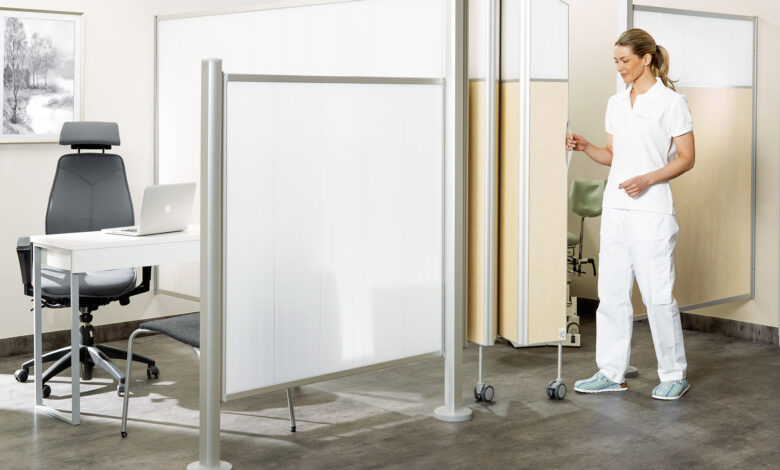
In an active hospital environment, the physical layout of a space does more than define where patients sit or sleep. It shapes how staff move, how infections are controlled, how patients experience care, and how quickly a unit can be reconfigured when demand changes. Dividers and partition systems are often treated as secondary to larger construction decisions, yet they directly affect daily operations in ways that other infrastructure components do not.
The challenge for facilities managers, infection control officers, and hospital administrators is that partition decisions are rarely straightforward. Material requirements differ by unit. Regulatory expectations vary. Installation timing must align with occupied facilities where downtime is not acceptable. And the maintenance burden over the product’s lifespan is rarely considered at the time of purchase.
This guide covers the full decision-making process for hospital partitions — from understanding the types available and how to evaluate them for specific clinical environments, through installation best practices and ongoing maintenance in occupied healthcare settings.
Understanding What Hospital Partitions Actually Do in Clinical Settings
A hospital partition is not simply a room divider. In clinical settings, it serves overlapping functions: it creates visual privacy for patients, contributes to acoustic separation between care areas, acts as a physical boundary during procedures, and in many cases, serves as part of the infection control protocol for a unit. Each of these functions carries different material and design requirements, and they rarely all point toward the same product.
For anyone working through a procurement or specification decision, a well-structured Hospital Partition guide — such as the one available at Hospital Partition guide — can help clarify the functional distinctions between product types before any technical shortlisting begins.
Visual privacy is the most basic requirement. Patients in multi-bed wards, emergency bays, and treatment areas have a right to visual separation during examinations and conversations with clinical staff. Acoustic separation is more complex. Full acoustic isolation is rarely achievable with movable or semi-permanent partitions, but meaningful reduction of ambient sound transmission can be achieved with the right material density and installation approach.
Infection control is where hospital partitions diverge most significantly from standard commercial dividers. Surfaces must be non-porous, resistant to cleaning agents used in medical-grade disinfection cycles, and free from gaps or crevices where pathogens can accumulate. This requirement eliminates a wide range of general-purpose partition products from clinical consideration.
The Difference Between Patient Privacy and Clinical Separation
These two needs are related but distinct, and conflating them leads to specification errors that create operational problems later. Patient privacy is primarily a visual and perceptual requirement — it addresses the patient’s sense of dignity and confidentiality. Clinical separation, by contrast, is a functional and procedural requirement. It defines the boundary around a treatment area, isolates a patient with an infectious condition, or creates a contained environment for a sterile procedure.
A curtain track system may meet patient privacy requirements in a general ward but fail entirely when clinical separation is needed in an isolation room or ICU bay. Conversely, a rigid partition with full-height construction may provide clinical separation while creating acoustic and workflow problems in a shared recovery area. Understanding which need is primary — and which is secondary — in each specific unit is the starting point for any product evaluation.
Types of Partition Systems Used in American Hospitals
American hospitals use several distinct categories of partition system, each suited to different environments, construction constraints, and operational requirements. The selection is rarely about finding the best product overall — it is about matching the product type to the specific conditions of a given space.
Cubicle Curtain Track Systems
Track-mounted curtain systems remain the most widely used partition solution in general inpatient wards, emergency departments, and outpatient treatment areas. Their primary advantages are flexibility and ease of maintenance. Curtains can be removed for laundering without disrupting the room configuration, and tracks can be reconfigured without structural changes to the space.
The limitation is material. Fabric curtains — even those treated with antimicrobial coatings — are porous surfaces that accumulate contamination over time. Research published through the Centers for Disease Control and Prevention has documented the role of contaminated soft surfaces in healthcare-associated infection transmission, which has prompted many facilities to increase curtain replacement frequency or shift toward wipeable curtain alternatives in higher-risk units.
Wipeable vinyl or coated fabric curtains address the surface contamination concern more directly. They can be disinfected in place, which is operationally significant in units where curtain removal is disruptive. However, they carry a higher upfront cost than standard fabric curtains and require staff training on appropriate cleaning agents to avoid surface degradation.
Rigid Modular Partition Panels
Rigid panels are used in spaces requiring more permanent boundaries — consultation rooms, procedure areas, and spaces where acoustic separation has clinical significance. These systems are typically floor-to-ceiling or floor-to-soffit in height, and they can incorporate glazed sections for observation without entry.
The specification of rigid panels requires attention to surface finish, joint design, and cleaning access. Panels with exposed joints, recessed tracks, or complex profile intersections create cleaning dead zones that are difficult to maintain in compliance with infection control protocols. Smooth, continuous surfaces with minimal joints are preferable in clinical areas.
Demountable and Relocatable Systems
Demountable partition systems are designed for reuse and reconfiguration. They are installed without permanent adhesives or significant structural modification and can be disassembled and relocated as departmental needs change. For hospitals managing ongoing space reconfiguration pressures — particularly post-pandemic demand shifts or departmental expansions — demountable systems offer meaningful long-term value.
The operational trade-off is installation complexity and the need for precise reinstallation to maintain surface integrity. A demountable system that is repeatedly relocated without proper reinstallation protocols can develop surface gaps, misaligned seals, and compromised acoustic performance over time.
Regulatory and Infection Control Considerations for U.S. Hospitals
Hospital construction and renovation in the United States operates within a regulatory framework that directly affects partition specification. The Facility Guidelines Institute publishes the Guidelines for Design and Construction of Hospitals, which many states reference when reviewing healthcare facility plans. These guidelines include spatial and surface requirements that affect partition selection.
Joint Commission accreditation standards require hospitals to maintain environments that support infection prevention. Surface materials in patient care areas must be cleanable, non-shedding, and appropriate for the disinfectants in clinical use. This creates a material requirement that must be verified — not assumed — during product evaluation.
Matching Partition Materials to Disinfection Protocols
Most healthcare facilities use quaternary ammonium compounds, accelerated hydrogen peroxide solutions, or bleach-based products as their primary surface disinfectants. Not all partition materials tolerate these agents equally. Some vinyl surfaces degrade with repeated bleach exposure. Certain powder-coat finishes develop surface crazing when cleaned with hydrogen peroxide formulations over time.
The appropriate process is to obtain the material safety and chemical compatibility data from partition suppliers and cross-reference it against the disinfectant products used in the specific unit where installation is planned. This step is often skipped in procurement decisions and becomes the source of accelerated surface wear and costly early replacement.
Planning Installation in Occupied Hospital Environments
Installation of partition systems in active hospitals requires a different approach than commercial construction. Dust, noise, vibration, and the presence of workers in clinical spaces are each potential sources of patient risk, staff disruption, and regulatory concern. Infection control risk assessments — commonly called ICRAs — are required before most construction and renovation work in occupied healthcare facilities.
Sequencing Work Around Clinical Operations
The most common installation challenge in occupied hospitals is sequencing. Work often cannot happen during normal operating hours in patient-facing areas. This requires detailed coordination between facilities teams, clinical leadership, and contractors to identify low-census periods, temporary patient relocation options, and phased work schedules that keep units functional throughout the project.
Prefabrication of partition components off-site can significantly reduce installation time in the clinical environment and limit the duration of construction-related disruption. Many modular and demountable systems are designed with this in mind, with panel assemblies built and finished before arriving on site.
Maintaining Hospital Partitions Over Their Service Life
The maintenance requirements for hospital partitions are ongoing and tied directly to infection control compliance. A partition that passes initial inspection but deteriorates through improper cleaning or deferred maintenance creates risk that grows invisibly until it becomes a compliance finding or a clinical incident.
Establishing a Cleaning and Inspection Schedule
Facilities teams should establish a documented cleaning frequency for each partition type and clinical area, based on patient volume, procedure types, and the risk category of the unit. High-acuity areas such as ICUs, oncology wards, and isolation rooms require more frequent cleaning cycles than lower-risk outpatient spaces.
Inspection protocols should include surface integrity checks for cracks, delamination, or joint separation, as well as track and hardware condition for curtain systems. Damaged surfaces are not a cosmetic concern in healthcare — they are a hygiene risk and should trigger immediate repair or replacement rather than deferred maintenance scheduling.
Curtain Replacement Cycles and Documentation
Fabric curtain systems require documented replacement cycles rather than condition-based replacement alone. Even a curtain that appears clean may carry a significant microbial load if it has been in service past the recommended replacement interval. Replacement frequency should be set by the infection control team in coordination with the unit’s risk profile, and records of replacement dates should be maintained as part of the facility’s infection control documentation.
Closing Considerations for Hospital Facilities Teams
The decisions made during partition specification, installation, and maintenance have compounding effects over a facility’s operational life. A product that is poorly matched to its clinical environment will demand more maintenance, create more compliance exposure, and require earlier replacement than one that was specified correctly from the outset. The cost of getting this right at the beginning is almost always lower than the cost of correcting it later.
Facilities managers and infection control coordinators who treat hospital partition decisions with the same rigor they apply to larger infrastructure investments — verifying material compatibility, planning installation logistics carefully, and building structured maintenance programs — consistently see better long-term outcomes in both cost and compliance performance.
The goal is not to find the most advanced or most expensive product. It is to find the product that functions reliably in the specific clinical environment where it will be used, can be maintained by the staff who will care for it, and meets the regulatory requirements of the facility without ongoing remediation. That is a grounded, practical standard — and it is achievable with the right process.