How Industrial Two-Way Radios Are Evolving Beyond Standalone Devices
For decades, selecting an industrial radio often began with a familiar question:
How far does it talk?
Range still matters. But for construction crews, manufacturing plants and other complex industrial operations, that question is increasingly incomplete.
A more useful question is:
Where does the operation need reliable communication?
That change reflects a broader evolution in industrial two way radios—from standalone devices toward communication systems designed around actual operating environments.
Industrial Communication Is an Environment Problem
A radio does not operate in an empty field.
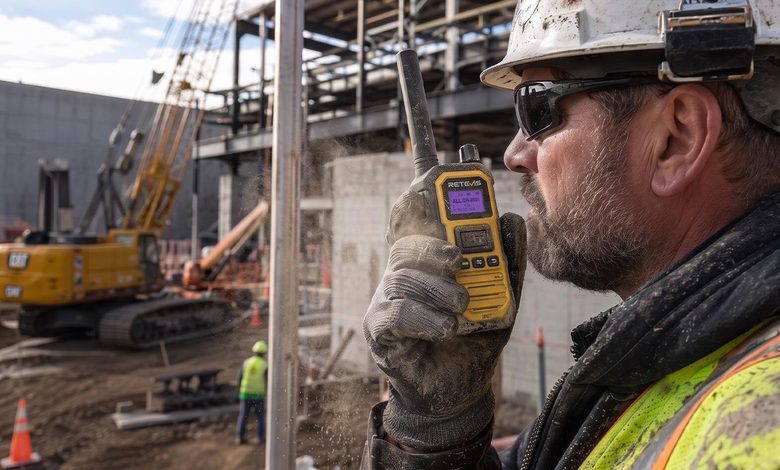
On a construction site, signals may encounter concrete floors, steel structures, heavy equipment and changing elevations.
Inside a manufacturing facility, machinery, walls and metal racks can create very different communication conditions.
That means maximum advertised range cannot describe every real-world deployment.
Reliable communication instead begins with understanding the environment.
Where are workers located?
Which teams need to communicate?
What physical barriers exist?
Where could coverage gaps affect operations?
Once those questions are answered, equipment can be selected around the site.
Three Dimensions of Reliable Industrial Communication
After 16 years in professional and consumer radio communication, RETEVIS is increasingly defining reliability across three dimensions:
Reliable Industrial Communication = Equipment Reliability + Coverage Reliability + System Reliability
Equipment Reliability
Industrial radios need to withstand the conditions in which they are used.
RETEVIS has developed aThree-Tier Industrial Reliability Standard that organizes requirements around Physical Durability, Environmental Resilience and Safety Assurance.
Products such as RETEVIS RB48 series have been tested with reference to MIL-STD-810H:2019 procedures across multiple durability and environmental conditions.
For potentially hazardous environments, ruggedness alone is not sufficient. Intrinsically safe equipment such as the ATEX- and IECEx-certified MateTalk E2 addresses a different level of operational risk.
Coverage Reliability
The second dimension is whether communication actually reaches the required work zones.
On smaller sites, handheld-to-handheld communication may be enough.
Larger or more structurally complex operations may require repeater-supported coverage.
Instead of selecting equipment based only on a maximum range figure, organizations can map the environment and identify potential communication gaps before deciding how the system should be deployed.
System Reliability
This leads to the third dimension.
The future of industrial communication is not simply a collection of individual radios. For larger facilities, manufacturing communication solutions can combine appropriate handheld radios with site-specific coverage and deployment planning.
Handheld radios, repeaters, channels, groups and deployment planning can increasingly be considered parts of one communication system.
For a large construction site, for example, professional handhelds such as rugged RETEVIS RB48 Plus can be combined with an RETEVIS RT97L portable repeater where additional coverage is required.
The specific combination depends on the site.
From Product Selection to Solution Design
This changes the buying process.
Instead of:
Choose Radio → Deploy
the process becomes:
Map Environment → Identify Communication Needs → Select Equipment → Add Coverage Support → Test → Deploy
The difference is important.
A powerful radio may still be unsuitable for a particular building or workflow.
A rugged radio may survive a difficult environment but fail to address a coverage gap.
And an intrinsically safe radio solves a different problem from a standard rugged device.
The operating environment determines the requirement.
What Comes Next?
As RETEVIS marks its 16th anniversary, the company is using Reliable as the foundation for its next stage of professional communication development.
The direction moves from:
Reliable Products → Industrial Standards → Scenario-Based Communication Solutions
Rather than treating reliability as one specification, the goal is to make it measurable at the equipment level and scalable across real operations.
RETEVIS plans to continue this direction at PMRExpo 2026 in Cologne, November 24–26, where industry professionals will be able to explore professional communication products and solutions for demanding working environments.
The evolution of industrial two-way radio communication is therefore not simply about talking farther.
It is about designing communication around where people actually need to stay connected.