Poxy Application in Opto-Mechanical Designs: Benefits and Engineering Challenges
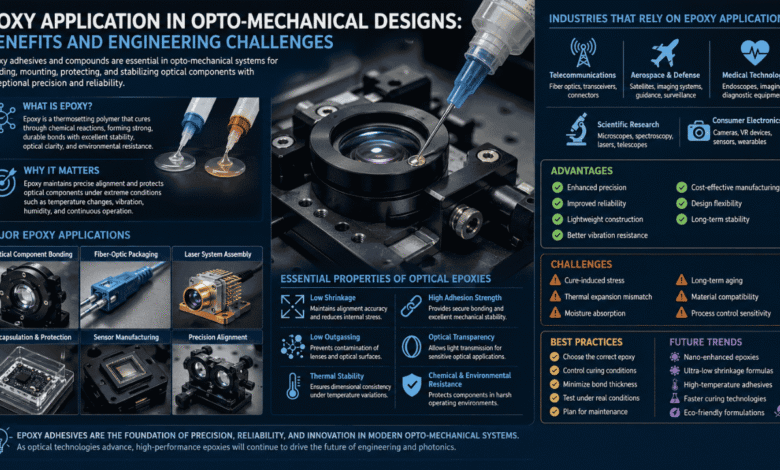
The poxy application in opto-mechanical designs has become an essential topic in modern optical engineering and photonics manufacturing. In most technical contexts, the term “poxy” refers to epoxy adhesives and compounds used in opto-mechanical systems. These specialised materials are essential for bonding, mounting, protecting, and stabilising optical components in precision instruments. Opto-mechanical systems combine optical elements with mechanical structures to create devices that manipulate, transmit, and detect light. Examples include cameras, telescopes, laser equipment, fibre-optic systems, medical imaging devices, and aerospace optical instruments. Because these systems demand extremely high precision and reliability, engineers frequently rely on epoxy materials to ensure structural integrity and maintain optical alignment. As optical technologies continue to evolve and become increasingly compact and sophisticated, the importance of epoxy applications in opto-mechanical designs continues to grow. This article explores the uses, advantages, applications, and challenges associated with epoxy materials in optical engineering.
Understanding Opto-Mechanical Designs
Opto-mechanical design is a specialised engineering discipline that focuses on integrating optical components with mechanical structures. The primary objective is to ensure that optical elements remain accurately aligned and protected throughout their operational life.
Opto-mechanical systems typically include:
- Lenses
- Mirrors
- Prisms
- Optical filters
- Image sensors
- Laser components
- Fiber-optic connectors
- Mounting assemblies
Since even minor misalignments can significantly affect performance, materials used in these systems must provide exceptional stability and precision. This is where epoxy adhesives become highly valuable.
What Is Epoxy in Opto-Mechanical Engineering?
Epoxy is a type of thermosetting polymer adhesive that cures through chemical reactions. Once cured, it forms a strong, durable bond that withstands environmental stress, vibration, and temperature changes.
Optical-grade epoxies are specifically formulated to meet the demanding requirements of precision optical systems. They may offer:
- High bonding strength
- Low shrinkage
- Optical transparency
- Thermal stability
- Chemical resistance
- Low outgassing properties
- Electrical insulation capabilities
These characteristics make epoxy one of the most widely used materials in opto-mechanical assembly processes.
Why Poxy Application in Opto-Mechanical Designs Is Important
The significance of the poxy application in opto-mechanical designs lies in its ability to preserve precise optical alignment while providing long-term reliability.
Optical systems often operate under challenging conditions, including:
- Extreme temperatures
- Mechanical vibrations
- Humidity
- Dust exposure
- Continuous operation
- High-power laser environments
Without reliable bonding materials, optical components can shift, degrade, or fail entirely. Epoxy helps overcome these challenges by maintaining component positioning and protecting sensitive optical assemblies.
Major Poxy Applications in Opto-Mechanical Designs
Optical Component Bonding
One of the most common applications of epoxy is bonding optical components to mechanical structures.
Examples include:
- Lens-to-mount bonding
- Mirror attachment
- Prism installation
- Filter assembly
- Optical window mounting
The adhesive creates a secure connection while maintaining the precise positioning necessary for accurate optical performance.
Proper bonding ensures:
- Reduced alignment errors
- Improved mechanical strength
- Long-term stability
- Resistance to vibration and shock
Fiber-Optic Packaging
Fibre-optic communication systems require precise assembly techniques. Epoxy plays a crucial role in packaging and stabilizing fiber-optic components.
Applications include:
- Fiber termination
- Connector assembly
- Optical fibre positioning
- Cable strain relief
- Package sealing
Low-shrinkage epoxies are particularly important because even microscopic movements can affect signal transmission efficiency.
Laser System Assembly
Modern laser systems rely heavily on epoxy materials during manufacturing and packaging.
Epoxy is commonly used for:
- Laser diode mounting
- Beam alignment structures
- Optical sensor packaging
- Coupler assembly
- Semiconductor laser packaging
Specialised optical epoxies are often chosen for their excellent dimensional stability and thermal resistance.
Encapsulation and Environmental Protection
Optical and electronic components are often vulnerable to environmental damage.
Epoxy encapsulation protects components from:
- Moisture
- Corrosion
- Dust particles
- Chemical exposure
- Mechanical impact
- Vibration
Encapsulation significantly improves the durability and operational lifespan of optical equipment.
Sensor Manufacturing
Various optical sensors require secure mounting and protection of sensitive components.
Epoxy is used in:
- Imaging sensors
- Infrared detectors
- Photodiodes
- Optical measurement systems
- Position sensors
These applications demand materials that maintain precision under varying operating conditions.
Essential Properties of Optical Epoxies
Low Shrinkage
Shrinkage during curing can cause optical misalignment. Therefore, optical-grade epoxies are engineered to exhibit minimal shrinkage.
Benefits include:
- Improved positioning accuracy
- Reduced internal stress
- Enhanced reliability
- Better optical performance
Low Outgassing
Some materials release gases over time. In optical systems, these gases can deposit contaminants onto lenses and mirrors.
Low-outgassing epoxies help maintain:
- Optical clarity
- Clean surfaces
- Stable performance
- Long-term reliability
Thermal Stability
Optical systems often experience temperature fluctuations. Materials with poor thermal characteristics may expand or contract excessively.
Thermally stable epoxies provide:
- Dimensional consistency
- Reduced stress
- Improved alignment retention
- Better environmental performance
High Adhesion Strength
Strong bonding is essential in high-precision optical assemblies.
High-adhesion epoxies offer:
- Secure component mounting
- Improved mechanical stability
- Better shock resistance
- Longer service life
Optical Transparency
Certain applications require adhesives that allow light to pass through.
Transparent optical epoxies are frequently used in:
- Optical sensors
- LED packaging
- Fiber-optic assemblies
- Imaging systems
Industries Using Poxy Application in Opto-Mechanical Designs
Telecommunications Industry
The telecommunications sector relies heavily on fibre-optic technologies.
Epoxy applications include:
- Fiber connectors
- Optical transceivers
- Signal transmission components
- Data communication equipment
Aerospace and Defense
Aerospace environments place significant demands on optical equipment.
Applications include:
- Satellite optics
- Surveillance systems
- Guidance systems
- Military imaging devices
- Space-based optical instruments
Medical Technology
Medical equipment increasingly depends on sophisticated optical systems.
Examples include:
- Endoscopes
- Surgical imaging devices
- Diagnostic equipment
- Optical scanners
- Laser treatment systems
Scientific Research
Research laboratories utilise highly precise optical instruments.
Epoxy applications include:
- Spectroscopy equipment
- Microscopes
- Telescopes
- Analytical instruments
- Experimental laser systems
Consumer Electronics
Many everyday electronic products incorporate optical technologies.
Examples include:
- Smartphone cameras
- Virtual reality devices
- Digital cameras
- Wearable electronics
- Smart sensors
Advantages of Poxy Application in Opto-Mechanical Designs
Enhanced Precision
Epoxy adhesives help maintain extremely accurate positioning of optical components.
Improved Reliability
Strong and stable bonding increases product durability and operational life.
Lightweight Construction
Epoxy bonding can reduce the need for heavy mechanical fasteners.
Better Vibration Resistance
Many optical systems operate in environments involving vibration and mechanical shock. Epoxy provides excellent vibration damping capabilities.
Cost-Effective Manufacturing
Adhesive bonding often simplifies assembly procedures and lowers manufacturing costs.
Design Flexibility
Engineers can create compact and innovative designs that may not be possible with traditional fastening methods.
Challenges of Using Epoxy in Opto-Mechanical Designs
Despite its many advantages, epoxy usage also presents several engineering challenges.
Cure-Induced Stress
During curing, internal stresses may develop, slightly altering the optical alignment.
Thermal Expansion Mismatch
Different materials expand at different rates. Mismatched expansion coefficients can introduce stress into optical assemblies.
Moisture Absorption
Certain epoxy formulations absorb moisture over time, potentially affecting performance.
Long-Term Aging
Extended exposure to environmental conditions may gradually alter material properties.
Material Compatibility
Engineers must carefully select adhesives that are compatible with:
- Glass
- Metals
- Ceramics
- Plastics
- Semiconductor materials
Improper material selection can lead to premature system failure.
Best Practices for Using Epoxy in Opto-Mechanical Systems
To achieve optimal performance, engineers typically follow several best practices:
Choose the Correct Epoxy
Adhesive selection should consider:
- Operating temperature
- Optical requirements
- Environmental conditions
- Mechanical loads
Control Curing Conditions
Proper curing procedures help minimise stress and improve bond quality.
Minimise Bond Thickness
Thin adhesive layers often provide greater dimensional stability.
Conduct Environmental Testing
Testing under expected operating conditions helps verify long-term reliability.
Consider Future Maintenance
Designs should account for inspection, servicing, and replacement requirements whenever possible.
Future Trends in Poxy Application in Opto-Mechanical Designs
As optical technologies continue to advance, epoxy formulations are evolving as well.
Emerging trends include:
- Nano-enhanced epoxies
- Ultra-low shrinkage formulations
- High-temperature optical adhesives
- Faster curing technologies
- Environmentally friendly formulations
- Advanced encapsulation materials
The rapid growth of artificial intelligence, autonomous vehicles, advanced medical devices, and photonic computing is expected to increase demand for highly specialised optical adhesives.
Conclusion
The poxy application in opto-mechanical designs is a fundamental aspect of modern optical engineering. Epoxy materials provide the strength, stability, and precision necessary for assembling and protecting sophisticated optical systems. Their applications range from fibre-optic packaging and laser assembly to sensor manufacturing and aerospace instrumentation.
You May Also Read: CFLOP-Y44551/300: The Game-Changing Technology Powering the Future of Computing