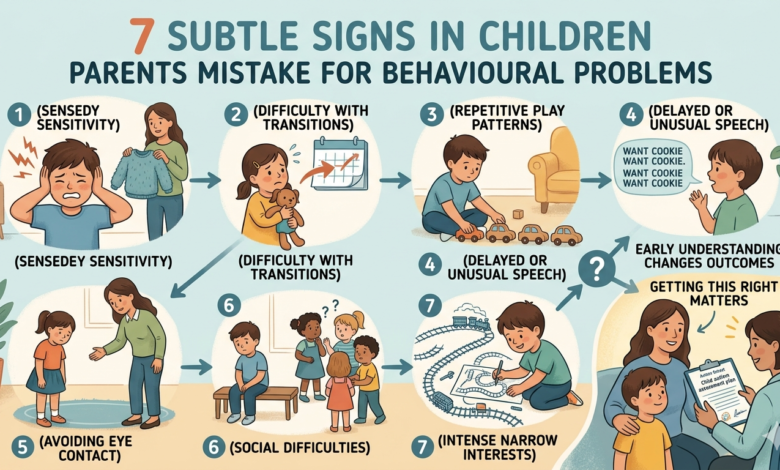
7 Subtle Signs in Children That Parents Often Mistake for Behavioural Problems
Every parent has been there: standing in a supermarket aisle, a school corridor, or a living room, wondering why their child is reacting so intensely to something that seems perfectly ordinary. A meltdown over a scratchy jumper. Refusing to make eye contact. Unable to follow instructions, even when explicitly and repeatedly told. It’s easy to chalk these moments up to stubbornness, shyness, or a “difficult phase.”
But sometimes, what looks like a behavioural problem on the surface is something else entirely. For some children, these patterns could be signals of autism, and early assessment can make an enormous difference. It can help them access the support they need to build an independent life.
Here are seven subtle signs that parents shouldn’t ignore.
1. Extreme Sensitivity to Textures, Sounds, or Lights
Your child refuses to wear certain clothes, covers their ears at everyday sounds, or melts down in brightly lit spaces. This is often labelled as fussiness or drama, but it can actually reflect sensory processing differences, which is a hallmark of autism.
2. Difficulty with Transitions and Unexpected Changes
Does your child get upset when a routine changes, even a small one, like taking a different route to school or having a substitute teacher? Parents often interpret this as inflexibility or a need to “control” things. In reality, a strong need for predictability and routine is a well-documented trait in autistic children.
3. Unusual or Repetitive Play Patterns
A child who lines up cars instead of racing them, or replays the same imaginary scene repeatedly, is sometimes described as “not playing properly.” But repetitive or structured play is not a problem; it may simply be a different way of engaging with the world. Autistic children often find deep focus and real comfort in repetitive activities.
4. Delayed or Unusual Speech Development
Some autistic children develop speech later than their peers. Others develop it on time but use language in unexpected ways, like repeating phrases from television (echolalia), speaking very literally, or struggling to hold a back-and-forth conversation. When these patterns persist and begin to affect daily communication, they deserve more than a wait-and-see approach. It is also worth noting that difficulties with focus and attention, which can look similar on the surface, have their own distinct causes. A child autism assessment with Autism Detect can provide clarity and rule out symptoms that may not be related.
5. Avoiding Eye Contact
This is frequently misread as rudeness, shyness, or social anxiety, but for many autistic children, making eye contact is genuinely difficult. It is not an intentional choice they’re making. If your child consistently avoids eye contact across different settings and with different people, it’s worth considering whether something more is happening beneath the surface with early autism assessment for children.
6. Social Difficulties That Go Beyond Introversion
Struggling to read facial expressions, missing social cues, and not understanding the unspoken rules of group play can look like bad manners or self-centredness. Teachers may flag a child as “not a team player”, and peers may find them hard to connect with. An autistic child isn’t being antisocial, they’re often genuinely trying to connect, but find social cues difficult to decode. The effort it takes can be exhausting, leading to withdrawal that’s then mistaken for aloofness.
7. Intense, Narrow Interests
Your child becomes completely absorbed in one topic, such as trains, numbers, a particular animal, a specific TV show, or anything they find interesting, to the point that they almost exclude everything else. These interests aren’t just hobbies. For many autistic children, they provide real comfort, a sense of mastery, and a way of making sense of the world. Dismissing them as obsessive or odd can inadvertently communicate to a child that the things that bring them joy are something to be ashamed of.
Why Getting This Right Matters
None of these signs, taken individually, confirms autism. But when several appear together, persist across different settings, and cause genuine difficulty in the child’s daily life, exploring further is far better than waiting for them to “grow out of it.”
Early understanding changes outcomes. When families know what’s actually happening, children can access the right support at school, home, or anywhere they go, before gaps become harder to close. If these patterns feel familiar, a child autism assessment with Autism Detect is a structured, specialist-led way to get real clarity. Replace guesswork with answers that actually help.
Noticing these signs isn’t stereotyping; it’s paying close attention. You’re not labelling your child by asking questions. You’re simply trying to understand them better, which is always the right instinct. The earlier a child is properly understood, the better equipped they are to thrive on their own terms, with the right support around them. If several of these patterns feel familiar, don’t dismiss them. Trust what you’re seeing, and take the next step with a child autism assessment at Autism Detect.