Localization for Security & Compliance Pages: Meeting Global Buyer Expectations
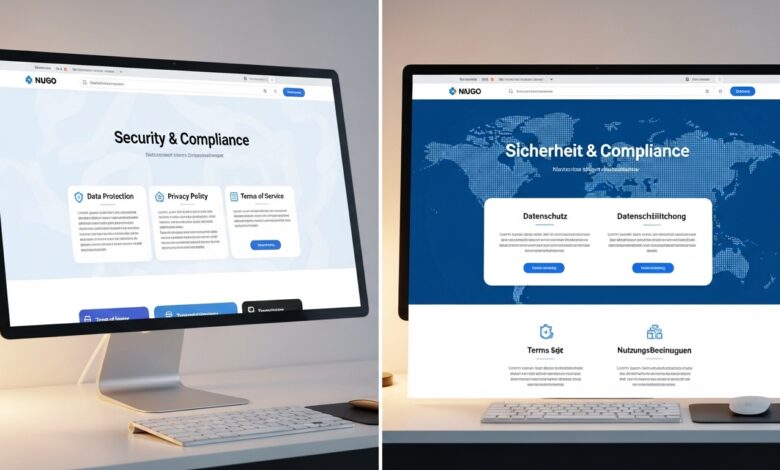
Enterprise buyers in 2025 don’t wait for a sales call to evaluate your security posture. Before they ever request a demo, procurement teams in Frankfurt, Tokyo, São Paulo, and Chicago are scrutinizing your trust center, cross-referencing your certifications, and checking whether your data protection claims align with their local regulations.
This shift has made localization for security content a strategic priority rather than a nice-to-have. When a German CISO lands on your security page and sees references to SOC 2 Type II, ISO/IEC 27001:2022, GDPR compliance, and Frankfurt-based data residency options – all in precise German legal terminology – they can move forward with confidence. When they find vague claims or awkward translations, they move on to a competitor who took the time to get it right.
This article is written from the perspective of a B2B SaaS vendor selling into multiple regions. The goal: remove friction from security reviews, shorten procurement cycles, and win more deals in regulated industries. In global product and trust ecosystems, saas content localization ensures that security, legal, and product messaging remain consistent across markets and compliance frameworks. Here’s what you need to know.
- Shorter sales cycles: Companies with well-localized trust centers report 2–4 weeks less time spent on security questionnaire follow-ups
- Higher win rates: Vendors have reported 20–30% improvements in win rates among EU finance customers after launching region-specific compliance content
What “Localization for Security & Compliance Pages” Actually Means
Marketing localization focuses on tone, brand voice, and cultural resonance. Security localization operates under different rules. Every claim you make about data protection, every certification badge you display, and every policy you publish will be scrutinized by CISOs, DPOs, legal counsel, and procurement teams who understand the technical and regulatory stakes.
The scope of security and compliance pages typically includes:
- Security overview or trust center landing page
- Certifications and attestations page (SOC 2, ISO 27001, penetration test summaries)
- Policy library: privacy policy, data processing agreement (DPA), cookie policy
- Incident response statements and status dashboards
- Regional addenda or jurisdiction-specific notices
Localization here means adapting language, jurisdiction references, regulatory context, and assurance expectations. It means linking to local supervisory authorities, disclosing local data centers, listing local subprocessors, and explaining cross border data transfers in terms that match how each region’s laws actually work.
Terminology must remain consistent with official norms. In GDPR, “controller” and “processor” have precise definitions under Article 4. In HIPAA, “covered entity” and “business associate” carry specific legal weight. In Brazil’s LGPD, “controlador” and “operador” have their own meanings. Translators who improvise synonyms create risk.
Core Principles: Accuracy, Consistency, and Risk Management
Localized security content is quasi-legal documentation. Errors can create exposure during audits, procurement red-lines, and breach investigations. A single mistranslation – claiming “ISO 27001 certified” when your audit scope only covers US operations, for example – can derail deals and trigger regulatory scrutiny.
Here are the principles that should guide every localized security page:
- Legal accuracy: Every regulatory reference must be verified. Cite “GDPR Article 28(3) processor obligations” or “UK GDPR and Data Protection Act 2018” with exact wording. Have legal counsel review translations of high-risk claims before publication.
- Terminology consistency: Terms like “SOC 2 Type II report,” “ISO/IEC 27001:2022 certification,” “Data Protection Officer,” “standard contractual clauses (SCCs),” and “binding corporate rules (BCRs)” must appear identically across all locales. Inconsistent usage triggers follow-up questions from security reviewers.
- Version control: Every security page should display a “Last updated” date (e.g., “Last updated: 15 January 2025”). When the English source changes, all localized versions should update within 24–48 hours for critical content.
- Alignment with actual controls: If your page claims “encryption at rest using AES-256” and “incident detection within 1 hour,” those must reflect your real operational capabilities. Localized assurance statements must match what your security team can actually demonstrate during audits.
Many SaaS vendors also support their security documentation with references to infrastructure compliance programs provided by cloud platforms. For example, major cloud providers publish detailed information about certifications, audit frameworks, and regional security controls through resources such as the Google Cloud compliance programs.
Localizing Security & Trust Content by Region
Enterprise buyers in different regions look for different signals. EU buyers focus on GDPR, international transfers, and supervisory authority oversight. US buyers prioritize SOC 2 and HIPAA. APAC buyers care deeply about data residency and sector-specific regulations. LATAM buyers want clarity on evolving privacy laws like LGPD.
This section breaks down what must be adapted for each major region and how your pages should present that information. Keep layouts consistent across regions, but allow for regional-specific callouts – local certification badges, authority links, and FAQs – to make content feel native and trustworthy.

EU & UK: GDPR, Schrems II, and Supervisory Expectations
EU and UK buyers expect explicit mention of Regulation (EU) 2016/679 (GDPR) and UK GDPR plus the Data Protection Act 2018. Your pages must clearly identify whether your organization acts as a controller or processor for different processing activities.
International data transfers require careful explanation. After Schrems II invalidated Privacy Shield in 2020, vendors must disclose their transfer mechanisms. This typically means:
- 2021 Standard Contractual Clauses (SCCs) for EU transfers
- UK International Data Transfer Agreement (IDTA) or Addendum for UK transfers
- EU–US Data Privacy Framework (DPF) self-certification, where applicable, with a note that legal challenges continue
Include a localized “Data Transfers & EU Hosting” subsection explaining which data centers handle EU customer data (Frankfurt, Dublin, Amsterdam), how data sovereignty is maintained, and what options exist for customers requiring data to be stored locally within the country’s borders.
Link to relevant supervisory authorities – CNIL in France, ICO in the UK, BfDI in Germany – and provide contact details for your Data Protection Officer or EU representative under Article 27.
Style guidance: Keep the tone formal and slightly more legal. Use short paragraphs. Include a small FAQ box addressing questions like “Where is my data stored?” and “What safeguards protect cross border data flows?”
North America: SOC 2, HIPAA, and Procurement Checklists
US and Canadian buyers often prioritize SOC 2 Type II reports covering Security, Availability, and Confidentiality trust service criteria. Procurement teams expect clear status and dates.
State this explicitly: “Current SOC 2 Type II report period: 1 July 2023 – 30 June 2024; audited by [CPA firm name], an AICPA-affiliated firm.”
If your product may process protected health information, address HIPAA alignment directly. Clarify that you offer Business Associate Agreements (BAAs) where applicable, but avoid claiming “HIPAA certified” – no such certification exists. Explain the scope: which parts of the product, which customer segments.
Include a bulleted “At a glance” panel listing concrete controls:
| Control | Details |
| Encryption at rest | AES-256 |
| Encryption in transit | TLS 1.2+ |
| Authentication | SSO/SAML 2.0, SCIM provisioning |
| Audit logs | 365-day retention |
| Backup & DR | RPO: 4 hours, RTO: 8 hours |
| Vulnerability scanning | Weekly automated scans |
North American buyers expect downloadable artifacts via your trust center: SOC 2 report, penetration test letter, cyber security overview PDF. Gate these behind an NDA or access request workflow, but make the process frictionless.
APAC: Data Residency, Sector Regulations, and Government Buyers
APAC is highly fragmented. Japan’s APPI (with amendments effective April 2022), Singapore’s PDPA, Australia’s Privacy Act, and India’s Digital Personal Data Protection Act 2023 all impose different data localization requirements. Sector-specific rules for financial data and government buyers add further complexity.
Outline your available data regions clearly:
- Tokyo for Japan-focused customers
- Singapore for Southeast Asia
- Sydney for Australia and New Zealand
- Mumbai for India
Clarify which data types are physically stored where and whether customers can elect “in-region only” processing data options that prevent data from leaving that particular country.
Add localized statements addressing common APAC concerns:
- Cross-border transfer mechanisms and legal basis
- Subcontractor and subprocessor vetting processes
- Ability to sign country-specific data processing terms for major enterprise clients
For highly regulated markets like Japan, include a small callout block referencing specific requirements – for example, “For Japanese customers: Processing complies with APPI amendments effective April 2022, including notification requirements for international transfers of personal data.”
Style guidance: Avoid overly Western legal idioms. Keep explanations practical and implementation-focused for technical evaluators accustomed to detailed compliance checklists.
LATAM and Other Emerging Markets: Clarity on Evolving Laws
Brazil’s LGPD (Lei Geral de Proteção de Dados), Mexico’s Federal Law on Protection of Personal Data Held by Private Parties, and evolving frameworks in Chile and Colombia create a complex web of data protection laws that mirror GDPR in some ways but differ in enforcement and scope.
Create a short “Regional Privacy Overview” subsection explaining how your global privacy program – likely built around GDPR or ISO 27701 – maps to LATAM requirements. This helps local procurement teams see that you’ve done the work, not just copied European compliance claims.
For localized Spanish and Brazilian Portuguese pages, avoid direct legalese translation from English. Use terminology that matches local guidance from authorities like Brazil’s ANPD. The term “titular de dados” resonates more than a literal translation of “data subject.”
State clearly whether citizen’s data is stored in regional data centers (e.g., São Paulo) or in nearby regions (e.g., US East), and what safeguards – encryption, SCCs, or other mechanisms – protect data if it leaves the country.
Use a simple FAQ format for LATAM markets:
- How do I withdraw consent?
- How long do you retain my data?
- What government access exists to my data?
- Which law regulates privacy in Brazil/Mexico?
Term Consistency and Glossaries for Security Localization
Inconsistent terminology across localized security pages – mixing “client” and “customer,” or “security audit” and “certification” – triggers follow-up questions from reviewers. These questions slow deals and signal sloppiness.
Build a master security and privacy glossary covering:
- SOC 2 Type II
- ISO/IEC 27001:2022
- ISO/IEC 27701:2025
- Data controller / data processor / subprocessor
- Personal data / sensitive personal data
- Pseudonymization
- Data subject rights
- Data retention periods
- Standard contractual clauses (SCCs)
- Binding corporate rules (BCRs)
Each target language needs a vetted glossary maintained jointly by InfoSec, legal, and localization teams. Reference authoritative sources: official EU translations of GDPR for European languages, ANPD guidance for Brazilian Portuguese, APPI translations for Japanese.
Lock specific phrases that translators should never alter: official law names, clause references, and certification titles. Use translation memory and term bases in your TMS tools to enforce consistency.
Review glossaries at least annually – or whenever major regulations change. The October 2025 revision of ISO/IEC 27701 into a standalone standard, for example, requires glossary updates across all locales.

Designing Trust Centers and Security Pages for Global Buyers
Trust centers have evolved from static pages into interactive hubs aggregating security documentation, certifications, policies, and real-time status dashboards. Design must support multiple locales without fragmenting the user experience.
Use a modular layout:
- Global hero section: Concise security value proposition, top-line certifications, and data security commitment
- Region-specific tabs or filters: EU/UK, North America, APAC, LATAM – each surfacing relevant frameworks and local infrastructure details
- Certification badges: Visual logos for SOC 2, ISO 27001, ISO 27701, CSA STAR – with localized captions describing scope and validity dates
Add a standardized “Resources” panel with localized document names:
- Data Processing Addendum (DPA) – EU/UK version
- DPA – US version
- SOC 2 Type II Executive Summary – English only
- Security Overview PDF – Available in 8 languages
Be transparent about which documents are only available in English. Buyers appreciate honesty about language limitations.
Localized forms for requesting security documents should comply with local consent norms. Clearly state who will receive the data (security team, sales team), how long you’ll retain it, and link to the appropriate privacy notice for each locale.
Operationalizing Updates: When Regulations and Certifications Change
Security and compliance language changes frequently. Certification cycles renew every 12–18 months. Regulatory guidance evolves. Transfer rules shift as courts and supervisory authorities weigh in. Your localized content must keep pace.
Key dates to note:
- ISO/IEC 27001:2022: Transition deadline was October 31, 2025. All certificates must now reference the 2022 version.
- ISO/IEC 27701:2025: Released October 14, 2025, as a standalone standard – no longer just an extension of ISO 27001.
- EU-US Data Privacy Framework: Adopted July 2023, with ongoing supervisory scrutiny and legal challenges.
Treat security and compliance pages as living documents:
- Maintain a formal change log (internal or public)
- Display a visible “Last updated” date on every locale
- Define SLAs for localization: English updates published within 24 hours of approval; top-tier languages (French, German, Japanese, Spanish, Portuguese) within 3–5 business days
Add a small “What’s new” section summarizing major changes: “October 2025: Completed ISO/IEC 27001:2022 transition; updated DPA to reflect new SCCs module; expanded APAC data center coverage.” Replicate these summaries across locales.
Preserve previous versions for legal and audit purposes. Ensure translators can see diffs to avoid re-translating unchanged content.
Scaling Security Content Localization Across Global Markets
Security localization must integrate with your broader content strategy. When discussing how to scale trust content alongside product documentation and marketing materials, the concept of saas content localization becomes essential – security, product, and legal narratives must scale together using shared infrastructure, glossaries, and workflows.
Triage languages and markets by revenue potential and regulatory enforcement risk:
| Tier | Markets | Localization Scope |
| Tier 1 | US, Germany, France, UK, Japan, Brazil | Fully localized trust centers, all policies, all certifications |
| Tier 2 | Spain, Canada, Australia, South Korea | Localized privacy pages, region-specific FAQs, key policies |
| Tier 3 | Other markets | High-quality English with localized headers and critical fragments |
Build reusable content blocks for common topics: encryption standards, incident response procedures, access controls, business continuity. Push updates consistently to all locales without rewriting from scratch.
Use a central TMS integrated with your CMS, with term bases and style guides specifically tailored for security and legal content. Avoid marketing-style paraphrasing that dilutes technical precision.
Measure impact:
- Reduction in time to complete security questionnaires
- Fewer follow-up questions about data residency and local laws
- Regional win rates before and after launching localized security pages
- Feedback from sales and legal teams on reduced procurement friction
Conclusion: Turning Localized Security Content into a Competitive Advantage
Localized security and compliance pages are now a core part of enterprise buying journeys. For large deals in finance, healthcare, and the public sector – where organizations operating under strict regulatory oversight must limit access to sensitive information – your trust center is often the first real evaluation checkpoint.
Success depends on combining legal precision, technical clarity, and culturally appropriate communication. This requires ongoing collaboration between legal, security, and localization teams, supported by rigorous update processes and clear ownership. When a buyer in Munich, Tokyo, or São Paulo lands on your security page, they should find exactly what they need to move forward confidently.
Treat trust content as a strategic asset. Design, localize, and measure it with the same discipline you apply to revenue-generating product pages. The payoff is shorter security reviews, fewer red-lines, and stronger long-term relationships with global businesses that value data governance and regulatory cooperation.
Looking ahead, regulations like EU NIS2, DORA, and evolving AI governance frameworks will add new layers of compliance complexity. Organizations that build a mature localization framework now – with glossaries, cross-functional workflows, and scalable content infrastructure – will be positioned to adapt faster than competitors still treating security content as an afterthought.
Start by auditing your current trust center against regional buyer expectations. The gaps you find today are the deals you’re losing tomorrow.