From Kerosene Lamps to LED Signals: The Complete Evolution of the Traffic Stoplight in America
Traffic management in American cities has never been simple. From the earliest days of horse-drawn carriages sharing cobblestone streets with electric streetcars, the challenge of directing movement safely through intersections has demanded practical, evolving solutions. What began as a public safety problem in a handful of industrial cities eventually became one of the most standardized systems in the country — present at nearly every major intersection, operating continuously, and trusted by millions of people every single day.
Understanding how signal technology developed over more than a century helps explain why modern traffic control is designed the way it is, and why changes to that infrastructure — even incremental ones — require careful planning and operational continuity. The history is not just interesting. It reflects real decisions made by engineers, municipalities, and transportation agencies responding to pressure, failure, and change.
The Origins of Traffic Signaling Before Electricity
The modern traffic stoplight did not emerge fully formed. It evolved from much simpler systems designed to address a basic problem: intersections with no reliable way to communicate right-of-way. In the mid-1800s, British railway engineers were already using semaphore signals — mechanical arms mounted on posts — to direct train movement. When congestion in cities like London became unmanageable, the same logic was applied to road traffic.
In 1868, a gas-powered signal was installed outside the British Houses of Parliament in London. It featured two semaphore arms that could be raised or lowered by a police officer, along with a red and green gas lamp for nighttime visibility. The system was short-lived — a gas leak caused an explosion that injured the officer operating it — but the concept proved its value. People responded to visible signals at intersections. The problem was making those signals reliable and scalable.
Why Mechanical Signals Had Structural Limits
Manually operated signals depended entirely on human presence. A police officer or signal operator had to be stationed at the intersection at all times, making continuous operation expensive and inconsistent. If the operator was distracted, absent, or managing an emergency, the system effectively stopped working. In cities where intersections numbered in the hundreds, the labor cost alone made mechanical signaling impractical at scale.
There was also the question of standardization. Different cities used different configurations. Some used semaphore arms, others used lanterns with colored glass. Drivers traveling between cities had no consistent framework for interpreting signals, which introduced its own risks. The absence of a shared visual language made the problem worse as vehicle volumes increased.
The Arrival of Electrical Signals in American Cities
The United States entered the traffic signal story at the beginning of the twentieth century, driven by the rapid adoption of the automobile. By 1910, vehicles were common enough in major cities that intersection management had become a genuine public safety crisis. Police officers standing in the middle of busy crossings were both ineffective and endangered.
The first known electric traffic signal in the United States was installed in Cleveland, Ohio, in 1914. It was a two-color system using red and green lights, controlled manually from a booth. A buzzer sounded before the color changed to give drivers a brief warning. Salt Lake City and New York City followed with their own early installations, each slightly different in design but aligned on the core idea: a fixed, visible signal that drivers could learn to obey without needing an officer present at every crossing.
The Three-Color System and Its Adoption
The addition of yellow as a transitional warning signal represented a significant operational improvement. Two-color systems created an abrupt switch between stop and go, giving drivers no preparation time. Yellow — placed between red and green — introduced a brief interval during which drivers could reasonably decide whether to stop or clear the intersection. This reduced both collision risk and the sudden braking patterns that caused rear-end accidents.
Garrett Morgan, an inventor in Cleveland, is widely credited with patenting an improved three-position traffic signal in 1923. His design added a neutral position that halted traffic in all directions simultaneously, which gave pedestrians and cross-traffic a clearer and safer window. While not identical to the modern three-light system, it addressed a practical gap that two-color signals left open. According to records held by the Library of Congress, Morgan’s patent influenced subsequent federal standardization efforts that shaped traffic signal design throughout the following decades.
Federal Standardization and the Push Toward Uniformity
By the 1930s, the United States had hundreds of cities operating traffic signals, but almost no consistency in how those signals were designed, timed, or positioned. Colors varied. Mounting heights differed. Some signals were horizontal, others vertical. Drivers moving between jurisdictions faced genuine confusion, and transportation agencies recognized that inconsistency was itself a safety hazard.
The federal government responded with the first edition of the Manual on Uniform Traffic Control Devices, published in 1935. The manual established national guidelines for signal placement, color sequencing, and timing intervals. It was not an overnight transformation — cities had existing infrastructure and budget constraints — but the framework it created became the foundation for everything that followed. Successive editions of the manual refined and expanded those standards as vehicle volumes increased and road design evolved.
How Standardization Changed Operations at the Local Level
For city transportation departments, standardization meant that maintenance crews could be trained on a consistent set of equipment. Replacement parts could be sourced from multiple manufacturers because specifications were shared. Signal timing could be coordinated across corridors rather than managed intersection by intersection. The operational benefits extended beyond aesthetics — uniform systems reduced the margin for error during maintenance, installation, and emergency response.
Standardization also shaped how contractors and traffic engineers approached signal projects. When every signal followed a known configuration, inspections were faster, permitting was more predictable, and coordination with utility providers became more straightforward. The reduction in variables had a direct effect on project timelines and public safety outcomes during construction and repair windows.
From Incandescent Bulbs to LED Technology
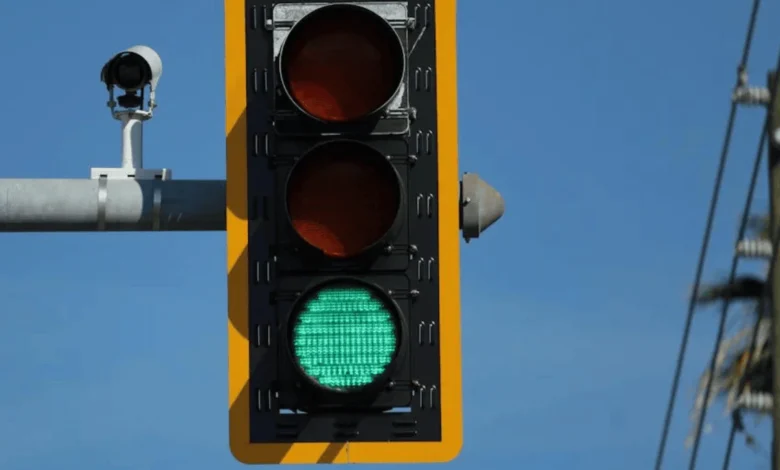
For most of the twentieth century, traffic signals used incandescent bulbs — the same basic technology found in household lighting. These bulbs were inexpensive to produce but had significant operational drawbacks. They burned out frequently, required regular replacement schedules, consumed substantial electricity, and generated heat that shortened the lifespan of signal housings over time. In cold climates, the heat they produced also helped prevent snow and ice buildup on signal lenses, which created an unexpected problem when more efficient alternatives arrived.
LED technology entered the traffic signal market in the 1990s. Light-emitting diodes had been used in electronics for decades, but advances in brightness and color accuracy made them viable for outdoor traffic applications. Early LED signal modules were more expensive to purchase than incandescent alternatives, but transportation agencies quickly found that the long-term economics justified the switch.
The Operational Case for LED Signals
The transition to LED signals was not primarily about energy savings, though those savings were real and measurable. The more significant operational advantage was reliability. LED modules last significantly longer than incandescent bulbs, which reduced the frequency of maintenance calls and the risk of dark signals at active intersections. A burned-out signal — even a single color — creates a legal and safety complication that agencies must respond to immediately. Fewer failures meant fewer emergency responses and a more consistent experience for drivers.
LED signals also offered better daytime visibility. Their directional light output made signals easier to read in direct sunlight, which was a known limitation of incandescent systems. The reduction in solar washout — a condition where bright sunlight made signal colors difficult to distinguish — addressed a real safety gap that had existed for decades without a practical solution.
Smart Signals and Adaptive Control Systems
The most recent phase of traffic signal development moves away from fixed timing toward systems that respond to real-time conditions. Adaptive signal control technology uses sensors, cameras, and data processing to adjust cycle timing based on actual traffic volumes. Rather than running on a preset schedule regardless of conditions, these systems can extend green phases when traffic is heavy, shorten them when intersections are clear, and coordinate timing across multiple signals along a corridor.
Adaptive systems are not universally deployed. They require significant infrastructure investment, ongoing calibration, and technical expertise to manage. Most American intersections still operate on fixed or semi-actuated timing plans, which use basic sensors to detect vehicle presence but do not adapt dynamically to broader traffic patterns. The gap between available technology and widespread implementation reflects the financial and operational realities that most municipal transportation agencies work within.
What Adaptive Systems Reveal About Infrastructure Complexity
The introduction of adaptive control has made it clear that traffic signal systems are no longer purely mechanical infrastructure. They are now part of a broader data and communications network. Signals communicate with central management systems, relay performance data, and in some configurations interact with emergency vehicle preemption systems that clear intersections ahead of responding units.
This complexity changes the nature of maintenance and replacement decisions. A failed signal in an adaptive network is not just a hardware problem — it can disrupt timing coordination across an entire corridor. Planning for that kind of failure requires different operational protocols than the incandescent era ever demanded.
Conclusion: What the History of Traffic Signals Tells Us About Infrastructure Decision-Making
The evolution of the traffic stoplight across more than a century reflects something consistent: each major transition — from manual to electric, from two-color to three-color, from incandescent to LED, from fixed to adaptive — was driven by the limitations of the previous system under real operating conditions. Innovation did not happen in isolation. It happened because failures were visible, costs were measurable, and the consequences of unreliable infrastructure were immediate and public.
For transportation agencies, municipalities, and contractors working in traffic control today, that history carries a practical lesson. The systems being installed and maintained now will eventually be replaced by something better, just as every previous generation of equipment has been. The decisions worth making carefully are the ones that affect reliability, consistency, and public safety in the present — not in anticipation of some future standard, but in response to the operational demands that exist today.
Understanding where the technology came from, and why each design choice was made, helps the people responsible for maintaining it make better decisions about when to upgrade, when to repair, and how to plan for continuity when systems change. That context is not academic. It is a working part of infrastructure management.