RLP Letter: What It Means, Why You Received One, and What to Do Next
Receiving an RLP letter can be confusing and stressful, particularly if you have never heard of Retail Loss Prevention before. People who receive these letters often have questions about why they were contacted, how much money is being requested, whether the letter is connected to criminal proceedings, and what could happen if they do not respond.
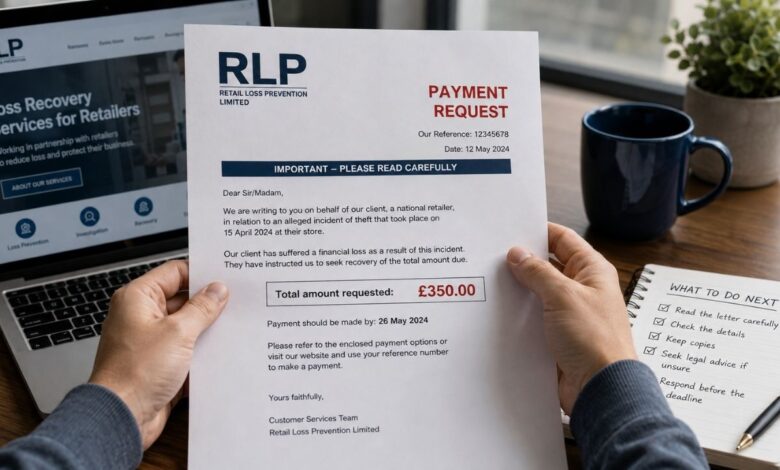
An RLP letter is generally associated with Retail Loss Prevention Limited (RLP) and claims involving alleged losses suffered by retailers. The correspondence may ask the recipient to pay a specified amount, often described in terms of civil recovery. RLP’s official website provides information about its services and payment process, including the use of a reference number on its correspondence.
This article explains the RLP letter in straightforward terms, discusses why such correspondence may be sent, and outlines some practical considerations for anyone who receives one.
What Is an RLP Letter?
An RLP letter is correspondence associated with Retail Loss Prevention Limited that generally concerns an alleged retail-related loss. It may be sent following an incident at a shop or other retail premises where the retailer believes it has suffered a financial loss.
The letter may contain information about the alleged incident and request payment of a specific amount. Depending on the circumstances, the claimed amount may exceed the value of the goods allegedly involved because the claim may include other losses or costs.
It is important to read the specific document carefully because not every letter contains the same information or has the same legal significance.
Why Might You Receive an RLP Letter?
A person might receive an RLP letter after a retailer alleges that an incident caused it a financial loss.
For example, the correspondence could follow an incident involving suspected shoplifting or another event that the retailer believes resulted in loss. The retailer may provide information about the incident to a loss-recovery service.
The letter may then be sent to the person the retailer believes was responsible.
Receiving such a letter does not, by itself, mean that a criminal conviction has occurred. Civil recovery and criminal proceedings are separate matters, and the exact circumstances of an individual case are important.
What Is Retail Loss Prevention Limited?
Retail Loss Prevention Limited, commonly known as RLP, provides loss-recovery services to retailers.
Its website contains information for people who have received correspondence from the company, including payment-related information. RLP states that its correspondence includes a case or reference number that can be used when dealing with a payment.
Because information and procedures can change, anyone dealing with an RLP matter should examine the current correspondence and official information rather than relying exclusively on old online discussions.
What Does an RLP Letter Usually Contain?
The precise contents vary, but an RLP letter may include several important details.
These can include:
- The recipient’s name and address
- The name of the retailer
- An alleged incident date
- A case or reference number
- Details concerning the alleged loss
- The amount being requested
- Payment instructions
- A deadline
- Information about what may happen if the matter remains unresolved
Before taking any action, it is sensible to read the entire letter carefully.
The reference number is particularly important because it can help identify the specific case when communicating with RLP.
How Much Money Can an RLP Letter Request?
There is no single standard amount that applies to every RLP letter.
The amount can depend on the circumstances of the alleged incident and the losses being claimed. Some consumer discussions describe demands that are considerably higher than the value of the goods involved.
This can lead recipients to ask why a retailer or recovery company is requesting more than the merchandise’s apparent value.
The explanation may relate to additional losses or costs claimed by the retailer. However, the precise legal basis for any particular amount depends on the individual case.
For that reason, recipients should not assume that a requested amount is automatically correct simply because it appears in a letter. At the same time, they should not automatically assume that it has no legal significance.
Is an RLP Letter a Criminal Fine?
One of the most important distinctions to understand is that an RLP letter is not automatically equivalent to a criminal fine.
A criminal fine is generally imposed through a criminal justice process. An RLP demand is generally presented in the context of civil recovery.
These are different legal concepts.
A person can therefore receive correspondence seeking civil recovery without that correspondence itself constituting a criminal conviction or a court-imposed fine.
However, circumstances can vary. If the police, courts, or another authority is involved, there may be separate proceedings or obligations. Anyone who receives official court paperwork should treat it seriously and obtain appropriate advice.
Is an RLP Letter the Same as Court Papers?
No. An ordinary demand or recovery letter is not necessarily the same as formal court documentation.
This distinction matters because people sometimes assume that every letter demanding money is a court document.
If an RLP letter contains information about a possible future legal action, that is different from actually receiving formal documents issued through a court.
Readers should carefully check what they have received rather than relying on the letter’s appearance or tone.
If genuine court paperwork arrives, deadlines and procedural requirements can apply. Ignoring court documents can create additional problems.
What Should You Do After Receiving an RLP Letter?
There is no universal response that is appropriate for every situation. However, several sensible steps can help you understand the matter.
Read the Letter Carefully
Start by reading the complete document. Identify the retailer, alleged incident, claimed amount, reference number, and response deadline.
Do not focus only on the amount requested.
Keep Copies of Everything
Keep the original RLP letter and make copies or digital records of related correspondence.
If you communicate with RLP or another organization about the matter, retain records of those communications.
Check the Details
Look at the factual information in the letter. Consider whether the date, retailer, amount, and other details appear accurate.
If something appears incorrect, make a note of the discrepancy.
Avoid Making Unnecessary Admissions
When people become worried after receiving an RLP letter, they may respond immediately without fully understanding what they are saying.
It is sensible to think carefully before making statements about an alleged incident, particularly where there could be separate legal consequences.
For complicated circumstances, professional legal advice can be useful.
Consider Getting Legal Advice
If the amount is substantial, the allegations are disputed, or you are unsure about your rights and obligations, consider speaking with a qualified solicitor or an appropriate consumer/legal advice organization.
A professional can assess the actual letter and circumstances rather than providing generic internet advice.
What Happens If You Ignore an RLP Letter?
This is one of the most frequently searched questions surrounding the RLP letter keyword.
Online discussions encompass diverse experiences, but there is no single, universally applicable answer.
Ignoring correspondence does not necessarily make a claim disappear. Depending on the circumstances, further letters or collection activity may follow.
On the other hand, the legal consequences of ignoring a particular demand depend on what the letter actually is and whether further formal action is taken.
The safest approach is to understand the nature of the correspondence and any applicable deadlines rather than assuming that ignoring it is always harmless.
Can an RLP Letter Affect Your Credit Score?
Another common concern is whether an RLP letter automatically damages a person’s credit record.
Receiving a demand letter by itself should not simply be treated as equivalent to an automatic credit-record entry.
Credit reporting depends on the relevant circumstances, the organizations involved, the nature of any account or debt, and applicable rules.
Therefore, it is better to avoid broad claims such as “every RLP letter damages your credit score.” Anyone concerned about their credit file should check the specific circumstances and obtain appropriate advice.
What If the Amount in the RLP Letter Seems Too High?
A recipient may believe that the requested amount is disproportionate to the value of the goods involved.
For example, someone might see a demand for several hundred pounds when the alleged merchandise was worth substantially less.
Rather than assuming that the amount is automatically valid or automatically invalid, examine how the claim is described.
Look for information explaining the basis of the amount. If the calculation is unclear, the recipient can seek professional advice about the claim and appropriate response.
RLP Letter and Debt Collection
Some people who receive an RLP letter later receive further correspondence regarding the collection of the claimed amount.
This is another reason to keep all documents together.
If a different organization contacts you, check the correspondence for any reference to the original claim and keep copies of both the original RLP material and the subsequent communications.
Do not assume that a new letter automatically creates a new debt. Instead, identify what claim the new correspondence is referring to.
Common Questions About an RLP Letter
What does RLP stand for?
RLP commonly refers to Retail Loss Prevention Limited, a company associated with loss-recovery services for retailers.
Why did I receive an RLP letter?
You may have received one because a retailer has alleged that you were involved in an incident that caused a financial loss and has referred the matter for recovery.
Is an RLP letter a criminal conviction?
No. An RLP demand should not automatically be confused with a criminal conviction or criminal fine.
Does every RLP letter require immediate payment?
The appropriate response depends on the circumstances and the contents of the correspondence. Carefully review the letter and consider professional advice if you are uncertain.
Can RLP take someone to court?
The possibility of further legal action depends on the individual circumstances and the nature of the claim. A demand letter itself should not be confused with actual court proceedings.
Should I keep the RLP letter?
Yes. Keep the original letter and records of any subsequent correspondence.
Why It Is Important to Avoid Internet Myths
The topic of the RLP letter generates significant discussion on forums and social media. Some people share personal experiences, but individual experiences do not necessarily establish what will happen in every case.
Legal rules can also change, and circumstances differ between cases.
For this reason, online articles should be used as general information rather than a substitute for professional legal advice.
A reliable article should distinguish between verified information, personal experiences, and legal conclusions.
Final Thoughts on an RLP Letter
An RLP letter is generally associated with a civil recovery claim connected to an alleged retail loss. Receiving one can understandably raise questions about payment, legal responsibility, court action, debt collection, and possible consequences.
You May Also Read: Civil National Business Centre Reviews: What People Are Saying About the UK’s Central Court Hub