Fascisterne: Meaning, History, Fascism, and Its Role in Denmark
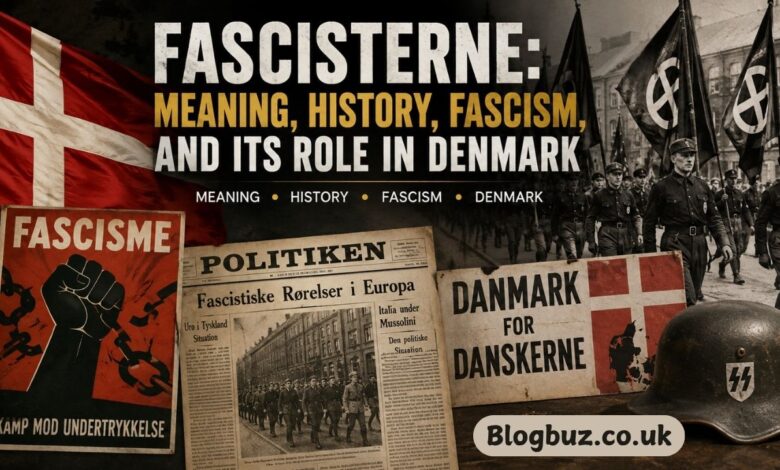
The word fascisterne is a Danish term that translates into English as “the fascists.” It is the definite plural form of fascist and is commonly used when referring to people who support or identify with fascism. The term can appear in historical discussions, political writing, journalism, and conversations about authoritarian movements.
Understanding fascisterne requires more than simply translating the word. The term is connected to the broader history of fascism, a political movement that became particularly influential in Europe between the First and Second World Wars. Fascist movements promoted intense nationalism, authoritarian leadership, political repression, and opposition to democratic institutions. In Denmark, related movements existed during the interwar period and the German occupation, although Denmark developed differently from countries where fascist parties took full control of government.
This article explores the meaning of fascisterne, the origins of fascism, its development in Europe, Danish fascist and National Socialist movements, and why the word continues to appear in modern discussions.
What Does Fascisterne Mean?
In Danish, fascisterne is the definite plural form of fascist. In simple English, it means “the fascists.”
According to Den Danske Ordbog, a fascist is a supporter of fascism. The dictionary also records a broader, transferred meaning referring to a person associated with strongly right-wing and nationalist ideas or authoritarian suppression of people with different opinions.
The grammatical structure is straightforward:
- fascist = a fascist
- fascisten = the fascist
- fascister = fascists
- fascisterne = the fascists
The word “therefore” does not necessarily identify a specific organization. Its meaning depends on the historical or political context in which it is used.
The older Ordbog over det Danske Sprog also documents historical Danish uses of fascisterne, including references to fascists taking power in Italy and to fascist movements during the 1920s and 1930s.
What Is Fascism?
To understand fascisterne, it is essential to understand fascism itself.
Fascism is a political ideology and movement associated with authoritarian government, extreme nationalism, political violence, suppression of opposition, and the rejection or weakening of liberal democratic institutions. Den Danske Ordbog describes fascism as a political movement that places the state and the people above the individual and uses dictatorial methods against democratic principles. It specifically notes the importance of fascism in Italy, Germany, and Spain during the interwar period.
Fascism has taken different forms in different countries, so historians generally avoid treating every authoritarian or nationalist movement as identical. Nevertheless, several characteristics frequently appear in historical definitions of fascism.
These can include:
- Strong or dictatorial leadership
- Extreme nationalism
- Opposition to liberal democracy
- Suppression of political opponents
- Political violence and intimidation
- Glorification of national unity
- Hostility toward perceived internal enemies
- Mass political mobilization
- Restrictions on freedom of expression and political organization
These characteristics help explain why the term fascist carries such significant historical meaning.
The Origins of Fascism
Modern fascism developed in Europe after the First World War. Italy became the most important early example.
Benito Mussolini established the Italian Fascist movement and eventually transformed it into a powerful political force. Mussolini’s movement emphasized nationalism, discipline, centralized leadership, and opposition to socialist and liberal political movements.
The political and economic instability that followed the First World War created an environment in which radical political movements could attract supporters. Economic difficulties, social unrest, fears of revolution, and dissatisfaction with existing political systems contributed to the growth of extremist movements.
Fascism was not simply a response to one event. It developed through a combination of political, economic, social, and cultural circumstances.
Fascist Europe and Italian Fascism
Italy is central to the history of fascisterne because the modern political meaning of fascism developed there.
Mussolini’s Fascist Party eventually gained control of the Italian state. Fascist Italy rejected political pluralism and concentrated power around Mussolini and the Fascist regime.
The Italian example later influenced political movements in other European countries. However, influence did not always mean that every movement copied Italian fascism exactly. Different groups adapted fascist or authoritarian ideas to their own national circumstances.
The historical importance of Italy is also reflected in Danish dictionary records, which contain examples referring to fascists taking power there.
Fascisterne and Germany
The history of fascisterne is also closely associated with Germany, although historians distinguish between Italian Fascism and German National Socialism.
The Nazi movement developed its own ideology centered on racial hierarchy, antisemitism, dictatorship, territorial expansion, and racial persecution. Adolf Hitler and the National Socialist German Workers’ Party established a totalitarian regime after taking power in 1933.
In everyday language, fascism and Nazism are sometimes treated as interchangeable. Historically, however, they are related but distinct phenomena. National Socialism was Germany’s specific form of far-right dictatorship, while fascism originated earlier in Italy.
The distinction is important when writing about fascisterne, especially in a historical context.
Fascisterne in Denmark
Denmark had fascist and National Socialist movements during the interwar period. One of the most significant organizations was the Danmarks Nationalsocialistiske Arbejderparti (DNSAP), or National Socialist Workers’ Party of Denmark.
DNSAP was founded in 1930 and became the most important Danish National Socialist organization. German National Socialism strongly influenced its ideology.
During the German occupation of Denmark from 1940 to 1945, the far right’s political position became particularly significant. Danish National Socialists attempted to increase their influence, while the established political system continued to operate under extremely difficult circumstances.
Historical material from Danmarkshistorien.dk describes how the Danish political system came under pressure during the occupation and notes the role of the DNSAP and other far-right forces.
Frits Clausen and DNSAP
Frits Clausen was the leading figure of the DNSAP during the 1930s and occupation period.
Clausen opposed parliamentary democracy and promoted a political system based on authoritarian leadership and National Socialist principles. Historical educational material from Danmarkshistorien.dk reproduces and discusses a speech manuscript attributed to Clausen, which presents his criticism of parliamentary government.
This historical evidence helps explain why Danish discussions about fascisterne frequently overlap with discussions about DNSAP and Danish National Socialism.
It is nevertheless important to distinguish between the broader category of fascism and the specific ideology of Danish National Socialism.
Why Fascisterne Did Not Take Full Power in Denmark
Although Denmark had fascist and National Socialist organizations, they did not establish a fascist dictatorship comparable to Mussolini’s Italy or Hitler’s Germany.
Several factors contributed to this difference.
Denmark had an established parliamentary political system and relatively strong democratic institutions. Major political parties continued to command substantial support. During the German occupation, the Danish government initially pursued a policy of cooperation with the occupying power while attempting to preserve as much Danish political autonomy as possible.
The Danish National Socialist movement never achieved the level of electoral dominance necessary to control the country independently.
This distinction is important because simply identifying the existence of fascisterne in Denmark does not mean Denmark itself became a fascist state.
Fascisterne During World War II
The Second World War dramatically changed the political environment in Denmark.
Germany occupied Denmark in April 1940. The occupation created difficult choices for Danish politicians, institutions, businesses, and ordinary citizens.
During the occupation, Danish National Socialists hoped that Germany’s dominance would create opportunities for their movement. However, their political influence remained limited compared with the German Nazi regime.
At the same time, resistance to the German occupation and collaboration gradually became important parts of Danish society. As the war progressed, resistance activities increased, and public attitudes toward collaboration changed.
The history of fascism in Denmark during this period, therefore, cannot be separated from the broader story of occupation, collaboration, resistance, and the survival of Danish political institutions.
Fascism and Democracy
One of the central themes in the study of fascism is the relationship between fascism and democracy.
Fascist movements historically criticized parliamentary systems as weak, divided, or ineffective. They often argued that a nation required a strong leader and unified political direction.
In practice, fascist governments typically weakened or eliminated political competition, restricted civil liberties, controlled information, and suppressed opponents.
The Danish historical record provides examples of National Socialist criticism of parliamentary government.
This is why the study of fascism is closely connected to discussions about democratic institutions. Elections, independent media, political opposition, legal protections, and civil liberties are important mechanisms for preventing political power from becoming concentrated without accountability.
Fascism and Nationalism
Nationalism is another important element in understanding fascist movements.
Fascist organizations frequently presented themselves as defenders of the nation. They emphasized unity, national identity, loyalty, and collective strength.
However, fascist nationalism often went beyond ordinary patriotism. It could define certain groups as enemies or outsiders and demand conformity from citizens.
This distinction matters because nationalism itself is not synonymous with fascism. People can hold patriotic or nationalist beliefs without supporting authoritarian government or political repression.
Understanding the difference helps prevent the term fascisterne from becoming too broad and losing its meaningful historical value.
Fascisterne and Political Violence
Political violence has played an important role in the history of fascist movements.
Early fascist movements sometimes used organized groups to intimidate political opponents, disrupt meetings, and demonstrate strength in public spaces. Violence could become part of a broader political strategy designed to discourage opposition and create fear.
The historical record preserved by Danish dictionaries even includes references to fascist street disturbances in Denmark during the 1920s.
This illustrates that fascism was not simply an abstract collection of political ideas. In several historical contexts, fascist movements were associated with organized political confrontation and violence.
Fascisterne and Antifascism
The opposite of fascism is often discussed through the concept of antifascism.
In Danish, antifascist refers to someone who opposes fascism and authoritarian far-right ideas. Den Danske Ordbog defines antifascist as an opponent of fascism and right-radical authoritarian attitudes.
Historically, antifascist movements appeared in many European countries. Their participants included socialists, communists, liberals, trade unionists, conservatives, anarchists, and others who opposed fascist organizations.
The relationship between fascists and antifascists could become highly confrontational, particularly during periods of political instability.
How the Word Fascisterne Is Used Today
Today, fascisterne can have both a historical and contemporary meaning.
In historical writing, the term usually refers to identifiable supporters of fascist movements. For example, a historian might discuss Italian Fascists, Danish fascists, or fascist organizations during the interwar period.
In everyday political language, however, the word can be used more loosely. Someone may call an authoritarian political opponent a “fascist” even when the person does not belong to a historical fascist movement.
Den Danske Ordbog recognizes this broader transferred usage, describing it in connection with strongly right-wing and nationalist ideas or authoritarian suppression of people with different opinions.
Because of this broader meaning, context is extremely important.
Fascisterne as a Historical Search Term
For people searching for fascisterne, the keyword can lead to several types of information.
A reader may want to know:
- What does fascisterne mean?
- Is fascisterne a Danish word?
- Who were the fascisterne?
- What was fascism?
- Who were the Danish fascists?
- What was DNSAP?
- What happened to Danish fascists after World War II?
- How were fascists different from Nazis?
- What was antifascism?
- How did fascism affect European history?
A useful educational article should answer these questions without treating every far-right political movement as identical.
The Difference Between Fascism and Nazism
One of the most common sources of confusion is the relationship between fascism and Nazism.
Fascism developed first in Italy under Mussolini. National Socialism developed in Germany under Hitler and shared several authoritarian and ultranationalist characteristics with Italian Fascism.
However, Nazism placed an especially central emphasis on racial ideology and antisemitism.
The terms therefore overlap historically but should not automatically be treated as exact synonyms.
Danish historical dictionaries also distinguish terminology such as fascist, nazist, nationalsocialist, and related expressions.
Why Studying Fascisterne Still Matters
Studying fascisterne is important because history provides an opportunity to understand how authoritarian movements can challenge democratic societies.
Historical fascist movements demonstrate how political instability, economic hardship, social divisions, propaganda, nationalism, and dissatisfaction with existing institutions can create opportunities for extremist organizations.
The subject also demonstrates the importance of distinguishing political rhetoric from historical evidence.
Learning about fascism does not mean labeling every controversial political opinion as fascist. Instead, historical analysis requires examining specific ideas, organizations, actions, leadership structures, and relationships to democratic institutions.
Frequently Asked Questions About Fascisterne
What does fascisterne mean?
Fascisterne is a Danish word meaning “the fascists.” It is the definite plural form of fascist.
Is fascisterne a Danish word?
Yes. The word is used in Danish, and historical Danish dictionaries document its usage.
Who were the fascisterne?
The exact meaning depends on context. Historically, it can refer to supporters or members of fascist movements, particularly in discussions of European political history.
Were there fascists in Denmark?
Yes. Denmark had fascist and National Socialist organizations during the interwar period and the German occupation. DNSAP was the most prominent Danish National Socialist party.
Is fascism the same as Nazism?
No. Fascism and Nazism are closely related historical phenomena, but they are not identical. Italian Fascism and German National Socialism developed in different national contexts and had important ideological differences.
Conclusion
Fascisterne is a Danish term meaning “the fascists,” but understanding the term requires examining the much larger history behind it. The word is connected to fascism, one of the most influential and destructive political movements of modern European history.
You May Also Read: Angela Rayner Illness: Truth, Rumors, and Public Insights into Her Health and Wellbeing