Beatbot AquaSense X: How AI Is Changing Robotic Pool Cleaning
Robotic pool cleaning has moved beyond the old idea of a machine that simply travels around the pool and collects whatever debris happens to be in its path. Earlier robots helped reduce manual vacuuming and brushing, but many still depended on fixed routes, simple sensors, or random movement.
AI is changing that. A smarter pool robot can use vision, sensors, mapping, and cleaning logic to respond to the pool environment instead of treating every pool like the same open rectangle.
That matters because modern backyard pools are more varied. Larger pools, freeform shapes, sun shelves, steps, long waterlines, and mixed debris all create cleaning challenges. Homeowners are no longer looking only at suction or runtime. They want better coverage, less repeated movement, easier maintenance, and fewer missed spots.
Beatbot AquaSense X fits into this new category. It represents a premium pool robot ecosystem, where the goal is not just automatic movement, but smarter and easier pool care.
What AI Actually Means in a Pool Cleaning Robot
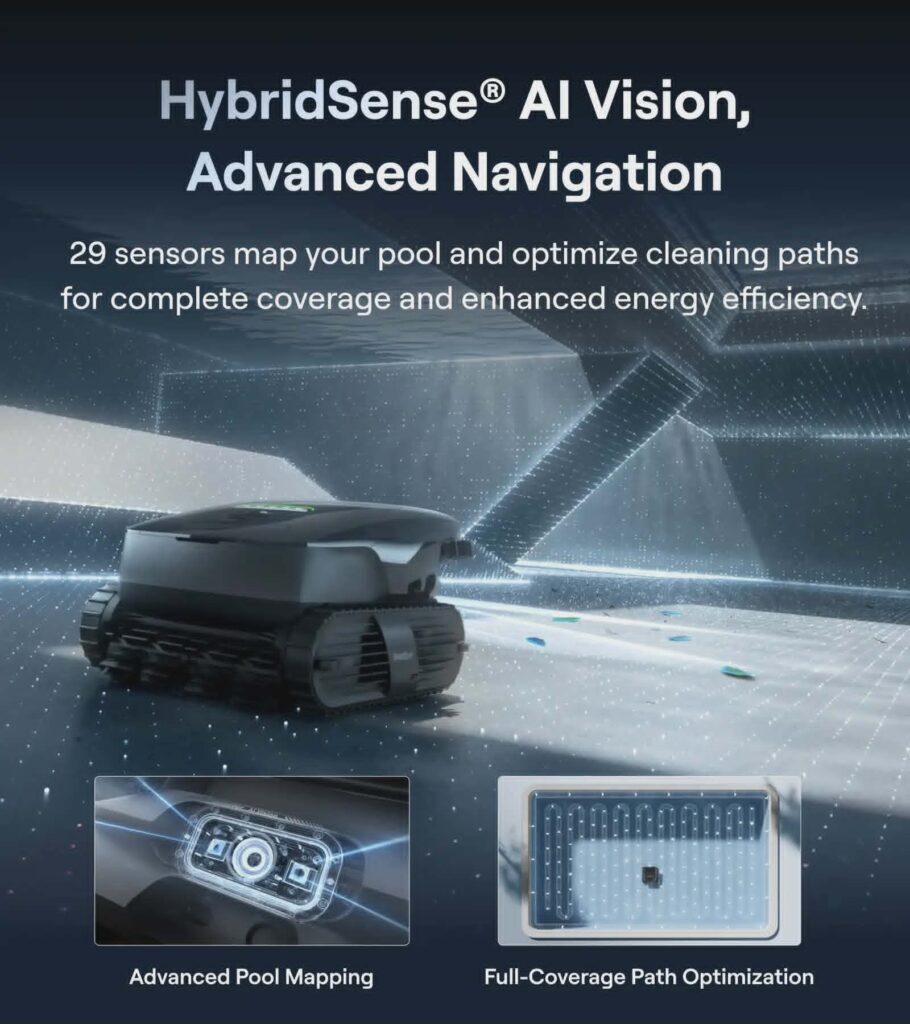
AI Vision Helps the Robot See More Than Open Floor Space
AI vision can help a pool robot recognize more than a flat floor. It can support detection of pool shape, debris zones, steps, walls, ledges, and obstacles that may interrupt a cleaning path.
Smart Navigation Reduces Repeated Paths
In a simple pool, repeated movement may not seem like a big problem. In a larger or irregular pool, it can waste time and leave corners, waterlines, ledges, or shallow areas unfinished. Smart navigation helps make the route more organized.
Adaptive Cleaning Changes How the Robot Responds
Different debris needs different treatment. Leaves, pollen, fine sand, sunscreen residue, and insects do not behave the same way in water. AI can help adjust movement, brushing, suction, or cleaning mode so the robot responds more intelligently.
Why AquaSense X Is Different From Earlier Pool Robots
AquaSense X is different because it is not positioned as just another standalone cleaner. It points toward a more complete pool cleaning ecosystem: robot cleaning, AI guidance, docking support, and less messy maintenance after each cycle.
For homeowners comparing pool cleaners, this is the real question: does the robot simply clean where it travels, or can it support smarter coverage, debris response, and easier maintenance after each cycle?
The self-cleaning dock is especially important. Many pool owners like robotic cleaning but dislike emptying and rinsing dirty filter parts. A dock that reduces that step changes the ownership experience. It makes robotic cleaning feel less like another chore and more like part of a modern backyard routine.
Traditional Pool Robots vs AI Pool Cleaning Ecosystems
| Feature | Traditional robotic pool cleaner | AI pool cleaning ecosystem |
| Navigation | Often random, preset, or pattern based | Uses AI mapping and sensors to plan smarter paths |
| Debris response | Cleans what it passes over | Can identify debris types and adjust cleaning behaviour |
| Coverage | May miss steps, corners, ledges, or waterline areas | Designed for more complete multi zone coverage |
| Maintenance after cleaning | User usually empties and rinses filter manually | Self-cleaning dock can reduce post cycle maintenance |
| Best fit | Simple pools and routine floor cleaning | Larger, complex, high use, or premium backyard pools |
| Main limitation | Less adaptive in irregular layouts | Higher cost and still requires water testing and pool care |
The value of an AI ecosystem is not that the homeowner never has to think about the pool again. It is that repeated cleaning and post cycle maintenance become easier to manage.
How AI Improves Coverage in Larger and Complex Pools
AI Mapping Helps Reduce Missed Spots
Missed spots are one of the biggest frustrations in robotic pool cleaning. In a freeform or kidney shaped pool, a robot may clean open floor space but miss inner curves, corners, or wall transitions. AI mapping helps the cleaner understand where it has been and where it still needs to go.
Multi Level Pools Need Smarter Movement
Tanning ledges, shallow entries, steps, benches, and platform areas are comfortable for people but difficult for many robots. AI navigation can help manage these transitions with less random repositioning.
Surface Cleaning Improves the Pool’s Visible Condition
A pool can still look unfinished even when the floor is clean. Floating leaves, pollen, waterline marks, wall film, and fine debris all affect how ready the pool feels before family use or guests arrive.
Where Beatbot AquaSense X Fits Into Modern Pool Care
Beatbot AquaSense X is designed for homeowners who want to move pool cleaning from a routine chore into a smarter maintenance system. Its core value is not a single suction number. It is the combination of AI vision, smart navigation, multi surface cleaning, and a self-cleaning dock that helps reduce repeated vacuuming, skimming, waterline brushing, and dirty filter handling. For larger backyard pools, freeform pools, multi level pools, tanning ledges, shallow entries, or pools that regularly collect leaves, pollen, and fine debris, AquaSense X shows why AI can matter in real life. It can help the robot recognize the environment, plan cleaner routes, and reduce the amount of manual intervention required from the user.
For anyone comparing a pool cleaner robotic, AquaSense X fits best in premium, tech-forward, high-convenience pool care. It is not a replacement for chlorine, pH, or alkalinity testing. It does not replace the main filtration system, adult supervision, safety rules, professional repairs, or hand removal of large branches, toys, rocks, and sharp objects. It is also more than many simple pools need; smaller or simpler pools may be better served by Sora 30 or Sora 70, while complex pools that need premium mapping support may fit AquaSense 2 Ultra.
What AI Pool Robots Still Cannot Replace
AI can improve cleaning, but it does not change the basic responsibilities of pool ownership. It cannot sanitize water, balance chlorine, adjust pH, manage alkalinity, or test stabilizer levels. It cannot repair pumps, filters, leaks, broken drains, or damaged pool surfaces.
Large branches, rocks, sharp objects, towels, and pool toys still need to be removed by hand. If algae, cloudy water, scale, or stains keep returning, the issue may require testing, brushing, filtration work, or professional help.
AI also needs good habits around it: correct charging, safe storage, app setup, dock care, and regular checks.
AI Is Making Pool Cleaning More Predictive, Not Just Automatic
Earlier pool robots made cleaning automatic by moving through the water. AI robots are making cleaning more predictive by improving decisions, coverage, and maintenance flow.
AquaSense X points toward the next stage of pool care: not just a cleaner, but a connected cleaning ecosystem. The best results still come from pairing AI cleaning with water testing, filter care, safe pool habits, and regular visual checks.
AI is changing robotic pool cleaning by making coverage smarter, maintenance easier, and premium pool care more consistent.