Tested in a Terraced House: Julia vs Baggio Standing Desks
Six weeks, one Victorian spare room, two SKUs — an honest real-home verdict
The Test Environment
Before we get into the desks themselves, a word about the room — because the room is the whole point.
The test space is a Victorian spare room in a mid-terrace house in South East England. Dimensions: 3 metres wide by 3.2 metres deep. Ceiling height: 2.7 metres. Original cast-iron fireplace on one wall, a chimney breast that eats approximately 40 centimetres of usable width. Sash windows — double-glazed replacements in the original style — face north-east, which means flat, diffuse light through most of the working day and a tendency toward glare in early morning. Wooden floorboards throughout, painted white with visible age. The walls are a warm off-white. It is, in other words, a perfectly representative Victorian terrace spare room: not small, but not generous either, and full of the visual character that makes period British homes simultaneously lovely to live in and mildly challenging to furnish.
Both desks were tested at the same wall position — under the window, the natural desk location in this room — with the same monitor arm setup, the same keyboard and peripherals, and the same working pattern: approximately five hours of seated use and three hours of standing use across a typical working day. Neither desk was given an easier ride than the other. If something annoyed me, I wrote it down.
First Impressions: Assembly and Aesthetics
Both desks arrived flat-packed and both required a second pair of hands at one stage during assembly — specifically when attaching the frame to the surface, which needs someone to hold one end while the other is bolted. Budget around 45 minutes for Julia and slightly less for Baggio, which has fewer components. Neither is difficult. Both include clear printed instructions. Neither requires a degree in mechanical engineering, but both will punish impatience.
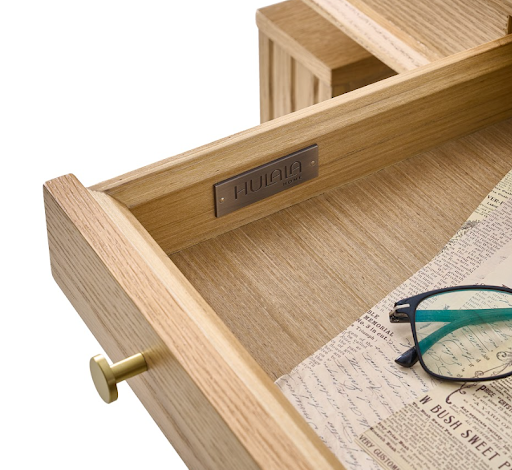
The first visual impression of the Julia, once assembled and positioned in the room, was genuinely arresting. The solid wood surface — warm, slightly textured, with the kind of tonal variation that only real timber has — did something I had not quite expected: it made the room look better. Not just not worse. Actually better. Against the wooden floorboards and the cream walls, the Julia surface read as furniture rather than equipment. Its square tabletop profile, built-in drawer, and choice of Cocoa Walnut or Light Oak finish give it a considered, domestic quality that most standing desks entirely lack. It looked as though it had been chosen, which is the highest compliment you can pay a desk in a room that has been curated with care.
The Baggio’s first impression is different but no less considered. Its surface is matte and smooth rather than warm and tactile, its profile cleaner and lower-profile. The round edges and grooved edge design give it a distinctly contemporary quality, and like the Julia it comes with a built-in drawer and is available in Cocoa Walnut or Light Oak. In this particular Victorian room, it read as a slight visual interruption — not jarring, but present in a way the Julia was not. In a room with white walls, polished concrete floors, and contemporary furniture, I suspect the calculus would reverse entirely. The Baggio is not a worse-looking desk. It is a desk designed for a different kind of room.
Six Weeks of Daily Use
Motor noise was the thing I was most anxious about before testing. I live in a terraced house. The walls are not thick. My neighbour works from home three days a week, and she is close enough that I can sometimes hear her phone calls through the party wall. The Julia’s motor, in practice, is quieter than a kettle boiling and significantly quieter than the boiler firing. At standing height, the motor completes its travel in approximately four seconds. My neighbour has never mentioned it. I consider this a pass.
Baggio’s motor is comparable — perhaps fractionally quieter at the lower portion of its height range, indistinguishable at the top. In practical terms, neither desk is going to cause problems in a terraced home.
Sit-stand habit formation took longer than I expected with both desks. The first week, I used the standing function approximately twice a day. By week three, I was alternating three or four times without thinking about it. The memory presets — both desks include programmable height settings — helped considerably once I had them calibrated. My sitting height and standing height are now a single button-press apart, which removes the friction that, I suspect, causes most people to stop using the standing function altogether.
Stability at standing height: both desks performed well under a dual-monitor setup (two 24-inch screens on a single arm, total weight approximately 12kg). No wobble during typing. A small amount of movement was detectable if I placed both hands flat on the surface and pushed, but no more than you would expect from any desk at full extension. Neither felt like it was going to come apart.
Cable management is, on both desks, adequate rather than excellent. The routing channels work. Cables stay where you put them. But in a room where the desk is a visible, considered piece of furniture — as it is with the Julia — the cable situation remains the most visually distracting element. A single monitor cable managed into a desktop cable box resolves most of it. I would not call this a failing of either desk; I would call it the unavoidable reality of a motorised workstation in 2025.
Julia vs Baggio: The Honest Comparison
Here is what six weeks of daily use with both desks actually tells you:
| Criteria | Julia | Baggio |
| Motor noise | Quiet — barely audible through a party wall | Slightly quieter at low heights; comparable overall |
| Surface feel | Solid wood — warm, tactile, furniture-grade | Smooth matte finish — clean, contemporary, cool |
| Assembly time | 15–30 mins, two people recommended for one step | 15–30 mins, manageable with two people |
| Aesthetic register | Period homes, warm palettes, natural materials | Contemporary, minimal, white-wall rooms |
| Footprint depth | Compact — workable in 2.8m rooms | Similar depth, slightly slimmer profile |
| Height range | Sits low enough for seated use; reaches comfortable standing height | Same functional range |
| Cable management | Routed cleanly; visible if you look for it | Cleaner run overall — suits minimal rooms |
| One limitation | Higher price than budget alternatives | Less warmth in period or traditional rooms |
Neither desk is objectively superior. That is the honest answer, and I want to be clear about it because most standing desk comparisons eventually declare a winner to give the reader something clean to take away. I am not going to do that here, because the winner depends entirely on the room.
In the Victorian spare room used for this test, Julia won — not by a small margin. In a contemporary open-plan flat with white walls and oak laminate floors, I believe Baggio would win by a similar margin. The Baggio is a standing desk that you can find out more about at Hulala Home’s standing desk range — it is worth considering seriously if your room leans contemporary rather than period.
The Verdict
Buy the Julia if: you work in a period home — Victorian, Edwardian, or any property with warm material tones, aged timber, or original features. If you have curated your home with care and cannot bear an object in it that looks like it was ordered from a corporate supplies catalogue. If the quality of your room at 6pm — when the laptop is closed and the desk has to be something you are glad to live with, not just work at — matters as much to you as the quality of your posture at 11am.
One genuine limitation: the Julia is not the cheapest standing desk available. It is a quality object at a quality price, and if your primary criterion is cost per centimetre of height adjustment, there are cheaper options. It is also worth noting that the wood surface, while beautiful, requires slightly more care than a laminate — a felt desk pad is advisable if you work directly on the surface.
Buy the Baggio if: your room is contemporary, minimal, or white-walled. If your floors are polished concrete or light oak laminate. If the desk is going into a dedicated home office rather than a room that doubles as a guest bedroom or a reading room. If clean lines matter more to you than warmth.
After six weeks, the desk still in position in my test room — the one that didn’t get packed up and moved to the corner — is the Julia standing desk UK from Hulala Home. In this room, at this stage of life, it is simply the right object. I am glad to work at it. I am glad to look at it when I am not. That, in the end, is the only verdict that matters.