Industries That Benefit Most from Vacuum Casting Services
Introduction
As product development cycles become shorter and market competition continues to grow, manufacturers need cost-effective ways to produce high-quality prototypes and low-volume production parts. This is where a vacuum casting service becomes an essential manufacturing solution.
Vacuum casting is widely used across various industries because it offers excellent surface finishes, accurate detail reproduction, and lower tooling costs compared to traditional manufacturing methods. It allows companies to test designs, validate products, and produce small batches without investing in expensive production tooling.
From automotive engineering to medical device development, vacuum casting helps businesses accelerate innovation while maintaining product quality. Understanding which industries benefit the most from this manufacturing process can help organizations determine whether vacuum casting is the right solution for their projects.
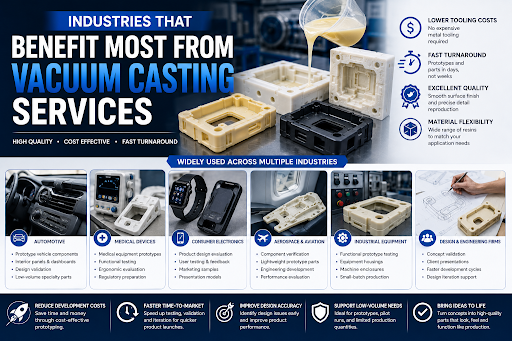
Why Vacuum Casting Is Popular Across Industries
Vacuum casting bridges the gap between prototyping and mass production. It allows manufacturers to create parts that closely resemble injection-molded products in terms of appearance and functionality.
Cost-Effective Low-Volume Production
Traditional manufacturing methods often require expensive tooling investments. Vacuum casting significantly reduces these costs, making it ideal for small production runs.
Fast Turnaround Times
Products can be produced within days rather than weeks, helping companies accelerate product development and testing.
High-Quality Surface Finishes
Vacuum casting produces parts with excellent cosmetic quality, making it suitable for presentation models and customer demonstrations.
Material Flexibility
Manufacturers can choose from various resin materials that mimic production plastics, rubber, and transparent components.
Automotive Industry
The automotive sector is one of the largest users of vacuum casting technology.
Prototype Vehicle Components
Automotive engineers frequently use vacuum casting to create prototype parts for testing vehicle designs before mass production begins.
Common applications include:
- Interior panels
- Dashboard components
- Air vents
- Lighting housings
- Functional brackets
Design Validation
Before investing in production tooling, manufacturers use vacuum-cast parts to evaluate fit, functionality, and aesthetics.
Low-Volume Specialty Parts
Luxury vehicle manufacturers and custom automotive brands often use vacuum casting for limited-production components.
Medical Device Manufacturing
Medical companies require precise and reliable prototypes during product development.
Medical Equipment Prototypes
Vacuum casting is frequently used to manufacture prototype housings for diagnostic equipment and medical instruments.
Product Testing
Engineers can test ergonomics, assembly requirements, and device functionality before moving to large-scale production.
Regulatory Preparation
High-quality prototypes help manufacturers prepare for certification processes and product approvals.
Consumer Electronics Industry
The consumer electronics market relies heavily on rapid product development.
Product Design Evaluation
Companies use vacuum casting to create realistic product prototypes for smartphones, wearables, and smart devices.
User Testing
Functional prototypes allow manufacturers to gather customer feedback before launching new products.
Marketing Samples
Vacuum-cast models can be used in presentations, trade shows, and investor demonstrations.
Because of its ability to produce visually appealing components, a professional vacuum casting service plays a key role in consumer electronics development.
Aerospace and Aviation Industry
Aerospace manufacturers often require highly accurate prototypes for testing and validation purposes.
Component Verification
Vacuum casting helps engineers verify complex aerospace designs before investing in expensive production methods.
Lightweight Prototype Parts
The process is suitable for producing lightweight prototype components that support performance evaluations.
Engineering Development
Engineers use vacuum-cast models to identify design improvements early in the development process.
Industrial Equipment Manufacturing
Industrial machinery manufacturers frequently rely on vacuum casting during product development.
Functional Prototype Testing
Manufacturers use prototypes to evaluate equipment performance before full-scale production.
Equipment Housing Development
Vacuum casting is commonly used for:
- Control panels
- Equipment covers
- Protective housings
- Machine enclosures
Small-Batch Production
For specialized machinery, vacuum casting provides an economical solution for limited production quantities.
Product Design and Engineering Firms
Design consultancies and engineering companies regularly use vacuum casting throughout the product development cycle.
Concept Validation
Design teams create prototypes to evaluate product concepts and identify improvements.
Client Presentations
Realistic prototypes help communicate product ideas more effectively to clients and stakeholders.
Faster Product Development
Quick prototype production allows engineering firms to accelerate project timelines and improve efficiency.
Benefits of Vacuum Casting Across Industries
The versatility of vacuum casting makes it valuable for a wide range of applications.
Reduced Development Costs
Manufacturers avoid the high tooling expenses associated with injection molding.
Faster Time-to-Market
Rapid prototype production helps businesses launch products more quickly.
Improved Design Accuracy
Engineers can identify and correct design flaws before production begins.
Enhanced Product Testing
Functional prototypes support more effective testing and validation processes.
Greater Manufacturing Flexibility
Vacuum casting supports multiple design iterations without major production investments.
How to Determine if Vacuum Casting Is Right for Your Industry
Vacuum casting is often the ideal solution if your project requires:
- High-quality prototypes
- Low-volume production
- Fast turnaround times
- Realistic production-like parts
- Cost-effective manufacturing
Companies seeking efficient product development solutions often rely on a trusted vacuum casting service to meet these requirements while maintaining quality and speed.
Conclusion
Vacuum casting has become a valuable manufacturing solution for industries ranging from automotive and aerospace to medical devices and consumer electronics. Its ability to produce highly accurate prototypes, reduce development costs, and support low-volume production makes it an attractive option for businesses looking to accelerate innovation.
As companies continue to focus on faster product development and greater manufacturing flexibility, vacuum casting services will remain an important tool for bringing new products to market efficiently and cost-effectively.
FAQs
Which industries commonly use vacuum casting services?
Vacuum casting is widely used in automotive, aerospace, medical devices, consumer electronics, industrial equipment manufacturing, and product design industries.
Why is vacuum casting ideal for product prototyping?
Vacuum casting produces highly accurate prototypes with excellent surface finishes while keeping tooling costs relatively low.
Can vacuum casting be used for low-volume production?
Yes. Vacuum casting is commonly used for low-volume manufacturing runs where injection molding would be too expensive.
What materials can be used in vacuum casting?
Manufacturers can choose from ABS-like, PP-like, rubber-like, transparent, and heat-resistant resin materials.
How does a vacuum casting service help reduce development costs?
Vacuum casting eliminates the need for expensive production tooling, allowing companies to create prototypes and small production runs at a lower cost.