Grout, Moisture, and the PNW Problem: What Everett Homeowners Find Behind the Tile
There’s a version of bathroom renovation that looks like a magazine photo: gleaming white subway tile, frameless glass, a rainfall showerhead catching light. There’s another version that starts with a contractor prying off a 30-year-old tub surround and finding the studs behind it look like they’ve been composting in place.
Both are common outcomes of bathroom remodels in Everett, WA — often in the same week, from the same contractor.
Everett sits in Snohomish County’s rain corridor, and the wet winters here are long and serious. Annual rainfall averages around 35 inches, but the real story is the consistent moisture — the fog, the condensation, the months where nothing ever fully dries out. In bathrooms that were originally built without today’s waterproofing standards, that climate has been quietly working on the wall structure for decades.
A bathroom remodel in Everett, WA, done right, isn’t just a cosmetic upgrade. It’s a correction of everything the PNW has been doing to your bathroom’s substrate for the last 20 to 40 years. This post walks through what to expect, what to plan for, and how to make decisions that hold up in this climate long-term.
What Years of Everett Winters Do to a Bathroom
The Grout Line Is Where It Starts
Grout isn’t waterproof. Most homeowners don’t think about this until it becomes a problem. Sanded grout and unsanded grout are both cement-based materials with significant porosity. In a shower or tub surround, water passes through grout lines every single time the shower runs — and in Everett homes where shower steam adds to already-elevated indoor humidity, that’s a constant cycle.
Over time, water that passes through grout lines reaches the tile backer material behind it. In homes built before the early 2000s — which represents much of Everett’s housing stock in neighborhoods like Silver Lake, South Everett, and Mukilteo — that backer material is typically greenboard: a water-resistant drywall product that is emphatically not waterproof. Once greenboard gets repeatedly wet, it softens, deteriorates, and eventually crumbles. Tiles above it start to hollow out and crack.
By the time a homeowner notices something is wrong — a cracked tile, a soft spot in the surround, grout that keeps cracking back no matter how many times it’s repaired — the moisture has usually been migrating for years.
The Hidden Rot That Changes Project Scope
When a contractor opens a bathroom wall during a remodel in Everett, finding some degree of moisture damage in the framing is common. The extent of that damage determines whether the project stays on scope or expands.
Light moisture staining on studs — discoloration without structural softening — is treatable with antimicrobial products and remediation of the moisture source. Actual rot in framing members requires cutting out the damaged sections and sistering in new lumber before any finish work can proceed. In severe cases, if the damage has affected the subfloor beneath the tub or shower, that comes out too.
None of this is unusual for Everett homes of a certain age. What matters is that the contractor identifies it clearly, explains it honestly, and repairs it completely rather than covering it back up with new tile.
What a Proper Bathroom Remodel in Everett Looks Like
Waterproofing Before Tile — Always
Modern bathroom tile installation starts with the substrate, not the tile. Cement board or similarly rated backer is fastened to the wall framing. A waterproofing membrane — either a liquid-applied product like RedGard or a sheet system like Schluter Kerdi — is then applied to the entire wet area surface, including all corners and transitions.
This membrane is what actually keeps water out of the wall assembly. The tile and grout on top of it are the first line of defense; the membrane is the backstop. In Everett’s climate, where ambient humidity is elevated for months at a time, that backstop is what makes the difference between a remodel that lasts 25 years and one that starts showing problems in eight.
Contractors who skip the membrane to save time or cost are creating a future problem for the homeowner. Ask specifically about waterproofing method and system — not just whether waterproofing is included, but how it’s done.
Ventilation: The Upgrade That Changes Everything
The single most impactful functional upgrade in a bathroom remodel in Everett, WA is often the one nobody gets excited about: the exhaust fan. Older homes in Silver Lake, Marysville, and throughout Snohomish County routinely have bath fans that are either undersized for the room, worn out and barely moving air, or — very commonly — vented into the attic rather than outside.
An attic-vented bathroom fan is essentially a humidifier for your attic. The moisture being pushed out of the bathroom condenses in the attic space, creating conditions for mold, structural deterioration, and in cold winters, frost buildup on the sheathing. During a remodel is the natural time to correct this — running new duct to a roof cap or gable vent is straightforward when walls are already opened.
Specify a quality bath fan — at minimum 80 CFM for a standard bathroom, higher for larger spaces — with a humidity-sensing feature that runs the fan automatically when steam levels rise. This single upgrade does more to protect a bathroom remodel than almost any other decision.
Shower Niche and Shelf Details That Matter
One of the most common sources of water infiltration in shower remodels is the shower niche — the recessed shelf that’s cut into the wall for shampoo and soap. When niches aren’t properly waterproofed, they become a direct path for water into the wall assembly.
In Everett bathrooms, niches are particularly high-risk because the consistent wet season means shower usage is high and drying times between uses are longer. A properly built niche is framed, lined with cement board, waterproofed as part of the overall membrane system, and tiled to a slope so water drains out rather than pooling. It’s not complicated, but it requires attention to detail.
Choosing Your Design Elements for an Everett Bathroom
Tile Selection for a PNW Climate
Porcelain tile is the most practical choice for shower walls and bathroom floors in Everett. It’s dense, virtually non-porous, and doesn’t require regular sealing. Ceramic tile is a step down in density but still performs well when properly installed and grouted.
Natural stone — marble, travertine, slate — looks beautiful but requires consistent sealing to maintain its moisture resistance. In a frequently-used family bathroom in Everett, the maintenance commitment is worth thinking through honestly before committing to natural stone.
For floor tile specifically, choose tiles with a texture rating appropriate for wet surfaces. Polished tiles are stunning in a showroom and extremely slippery when wet.
Vanity and Storage for Pacific Northwest Life
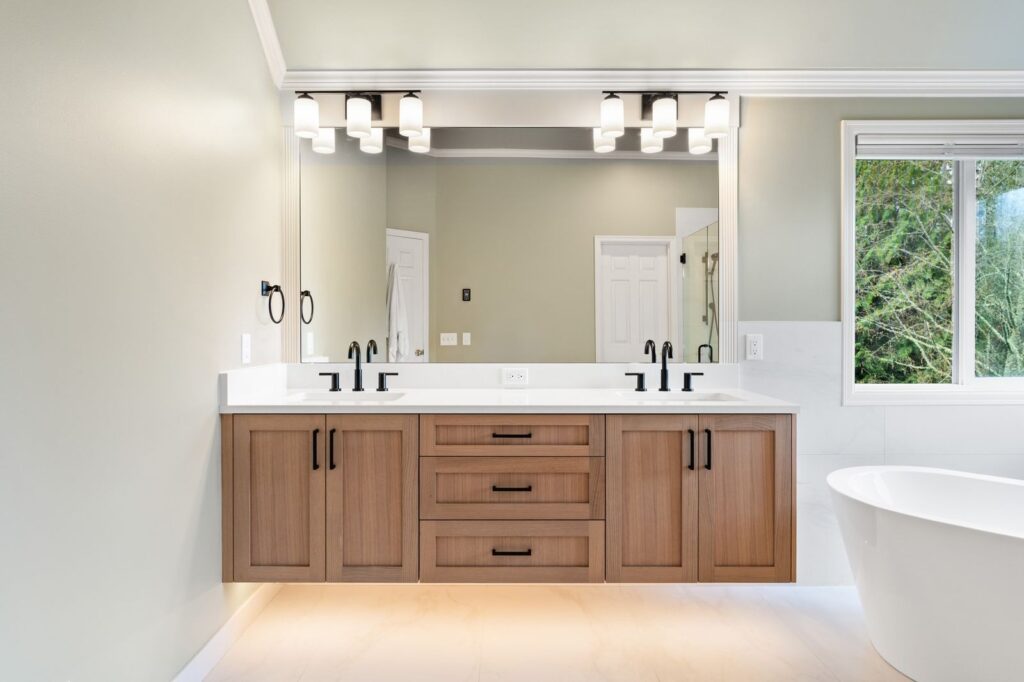
Bathroom storage decisions get real fast when you have multiple people getting ready in a damp PNW morning. Floating vanities look clean and modern; they also make it significantly easier to clean the floor beneath them, which matters in a bathroom where wet footprints and drips are a daily reality.
Cabinet materials in the vanity should prioritize moisture resistance — plywood or solid wood construction with a durable finish outperforms particleboard in a bathroom environment.
Crafthaus Remodel and Everett Bathroom Projects
Crafthaus Remodel operates throughout the Everett area — Silver Lake, Mukilteo, Marysville — and the team’s hands-on experience with PNW moisture conditions shapes how they approach every bathroom remodel in Everett. From substrate waterproofing to ventilation specification to honest communication about what’s behind the walls, the approach is built around bathrooms that hold up in this climate.
Frequently Asked Questions
How do I know if my Everett bathroom has moisture damage behind the tile?
Tap on the tile surround with your knuckle — a hollow sound indicates the tile has separated from the substrate, usually because moisture has compromised the backing material. Soft spots in the floor near the tub or shower base, persistent grout cracking, and discoloration or staining at caulk lines are also indicators of moisture infiltration.
What waterproofing system is best for a bathroom remodel in Everett, WA?
Schluter Kerdi and liquid-applied membranes like RedGard are both widely used and proven systems. Either approach, applied correctly to cement board substrate, provides the continuous water barrier that PNW bathrooms need. The key is that the waterproofing membrane covers all surfaces in the wet zone, including corners and transitions.
How long does a bathroom remodel take in Everett?
A full bathroom remodel — new tile, tub or shower, vanity, plumbing and ventilation updates — typically runs three to five weeks from demo to completion. Projects involving significant moisture remediation may add one to two weeks. Ask your contractor for a project-specific schedule.
Do I need permits for a bathroom remodel in Everett, WA?
Plumbing and electrical changes require permits. A purely cosmetic tile-and-fixture update may not, but any work that modifies the mechanical systems — moving drain lines, adding or upgrading electrical — goes through the permit process. Your contractor handles this as part of the project.
What’s the most important thing to look for when hiring a contractor for a bathroom remodel in Everett?
Ask specifically how they handle moisture damage discovered during demo, what waterproofing system they use, and how they route bathroom exhaust. A contractor who can answer those questions fluently and specifically — not vaguely — is demonstrating real familiarity with PNW bathroom remodeling.