How Much Does a Drone for Agriculture Really Cost? A State-by-State Price Guide for US Farmers
Farming decisions are rarely simple, and equipment purchases are no exception. Over the past several years, agricultural drones have moved from experimental tools used by early adopters to practical field equipment that crop producers across the United States now consider during their annual planning cycles. The shift has been gradual but consistent, driven by real improvements in spraying accuracy, crop monitoring capability, and the economics of labor substitution.
Yet despite growing familiarity with the technology, most farmers still face the same foundational question when evaluating whether a drone fits their operation: what does it actually cost? Not in general terms, but in the context of their state, their acreage, their crops, and their workflow. That question deserves a grounded, practical answer — not a sales pitch.
This guide walks through the cost variables that matter most for US farmers, organized by how those variables interact across different regions and crop types.
Understanding What Drives the Cost of a Drone for Agriculture
When farmers or farm managers research the drone for agriculture price, they often encounter wide ranges — figures that span from a few thousand dollars to well over fifty thousand. That range is not a sign of inconsistency in the market. It reflects genuine differences in what the technology is being asked to do. A drone used primarily for aerial scouting and crop imaging operates under completely different requirements than one designed to apply liquid inputs across hundreds of acres per day.
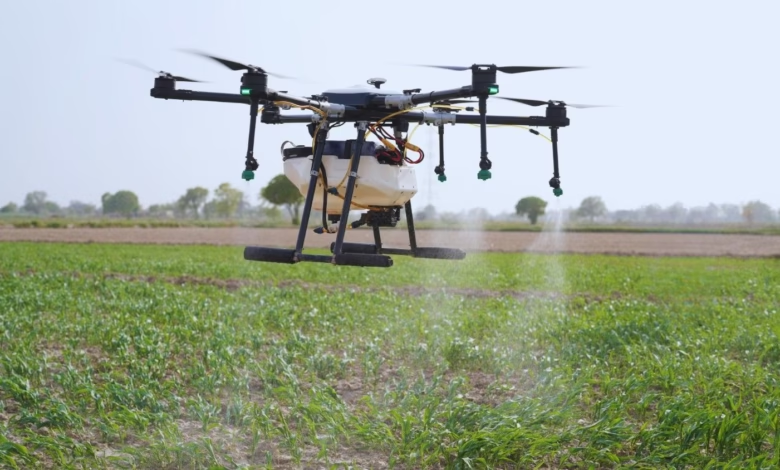
To make sense of pricing, it helps to understand that agricultural drones are generally categorized by their primary function. Imaging drones, which capture multispectral or RGB data for crop health analysis, tend to sit at the lower end of the investment spectrum. Spraying drones, which carry tanks and distribute pesticides, herbicides, or fertilizers, require substantially more engineering and therefore carry higher base costs. Hybrid platforms that combine both functions exist but represent a smaller share of what’s available in the US market.
For a detailed breakdown of current service and ownership costs by state and crop type, the drone for agriculture price data published by Leher provides a useful reference point for comparing regional rates across the country.
The Role of Payload Capacity in Cost Structure
Payload capacity is one of the most direct cost drivers in spraying drones. The amount of liquid a drone can carry in a single pass determines how many flights are needed to cover a given area, which in turn affects both operating time and the cost per acre. Drones with larger tanks require more powerful motors, larger frames, and more robust battery systems — all of which increase the base price.
For row crop farmers in the Midwest working with large, flat fields, a higher-capacity spraying drone often makes more economic sense per acre than a smaller unit, even if the upfront cost is greater. For specialty crop producers in California or the Pacific Northwest working in terrain where access is difficult, a smaller and more maneuverable unit may deliver better practical results regardless of its per-acre efficiency on flat ground.
Battery Systems and Operating Costs Over Time
Battery replacement is a cost that many first-time buyers underestimate. Agricultural drones operate under demanding conditions — heat, humidity, dust, and extended daily use during peak seasons — all of which accelerate battery degradation. Depending on usage intensity, battery packs typically need replacement within one to three growing seasons.
This ongoing cost should be factored into any honest total-cost-of-ownership calculation. A drone with a lower purchase price but a more expensive battery system can end up costing more over a five-year period than a higher-priced unit with more durable or widely available battery components. Buyers should ask for battery cycle ratings and replacement costs before committing to a platform.
Regional Pricing Patterns Across US States
Agricultural drone pricing in the United States does not follow a single national standard. State-level differences in land cost, crop values, labor markets, and regulatory environments all affect what farmers are willing to pay, what service providers charge, and what ownership economics look like in practice. These regional patterns are worth understanding before making a purchase or service agreement decision.
The Midwest: Volume Economics and Commodity Crops
States like Iowa, Illinois, Indiana, and Kansas represent some of the highest-volume drone adoption markets in the country. The scale of corn, soybean, and wheat production in these states creates natural economic pressure toward efficiency. Drone spraying services in this region have become increasingly competitive, with per-acre rates often lower than in other parts of the country simply because operators can cover more ground in a single day on flat, accessible terrain.
For farmers in this region considering ownership rather than service contracts, the economics tend to favor larger, higher-capacity platforms. The cost per acre of a spraying drone decreases significantly as total annual acreage treated goes up, and Midwest operations often have the volume to reach that breakeven point more quickly than smaller farms elsewhere.
The South: Heat, Humidity, and Cotton Country
In states like Texas, Mississippi, Georgia, and Alabama, drone adoption has grown steadily in cotton, peanut, and specialty vegetable production. The climate presents unique operational challenges. High ambient temperatures reduce battery efficiency, and the combination of heat and moisture creates additional wear on electronic components. These factors tend to increase both the cost of ownership and the frequency of maintenance cycles.
Service providers in the South often price their rates to account for these conditions. Farmers evaluating drone service agreements in this region should pay attention to how providers handle equipment downtime and whether service contracts include provisions for weather-related delays or equipment failures during critical application windows.
The West: Terrain, Orchards, and Specialty Crops
California, Washington, and Oregon represent a distinct use case for agricultural drones. Specialty crops — tree fruit, wine grapes, almonds, and vegetables — often grow in terrain that limits ground equipment access. Drones offer a solution to this access problem, but the pricing dynamics differ from commodity crop regions.
Per-acre rates for drone services in these states tend to be higher, reflecting both the higher value of the crops being treated and the complexity of operating in hillside or canopy environments. Drone platforms used in these settings often require different sensor or nozzle configurations than those used in flat field applications, which can increase both the initial equipment cost and the expertise required to operate effectively.
The Federal Aviation Administration outlines operational requirements for agricultural drone use under its commercial UAS operator regulations, which apply regardless of state and affect how service providers structure their operations and insurance coverage.
Ownership vs. Service Contracts: The Real Cost Comparison
One of the most important decisions a farm operator makes when entering the agricultural drone market is whether to purchase equipment outright or contract with a service provider on a per-acre basis. Both models have legitimate advantages, and the right choice depends heavily on farm size, crop type, and how frequently drone services are needed throughout the growing season.
When Ownership Makes Financial Sense
Direct ownership becomes economically practical when a farm has enough annual acreage to spread the capital cost across a sufficiently large number of treated acres. Farms with consistent, high-volume application needs — particularly those with multiple crops requiring treatment at different times of the season — often find that owning a drone reduces their per-acre cost below what service providers charge once the equipment is amortized over several years.
Ownership also gives operators more scheduling flexibility. During peak seasons when service providers may be stretched across multiple clients, having dedicated equipment eliminates the risk of timing misalignment, which can be costly in crops where the application window is narrow.
When a Service Contract Reduces Risk
For smaller operations, farms with variable acreage from year to year, or producers who only need drone services for a single application event per season, service contracts are often the more sensible approach. The drone for agriculture price in a service model shifts from a capital expense to an operational one, which is easier to budget and removes the responsibility of maintenance, operator training, and equipment storage.
Service contracts also transfer weather and equipment risk to the provider. If a drone is grounded due to a mechanical issue during a critical spray window, that is the provider’s problem to solve — not the farmer’s. For risk-averse operations, this distinction has real value.
Hidden Costs Farmers Frequently Overlook
Beyond the purchase price or service rate, several secondary costs affect the total economics of agricultural drone use. Operator certification is required under FAA Part 107 rules for commercial drone operation, and obtaining that certification takes time and money. For farms that plan to operate their own equipment, this cost should be included in the initial planning budget.
Insurance is another line item that deserves attention. Agricultural drone operations carry liability exposure — particularly in aerial application scenarios — and standard farm insurance policies may not cover drone-related incidents without an explicit endorsement. The cost of appropriate coverage varies by state and operation type, but it is not optional for serious commercial use.
Software subscriptions for flight planning, data analysis, and prescription map generation also add to annual operating costs. Many drone platforms tie their full functionality to ongoing software agreements, and these fees can add up over time, particularly for farms managing multiple fields or crop types.
Conclusion: Building a Realistic Cost Picture Before You Commit
Agricultural drone technology has matured to the point where it delivers measurable value across a wide range of farm types and geographies in the United States. But that value is only realized when the investment decision is based on a complete and honest accounting of what the technology actually costs in a specific operational context.
The drone for agriculture price is not a single number. It is a product of the function the drone serves, the region where it operates, the scale of the farm, and whether the farmer chooses ownership or a service arrangement. Each of these variables interacts with the others in ways that make general estimates unreliable for individual decision-making.
The most useful approach is to start with a clear picture of what problem you are trying to solve — whether that is reducing labor dependence during spray season, improving crop monitoring coverage, or accessing terrain that ground equipment cannot reach — and then work backward to the cost model that best fits that need. Farmers who approach the decision this way consistently make better choices than those who start with the price and work forward.
State-level data, regional service provider comparisons, and a realistic assessment of your farm’s annual acreage are the three inputs that matter most. With those in hand, the question of what a drone for agriculture price looks like in your specific situation becomes far easier to answer.