How to Avoid Curtailment on Your Solar Project
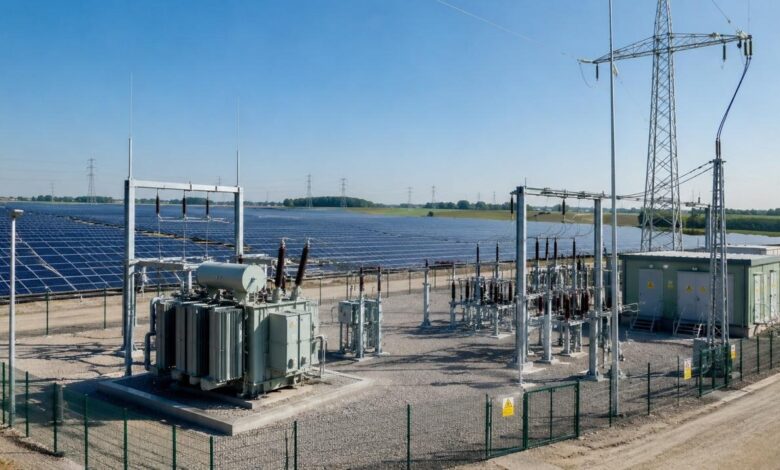
Spain curtailed 11% of a 100 MW solar farm’s output in summer 2025. California wasted 3.4 TWh of solar generation in 2024, up 29% from the prior year. Vietnam’s northern grid curtails 20%+ during peak solar hours 1. These are not edge cases — curtailment is becoming the default outcome for solar projects that don’t plan for it from the earliest design stage. Most of it was avoidable, if you knew where to look before construction began.
What Are the Two Types of Curtailment?
Not all curtailment is the same. The type determines the solution — and confusing the two wastes money.
Technical vs. economic curtailment: two different problems
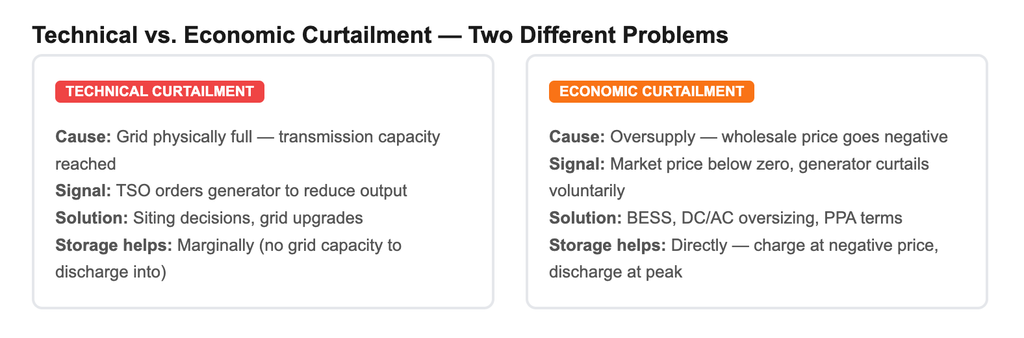
Technical curtailment and economic curtailment are fundamentally different problems that require fundamentally different solutions. Confusing the two — or applying the wrong solution to the wrong type — wastes money without solving the problem.
Technical curtailment occurs when the physical grid cannot carry the power. The transmission lines are at capacity, and the system operator orders the solar farm to reduce output. No amount of market negotiation can fix this — the constraint is physical.
Economic curtailment occurs when the wholesale price goes negative, and the solar farm voluntarily reduces output because producing would cost more than curtailing. The grid has capacity; the market has no demand at that moment.
| Type | Cause | Solution | Effectiveness |
|---|---|---|---|
| Technical (grid congestion) | Transmission capacity reached | Siting decisions, grid upgrades | Storage helps marginally |
| Economic (negative prices) | Oversupply during solar peak | Battery storage, DC/AC optimization | Storage solves this directly |
Why the distinction matters for project design
Storage solves economic curtailment well: charge the BESS during negative-price hours, discharge later when prices are positive. Storage addresses technical curtailment poorly: if the grid is physically full, there is nowhere to send the stored energy. Technical curtailment risk must be addressed at the siting stage, before the project is designed. Economic curtailment risk can be addressed through system design and contract structures.
How Do I Reduce Technical Curtailment Risk?
Technical curtailment is a siting problem. It must be addressed before the project is designed, not after.
Siting decisions and curtailment risk
Technical curtailment risk is baked in at siting — the decision of where to connect to the grid. Two sites in the same region with the same solar irradiance can have radically different curtailment forecasts depending on the local grid’s available capacity. In Spain’s Badajoz region, curtailment forecasts range from 3.5% to 22.5% depending on the specific grid connection point. The sun is the same; the node is different.
Checking grid capacity before site selection
Before committing to a site, request a grid capacity assessment from the transmission system operator (TSO). Most European TSOs publish grid capacity maps showing available connection capacity by region and voltage level. In Germany, the Bundesnetzagentur publishes a congestion map. In Spain, Red Eléctrica provides connection point availability data. In Vietnam, EVN’s provincial subsidiaries can provide informal capacity assessments upon request.
Options when the preferred site is congested
If the preferred site is in a congested area, the options are: find an alternative connection point with available capacity (even if it requires a longer private line to the solar farm), reduce the project size to fit within available grid capacity, or negotiate a grid reinforcement agreement with the TSO (which adds cost and timeline). None of these options is ideal after site acquisition — which is why grid capacity due diligence should happen before land acquisition, not after.
How Do I Reduce Economic Curtailment?
Economic curtailment can be managed through storage, DC/AC optimization, and contract structures.
Sizing the BESS for local negative-price windows
Economic curtailment is driven by negative wholesale prices, which occur during specific hours when solar oversupply exceeds demand. The BESS must be sized to absorb generation during these events. In Spain, spring 2025 saw over 400 negative-price hours concentrated in the 10:00-16:00 window. A BESS sized for 4-6 hours of full solar output can capture most of the curtailed generation. A 100 MW solar farm generating at full output for 6 hours needs approximately 600 MWh of BESS capacity to absorb the full curtailed volume.
DC/AC oversizing as a lower-cost complement
DC/AC oversizing — installing more solar panel capacity than the inverter’s AC rating — is a lower-cost complement to BESS for managing economic curtailment. A DC/AC ratio of 1.3:1 means the solar array produces 30% more DC power than the inverter can convert to AC. During negative-price hours, the excess DC generation is simply not converted — the inverter clips the output. This “wastes” some generation, but it reduces the BESS capacity needed to absorb the remaining curtailed energy.
The optimal combination depends on local price patterns. In markets with extended negative-price windows (6+ hours), a higher DC/AC ratio (1.3-1.4:1) with a smaller BESS may be more cost-effective than a lower DC/AC ratio with a larger BESS. In markets with shorter negative-price events (2-3 hours), a larger BESS with a lower DC/AC ratio captures more value.
What Should My PPA Contract Say About Curtailment?
PPA contract language determines who bears the cost of curtailment. Four specific provisions can protect the generator.
Four essential PPA contract provisions
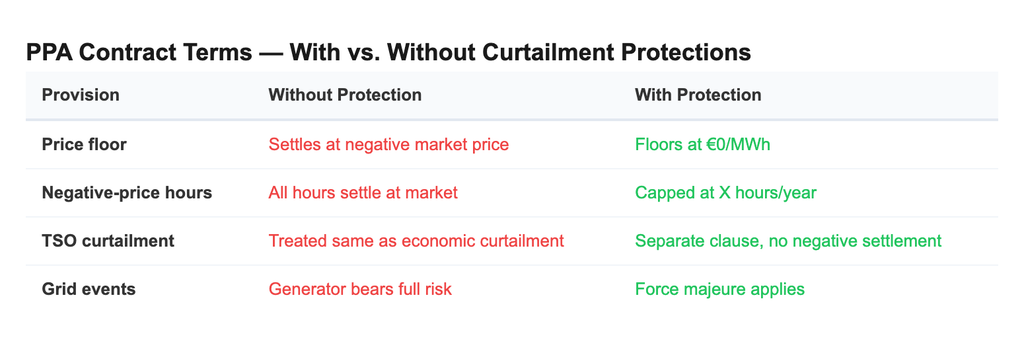
PPA contracts for solar projects in curtailment-prone markets should include four specific provisions:
€0/MWh price floor: The contract settles at zero, not at the negative wholesale price, when the market goes negative. This prevents the generator from paying the buyer during negative-price hours.
Caps on negative-price settlement hours: A limit on the number of hours per year during which negative-price settlement provisions apply. Once the cap is reached, the contract price holds at zero regardless of market conditions.
Clear liability for TSO-ordered curtailment: The contract should distinguish between curtailment ordered by the system operator (technical) and curtailment resulting from negative prices (economic). TSO-ordered curtailment should not trigger negative-price settlement clauses.
Force majeure provisions for grid events: Grid disturbances, connection outages, and transmission failures should be covered under force majeure, protecting the generator from revenue losses caused by grid infrastructure failures.
What Can My Inverter Do to Help?
Modern inverters provide grid support functions that TSOs increasingly require as grid code compliance.
Q-U reactive power control
Modern solar inverters do more than convert DC to AC. They provide grid support functions that TSOs increasingly require as grid code compliance. Q-U reactive power control adjusts the inverter’s reactive power output based on local voltage levels. When voltage rises (common during high solar generation), the inverter absorbs reactive power to lower voltage. When voltage drops, it injects reactive power to raise it.
Power ramp rate limiting
Power ramp rate limiting controls how quickly the solar farm’s output can change. A sharp increase in solar output (when clouds pass) can cause grid instability. Ramp rate limiting smooths the output curve, reducing the maximum rate of change. Most European grid codes now require ramp rate compliance as a connection condition.
Remote TSO dispatch
Grid-code-compliant inverters support remote dispatch, allowing the TSO to adjust the solar farm’s active power output in real-time. This is the mechanism through which technical curtailment orders are executed. Inverters that respond quickly and accurately to dispatch signals are preferred by TSOs and may receive more favorable grid connection terms.
| Inverter Function | What It Does | Grid Code Requirement |
|---|---|---|
| Q-U reactive power control | Adjusts reactive power based on voltage | Required in most EU markets |
| P-f active power control | Reduces output when frequency rises | Required for frequency stability |
| Power ramp rate limiting | Smooths output changes | Required: typically 10-20%/min |
| Remote TSO dispatch | Accepts active power setpoints | Required for all grid-connected projects |
How Sungrow’s Inverters and BESS Address Curtailment
Sungrow’s SG350HX and SG250HX string inverters include built-in Q-U and P-f control functions that meet European grid code requirements for reactive power management, active power control, and ramp rate limiting. These functions are configured through the inverter’s commissioning software and can be adjusted remotely via Sungrow’s monitoring platform — allowing operators to respond to TSO dispatch signals without site visits.
For projects combining solar with storage to manage economic curtailment, Sungrow’s PowerTitan BESS provides curtailment-aware dispatch. The energy management system automatically charges the BESS during negative-price or low-price hours and discharges during peak hours, converting curtailed generation into dispatched revenue. For developers evaluating curtailment mitigation strategies, Sungrow’s combined inverter and storage portfolio addresses both the technical compliance requirements (Q-U, P-f, ramp rate) and the economic optimization challenge (BESS arbitrage) within a single supplier relationship.
What This Means for Solar Project Developers
Curtailment risk is not a post-construction problem — it is a pre-construction decision. The site, the grid connection point, the DC/AC ratio, the BESS size, and the PPA contract terms all determine whether a solar project will lose 5% or 20% of its generation to curtailment. Developers who address these factors during the design phase — and select inverter and storage platforms that support grid code compliance — will produce projects that perform as modeled. Sungrow’s inverter and BESS portfolio provides the technical capabilities for both the grid compliance and economic optimization sides of curtailment management.