Cold-Climate Energy Storage: Why Low-Temperature Performance Is the Hardest Problem in Battery Design

Cold damages a lithium battery faster than heat does. High temperatures accelerate aging gradually, over months and years. Sub-zero charging can cause permanent, irreversible loss in a single cycle. For anyone specifying storage for a project in Alberta, Inner Mongolia, the Nordics, or Central Asia, that asymmetry is the constraint that shapes the whole system design.
The industry solves this at two levels, and system size decides which one belongs on a given project. Containerized utility-scale installations should handle cold through active thermal management, because the hardware is already on board for cooling duty. Small distributed systems are better served by cells engineered to accept charge when cold, because heating hardware costs more per kilowatt-hour stored than it returns. What follows is why that split exists, and how to verify a cell against it.
Why Cold Is Harder on Batteries Than Heat
Cold attacks a cell on three fronts at once, and only two of them are recoverable. Usable capacity drops, internal resistance climbs, and charging becomes physically hazardous to the cell. Warm the cell up and the first two effects disappear. The third leaves damage behind, because charging a cold cell can permanently remove lithium from the pool that carries charge.
The root cause is transport. As temperature falls, electrolyte viscosity increases and the mobility of lithium ions through it decreases. Solid-state diffusion inside the electrodes slows at the same time, so the ions that do arrive at the anode intercalate more slowly [1].
For a system operator, this shows up as three separate problems:
- Reduced usable energy. The same battery bank delivers fewer kWh on a January morning than it did in July, which changes the sizing math for winter-peaking loads.
- Voltage sag under load. Higher internal resistance means the pack hits its low-voltage cutoff earlier, cutting available runtime before the cell is actually empty.
- Charging restrictions. Most lithium cells restrict or heavily derate charging below 0°C. In a solar-plus-storage system, this is the failure that matters, because it can mean the battery refuses generation on exactly the days it is needed most.
Lithium Plating: The Failure Mode That Does Not Reverse
Charging a cold lithium cell risks depositing metallic lithium on the anode instead of storing it inside the graphite structure. This is lithium plating, and it is one of the primary causes of capacity fade under low-temperature and fast-charging conditions [2].
The mechanism is a race. During charging, lithium ions must reach the anode and intercalate into the graphite lattice. When cold slows both electrolyte transport and solid-state diffusion, the ions arrive faster than the lattice can absorb them, and metallic lithium plates out on the surface instead [1].
Some of the deposit does find its way back. At the end of charging, when the negative electrode potential rises above the lithium reference potential, a portion of the plated lithium strips off the surface and re-enters the electrode [2].
The rest is lost through two separate paths. Metallic lithium is far more reactive than lithium stored inside the graphite lattice, so exposed deposits react with the surrounding electrolyte and are consumed into surface film, locking up lithium and electrolyte together [3]. Other deposits stay chemically intact but lose electrical contact with the anode as film grows around them, leaving isolated metal that can no longer carry current in either direction.
This is the reason cold-charge damage does not reverse. A cell leaves the factory with a fixed quantity of cyclable lithium, and both paths subtract from it permanently. Warming the cell restores ion mobility, but it cannot return lithium that has been converted into surface film or electrically stranded. The deposits are also non-uniform, so the loss concentrates in patches rather than spreading evenly across the electrode.
The long-term data is stark. In one study of a commercial cell cycled at -10°C, capacity fell to 18.3 Ah after 500 cycles with substantial irreversible loss, and post-mortem analysis identified anode lithium plating as the dominant cause. The cells also produced gas during subsequent room-temperature storage [4].
Plating is not strictly a sub-zero phenomenon either. Research on commercial NCA/graphite cells detected plating onset at an ambient temperature of 5°C under a 1C charge, which means a system relying on a simple “above freezing is fine” rule can still be accumulating damage [5].
The System-Level Answer: Heating, Insulation, and Charge Derating
Most cold-climate storage projects solve the problem outside the cell. Enclosure insulation, resistive or circulating pre-heating, and BMS-controlled charge derating together keep the cells inside a safe operating window regardless of ambient conditions.
For containerized utility-scale systems, this is the mature and appropriate answer. The thermal management hardware is already present for cooling duty, so extending it to heating adds control logic rather than a new subsystem. Published specifications for liquid-cooled rack products routinely state operating windows from -40°C to 60°C on that basis [6].
The tradeoff is parasitic energy. Pre-heating draws from stored energy or from the grid before charging can begin, and in a cold climate that draw recurs daily through the winter. In a containerized installation the overhead is a small share of throughput and disappears into project economics.
Three things change when the same approach is scaled down. The heater, insulation, and control hardware cost roughly the same whether they serve a container or a single residential cabinet, so the cost per kilowatt-hour stored climbs steeply at the small end. The parasitic draw becomes a larger fraction of a smaller throughput. And distributed sites are frequently unattended, which means a heating circuit that fails in December may not be found until spring.
That is the gap where cell-level engineering earns its place.
The Cell-Level Answer: Widening the Charging Window Itself
The second approach is to change the cell so it accepts charge at temperatures where a standard cell cannot. This is materials work: electrolyte formulation that stays conductive when cold, and electrode design that raises lithium-ion diffusion rates so intercalation keeps pace with the incoming current.
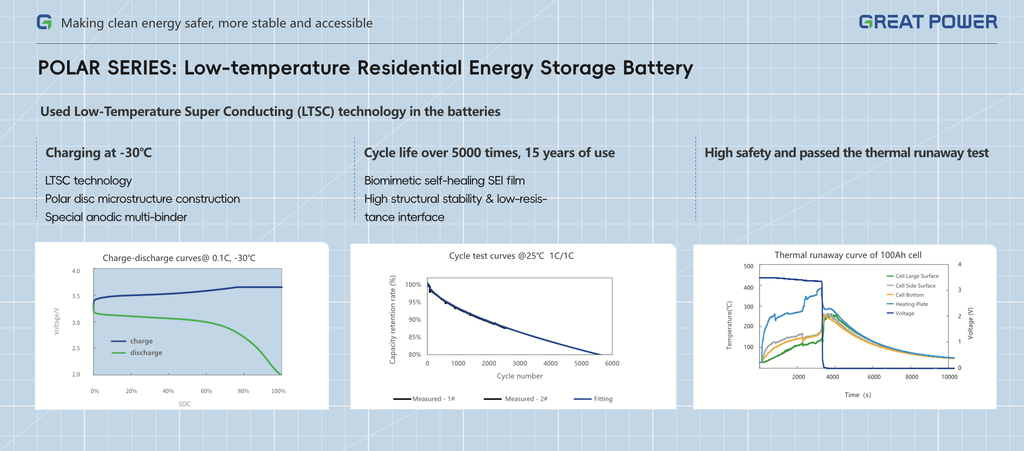
Guangzhou-based cell manufacturer Great Power offers one production example. Its POLAR series uses LTSC low-temperature superconducting technology to accept charge at -30°C, and is rated at 5,000 cycles or more to 80% capacity across a 15-year service life [7].
The scope matters as much as the specification. POLAR is a residential low-temperature line, built for the distributed end of the market where heating hardware is hard to justify: home storage in cold regions, telecom base stations, and light mobile energy storage [7].
Where this approach does not apply: cell-level cold engineering is not a replacement for system-level thermal management in utility-scale containers. Large systems need active thermal control for cooling duty regardless, and their cell formats are different. Treat the two solutions as complementary layers selected by system size and deployment pattern, not as competing options.
What to Check on a Datasheet Before You Specify
The most commonly misread line on a cell datasheet is the operating temperature range, because it usually covers discharge and hides a much narrower charging window inside it.
Published specifications for large-format LFP cells show how wide that gap gets. One 628Ah cell lists a discharge range of -30°C to 60°C but a charging range of 0°C to 60°C. A 588Ah cell from another supplier lists discharge from -35°C to 65°C with charging permitted from -10°C to 65°C. Two cells that look similar on a summary line behave very differently in a January morning charge event.
Four things to confirm before committing to a cell:
| Check | What to ask for |
|---|---|
| Charge vs discharge range | Separate stated limits, not a single combined operating range |
| Capacity retention | Measured retention at your design minimum temperature, with the test rate specified |
| Derating curve | Allowable charge current as a function of temperature, not just a hard cutoff |
| Heating assumption | Whether the quoted range assumes an integrated heating function or bare cell performance |
If a supplier can only provide a single combined range, that is itself a data point. The charging limit is the number that governs whether the system works in winter, and a manufacturer confident in it will publish it separately.
Getting the Layer Right
Two questions settle the layer for most projects.
Does the system already carry an active thermal loop for cooling duty? Where it does, extending that loop to heating is the cheaper path, and the engineering task is verifying the control strategy rather than sourcing a different cell. Can a technician reach the site in winter within the time a heating fault can be tolerated? Where the answer is no, a cell that charges cold removes a failure mode instead of adding one.
Sites that fail both tests, unattended telecom, remote monitoring, and off-grid residential in cold regions, are where cell-level engineering pays for itself. Everything else starts with the same two requests to the supplier: the charging temperature range as a separate number, and the basis the cycle life was measured on.
Great Power manufactures lithium energy storage cells for residential, commercial, and utility-scale applications, with products deployed in over 50 countries and regions [6]. The POLAR series comes in 50Ah, 72Ah, and 100Ah LFP formats carrying UL1973, UL9540A, IEC62619, and UN38.3 certification [7]. Datasheets for its low-temperature energy storage cells are available on request.