How Rugged Outdoor Phones Are Changing Trail Adventures
For years, the phone was the weakest piece of gear on the trail. One drop onto rock or one slip at a creek crossing could take out your map, camera, and emergency line at the same moment. When the nearest shop is hours away, a small failure quickly becomes a serious problem. That risk shaped how people packed, planned routes, and even took photos outdoors.
A rugged outdoor phone changes that. Sealed ports, reinforced corners, and oversized batteries let you worry less about the device and more about the terrain.
This guide explains what has changed and why it matters in the field. You will learn how to read durability claims and which features are worth their weight.
What Are Rugged Outdoor Phones?
A rugged smartphone is built to survive drops, water, dust, and heat. It typically has sealed ports, reinforced corners, and a larger battery. Ordinary phones favor thin bodies and delicate glass, while rugged designs give up some slimness in exchange for durability.
Some models add outdoor extras such as bright screens, glove-friendly touch, and programmable buttons. Features vary by model, so always check the spec sheet. The goal is simple: keep your map, camera, and calls working in rough conditions. Think of a rugged outdoor phone as outdoor gear first and a gadget second.
How Rugged Phones Change Trip Planning
A tough phone removes one of the most common points of failure, so you can plan longer routes and wetter days with more confidence.
Longer Routes
A larger battery usually means more time for navigation and photos. You can run maps, record your track, and shoot video without checking the battery every few minutes. That makes remote loops and multi-day trips easier to plan. On multi-day trips, still carry a power bank.
Wet Conditions
Rain, mud, and creek crossings become far less worrying. Sealed ports and tough housings help the phone handle splashes and dirt. Treat any water rating as a limit, not a promise.
The change is mental as much as physical. You stop shielding the phone and start using it. Photos, tracking, and route checks happen in the moment instead of after the rain stops.
What IP and MIL-STD Ratings Really Mean
IP ratings describe protection against dust and water. MIL-STD-810 is a U.S. military standard that defines environmental test methods. Phone makers often cite both.
In an IP code, the first digit covers solids and the second covers liquids. Higher numbers mean stronger protection on each scale. For IP68, the maker decides the water depth and test duration, so always read the fine print. IP69K is a different kind of test. It comes from a road-vehicle standard and covers high-pressure, hot-water jets rather than long immersion. Makers also note that seawater, soapy water, and hot water can reduce water protection over time.
MIL-STD claims call for the same caution. A maker can say a phone was tested without publishing the results. Ask which test methods were used and under what conditions. Treat both labels as claims to verify, not guarantees. Seals also wear with age, so inspect ports and covers before every trip.
Which Features Matter Most in Rugged Outdoor Phones?
Battery, screen visibility, and controls matter most. Camera and speaker quality come next.
Check these five items on any spec sheet and compare them across your shortlist:
- Battery size: larger cells run maps and cameras for longer, though cold weather and weak signal also drain power.
- Sunlight readability: a bright screen keeps maps legible at midday.
- Glove and wet touch: the screen should respond to gloves and damp fingers.
- Programmable buttons: one press can open a flashlight, camera, or SOS shortcut.
- Satellite positioning: look for support for several systems, such as GPS, Galileo, and BeiDou.
Match features to your routine. A winter hiker needs glove-friendly touch. A paddler needs strong water protection. A mountain biker needs a secure mount and a bright display. Skip extras you will never use, since each one adds cost or weight.
Are Rugged Phones Too Bulky for the Trail?
They can be, depending on your trip. Rugged phones are heavier and thicker than slim ones, and the weight adds up over long climbs and all-day carries. Many models will not fit in a tight trouser pocket.
Plan where the phone will ride. A hip-belt pocket, chest pouch, or belt holster usually works well. Test the fit with your real gear before a long trip.
Cost matters too. Occasional hikers may do fine with a slim phone and a good case. Frequent, remote, or wet trips justify the extra weight. Let your trip pattern decide.
How to Build a Trip Setup
Pair one tough phone with a few simple backups, so a single failure does not end your trip.
Choosing the Phone
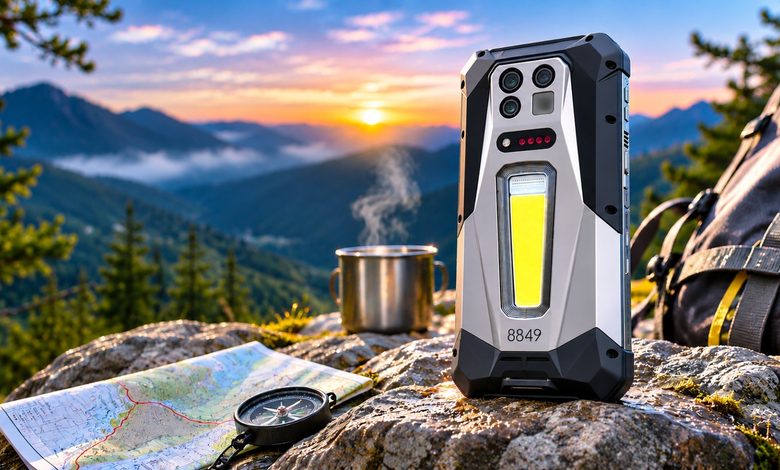
The 8849 Tank 5 Pro shows how far the category has gone. It combines a built-in projector, a thermal camera, and a night vision camera. According to the maker, it has a 17,600 mAh battery and 120W fast charging. The screen is a 6.73-inch AMOLED with 3000 nits of peak brightness, and a 1200-lumen camping light is built in.
The maker lists IP68 and IP69K ratings, so check the test details. At 715 g, it sits at the heavy end of the category, so plan where it will ride. Also check the stated operating temperature range, especially for cold-weather trips. Match these numbers to your route before you buy.
Backup Tools
Even a tough phone can fail or run flat. Use this short pre-trip routine:
- Fully charge the phone and any power bank.
- Download offline maps for your route.
- Test touch response with your trip gloves.
- Set up emergency contacts and shortcut buttons.
- Pack a paper map and share your route plan.
Run through this routine before every outing. Preparation matters as much as durability.
Conclusion
Rugged outdoor phones change trail life in three practical ways. They handle rougher conditions, often run longer, and let you use the phone freely. That freedom changes how you plan routes and pack gear: you stop babying the device and start relying on it.
Still, no phone replaces good preparation. Seals wear, batteries age, and weather changes fast. Treat every rating as a claim to check, match features to your route, and carry simple backups. Weigh the extra bulk against how often you head outdoors.
Ready to upgrade your kit? Compare a few models, read their published specs, and pick one for your next route. Test it on a short outing first so any surprises happen close to home. Then head out with a plan, a backup, and a phone you trust.
READ ALSO: 7 Best Phone Cases That Actually Protect Your Phone