How Sapphire FUE Improves Healing and Hair Density
Modern hair restoration has evolved significantly over the last decade. Patients are no longer searching only for hair coverage they are increasingly focused on natural-looking density, minimal scarring, faster healing, and long-term aesthetic outcomes.
As hair transplant technology continues to advance, the sapphire fue hair transplant method has become one of the most discussed techniques among international patients researching modern hair restoration procedures.
Although traditional FUE remains highly effective, Sapphire FUE introduced a more refined approach to recipient channel creation by using sapphire-tipped blades instead of conventional steel instruments. This innovation has attracted attention because of its potential advantages in healing, graft placement precision, and overall scalp recovery.
For patients comparing hair transplant techniques, understanding how Sapphire FUE works and where its benefits realistically apply can help create more informed expectations before treatment.
What Is Sapphire FUE Hair Transplant?
Sapphire FUE is an advanced variation of the traditional Follicular Unit Extraction (FUE) method.
Like standard FUE procedures, individual follicular units are extracted from the donor area and implanted into thinning or balding regions of the scalp. The main difference lies in the tools used to create recipient channels before graft implantation.
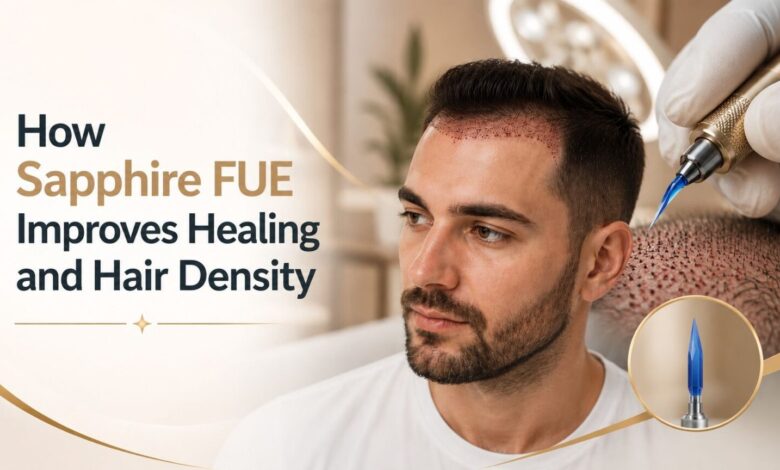
Instead of traditional steel blades, Sapphire FUE uses specially designed sapphire-tipped instruments to open microchannels in the recipient area.
These sapphire blades are known for their:
- sharper edges
- smoother surfaces
- precise incision capability
- reduced tissue resistance
The goal is to improve channel precision while minimizing unnecessary scalp trauma during implantation.
However, it is important to understand that successful outcomes still depend heavily on:
- surgical planning
- graft handling quality
- donor area management
- specialist experience
- natural hairline design
Technology alone does not guarantee successful results.
How Sapphire Blades Work
In hair transplantation, recipient channels determine:
- graft angle
- implantation direction
- density distribution
- overall hairline appearance
Sapphire blade technology allows specialists to create smaller and more controlled recipient channels compared to conventional steel blades.
Because sapphire blades are extremely sharp, they may allow:
- finer incisions
- more precise graft implantation
- reduced tissue disruption
- closer channel placement
This precision becomes particularly important in areas requiring:
- dense packing
- frontal hairline refinement
- natural directional growth
- high aesthetic accuracy
Smaller and more uniform channels may also contribute to improved scalp recovery in some patients.
Differences Between Sapphire FUE and Traditional FUE
One of the most common misconceptions is that Sapphire FUE is a completely different procedure from traditional FUE. In reality, both methods follow the same core extraction principle.
The primary distinction involves the channel creation phase.
Traditional FUE
Traditional FUE commonly uses steel blades to create recipient channels before graft implantation.
This method remains highly successful when performed by experienced specialists and continues to be widely used globally.
Sapphire FUE
Sapphire FUE replaces steel blades with sapphire-tipped blades designed for more refined microchannel creation.
Potential advantages may include:
- reduced scalp trauma
- improved incision precision
- faster healing response
- more controlled density planning
- smaller recipient channels
However, patients should understand that results vary based on:
- scalp characteristics
- hair type
- graft quality
- surgeon expertise
- healing response
No technique can fully compensate for poor planning or inexperienced execution.
How Sapphire FUE Improves Healing
Healing quality is one of the main reasons many patients explore Sapphire FUE procedures.
During any hair transplant, the scalp experiences controlled micro-injuries as recipient channels are created for graft implantation. Minimizing unnecessary tissue damage is important because excessive trauma may prolong redness, swelling, and discomfort.
Sapphire blades may support a smoother healing process because:
- incisions are often smaller
- tissue disruption may be reduced
- channel precision is improved
- surrounding scalp tissue experiences less pressure
For some patients, this can contribute to:
- faster scab shedding
- reduced inflammation
- shorter visible redness duration
- improved scalp comfort during recovery
The healing process still varies considerably between individuals depending on:
- skin sensitivity
- circulation
- smoking habits
- aftercare quality
- overall health
Patients should also remember that healing speed does not necessarily determine final density results.
How Sapphire FUE Supports Better Hair Density
Hair density is one of the most requested goals in modern hair restoration.
Achieving natural density involves far more than simply implanting a high number of grafts. Proper density planning requires careful consideration of:
- donor area capacity
- scalp flexibility
- graft survival rate
- hair caliber
- facial proportions
- future hair loss progression
Because sapphire blades can create smaller recipient channels, specialists may sometimes place grafts closer together with greater control.
This becomes particularly beneficial for:
- frontal hairline density
- temple restoration
- crown refinement
- smaller detailed areas
Closer graft placement may contribute to fuller visual density while still maintaining natural hair direction and scalp circulation.
However, excessive density packing performed incorrectly can compromise blood supply and reduce graft survival.
Experienced specialists focus on balanced density rather than unrealistic overpacking.
Natural Hairline Design and Precision
A natural hairline is one of the most important aesthetic aspects of hair transplantation.
Even technically successful procedures may appear unnatural if:
- graft angles are incorrect
- hairline placement is too aggressive
- density transitions are poorly planned
- follicular units are improperly distributed
Sapphire FUE’s microchannel precision may allow improved control over:
- implantation direction
- angle variation
- hairline softness
- density transitions
Natural hairlines usually contain:
- irregular patterns
- gradual density changes
- finer single graft placement in frontal zones
Creating these subtle details requires artistic planning in addition to technical skill.
The most successful results are often the ones that appear undetectable rather than overly dense or artificially sharp.
Recovery Expectations After Sapphire FUE
Although Sapphire FUE is considered minimally invasive, recovery still requires patience and realistic expectations.
Patients commonly experience:
- temporary redness
- mild swelling
- small scabs
- scalp sensitivity
- temporary shock loss
Most visible healing improves within the first several weeks, although complete hair growth takes significantly longer.
Typical Recovery Timeline
First 7–14 Days
- scabs gradually shed
- swelling decreases
- donor area begins healing
First 1–3 Months
- temporary shedding phase occurs
- transplanted follicles enter resting stage
Months 4–8
- visible growth progressively improves
- texture and density gradually increase
Months 10–12
- final maturation commonly becomes visible
Patients should avoid expecting immediate cosmetic transformation during early recovery stages.
Who Is a Good Candidate for Sapphire FUE?
Sapphire FUE may be suitable for individuals who:
- have stable donor areas
- seek natural-looking density
- want refined hairline work
- prefer minimally invasive techniques
- have realistic expectations
The technique may be especially useful for:
- moderate hair loss
- frontal hairline restoration
- detailed density planning
However, not every patient is automatically an ideal candidate.
Suitability depends on:
- donor hair availability
- scalp condition
- hair characteristics
- extent of hair loss
- long-term progression patterns
A detailed consultation remains essential before selecting the appropriate technique.
Common Misconceptions About Sapphire FUE
As Sapphire FUE becomes more popular internationally, several misconceptions continue to circulate online.
“Sapphire FUE guarantees perfect density”
No hair transplant method can guarantee identical density for every patient. Final outcomes depend on donor quality, healing response, graft survival, and long-term hair loss progression.
“Healing is instant with Sapphire FUE”
Although healing may be smoother for some patients, recovery still requires several months before visible growth develops fully.
“The technology matters more than the specialist”
Advanced tools are helpful, but specialist experience remains one of the most important factors influencing natural-looking results.
Poor planning cannot be corrected solely through technology.
Expert Considerations Before Procedure
Experienced hair restoration specialists typically evaluate several factors before recommending Sapphire FUE.
These include:
- donor area strength
- scalp elasticity
- graft availability
- hair texture
- long-term hair loss stability
- realistic density goals
Patients should also understand that preserving donor area integrity is essential for maintaining future treatment options if hair loss progresses over time.
Ethical treatment planning focuses on:
- natural appearance
- long-term sustainability
- realistic expectations
- balanced graft usage
Successful hair restoration is often achieved through conservative and strategic planning rather than aggressive short-term density goals.
Frequently Asked Questions
What makes Sapphire FUE different from traditional FUE?
The main difference is that Sapphire FUE uses sapphire-tipped blades instead of steel blades to create recipient channels during graft implantation.
Does Sapphire FUE heal faster?
Some patients may experience smoother healing and reduced scalp trauma due to smaller and more precise incisions, although recovery varies individually.
Is Sapphire FUE better for hair density?
Sapphire blade precision may allow closer graft placement in certain cases, which can contribute to improved visual density when planned properly.
Does Sapphire FUE leave scars?
Like other FUE methods, Sapphire FUE typically leaves tiny dot-like scars that are often minimally visible once healing is complete.
Is Sapphire FUE painful?
The procedure is usually performed under local anesthesia, so discomfort during treatment is generally minimal.
How long does recovery take after Sapphire FUE?
Initial healing commonly takes several weeks, while full hair growth results may require 10–12 months.
Is Sapphire FUE suitable for everyone?
No. Suitability depends on factors such as donor area quality, hair characteristics, scalp condition, and long-term hair loss progression.
Can women undergo Sapphire FUE procedures?
Yes, some women experiencing certain types of hair loss may also be suitable candidates depending on individual evaluation.
Conclusion
The growing popularity of the sapphire fue hair transplant technique reflects the increasing demand for procedures that prioritize natural-looking density, refined hairline design, and smoother healing experiences.
By using sapphire blade technology for recipient channel creation, specialists may achieve improved implantation precision, reduced scalp trauma, and more controlled density planning in suitable patients.
However, successful outcomes still depend heavily on:
- specialist expertise
- donor area management
- realistic expectations
- careful graft handling
- long-term treatment planning
For patients researching modern hair restoration options, understanding the technical and medical realities behind Sapphire FUE can help create more informed decisions before treatment.
Many international patients exploring advanced procedures such as Sapphire FUE Hair Transplant also compare recovery expectations, density planning strategies, and long-term aesthetic outcomes when evaluating modern hair restoration solutions.