How to Choose Raincoat Materials for Bulk Promotional Orders
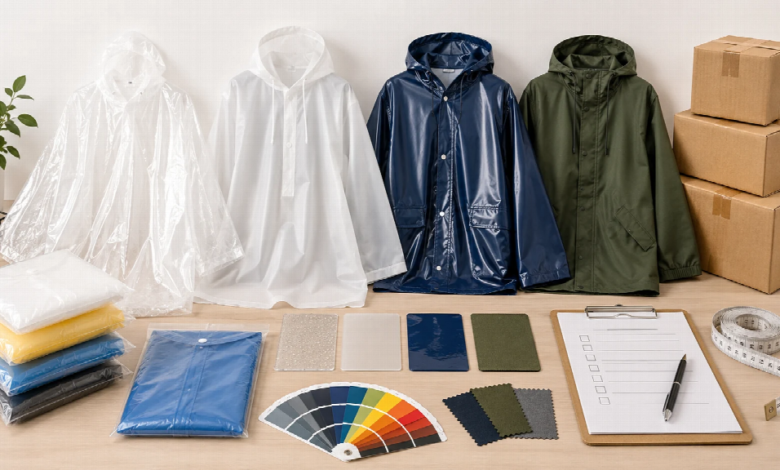
Promotional raincoats may look like simple giveaways, but the material choice affects unit cost, pack size, freight, comfort, logo appearance, repeat use, and complaint risk. A poncho for a one-day outdoor event does not need the same construction as reusable travel rainwear or a uniform for field staff.
The best material is therefore not the most expensive or the cheapest. It is the material and construction that meet the order’s actual use case, target market, branding requirements, packaging plan, delivery deadline, and acceptance criteria.
Decision in one sentence: Use PE for high-volume emergency or short-event distribution; consider EVA for softer, more reusable giveaways; use PVC when a robust plastic-film product is required; choose coated polyester or PVC-polyester for structured staff rainwear; and consider PU-coated polyester for lighter, garment-like higher-value programs. Always confirm the final choice with an approved sample and written specification.

Start with the Use Case
Instead of asking “Which material is best?”, start with “Where will the raincoat be worn, for how long, and what should the user do with it afterward?”
• Single-event distribution: concerts, races, school events, tourism programs, public campaigns, and emergency kits usually prioritize low unit cost, compact packing, fast handout, and adequate short-term coverage.
• Corporate gifts and travel kits: buyers usually place more value on hand-feel, appearance, individual packaging, logo presentation, and the likelihood that the product will be kept.
• Staff and outdoor service: delivery teams, parking attendants, venue staff, sanitation crews, and other outdoor personnel may need stronger seams, better closures, longer coverage, and repeat-use durability.
• Retail or e-commerce: sizing, color consistency, care labeling, packaging presentation, return risk, and documented performance become more important.
This use-case filter prevents overspending on features the campaign does not need and under-specifying products that must be reused or worn for longer periods.
Quick Comparison: PE, EVA, PVC, Polyester, and PU
The table below gives a procurement-level comparison. The cost and durability descriptions are directional only; actual performance depends on thickness or fabric weight, formulation or coating, garment design, seams, closures, and workmanship.
| Material | Best-fit promotional use | Main advantages | Main limitations | Logo printing suitability | Packaging impact | Buyer check before bulk order |
| PE film | Large events, emergency kits, backup rain ponchos | Lowest-cost direction; very light; compact; fast to distribute | Usually limited reuse; tear and seal strength vary greatly with thickness and workmanship | Often suitable for simple surface printing; confirm ink compatibility and fold/rub resistance | Lowest pack volume and freight burden | Thickness tolerance, unfolded size, heat seals, hood, print after folding, piece count and carton loading |
| EVA film | Tourism gifts, travel kits, corporate giveaways, reusable event ponchos | Softer and more flexible than basic PE; cleaner presentation; better perceived value | Higher cost and usually more pack volume than PE; performance still depends on thickness and seams | Can support branded decoration, but the exact ink/process must be tested on the production material | Low to medium; reusable pouch can raise volume and cost | Thickness, odor, hand-feel, color/clarity, snaps, seams, print adhesion and pouch quality |
| PVC film | Reusable plastic raincoats, duty rainwear, transparent or heavy-duty styles | Strong water barrier; durable film options; clear and colored designs available | Can be heavier, stiffer, and bulkier; formulation, odor, cold flexibility, and market compliance require attention | Generally printable with compatible systems; test adhesion, migration, and blocking | Medium to high because of weight and stiffness | Thickness/formulation, target-market compliance documents, cold crack risk, seam welding, closures and odor |
| Polyester / PVC-polyester | Staff uniforms, workwear, retail rain suits, structured jackets | Garment-like structure; sewn designs; broad color and feature options; reusable | Water resistance depends on coating, seam construction, and design—not polyester alone | Broad decoration options; verify print/transfer compatibility and appearance over seams or coatings | Higher pack volume; hangtags, liners, and retail packs add space | Fabric weight/denier, coating, seam tape or sealing, zipper/flap, reflective details, fit and water test target |
| PU-coated polyester | Higher-value staff wear, travel rainwear, branded jackets and retail programs | Lighter and softer garment feel; good visual finish; suitable for more structured apparel | Higher material and workmanship cost; coating quality and seam sealing are critical | Often supports multiple decoration methods, subject to coating and heat sensitivity tests | Medium to high, depending on lining and construction | Base fabric and coating specification, hydrostatic target, seam sealing, delamination risk, print test and wash/care expectations |
Procurement note: do not approve a bulk order from a material name alone. “PE,” “EVA,” “PVC,” “polyester,” or “PU” is only the starting point; the RFQ must also define measurable construction and acceptance criteria.
Why the Material Name Alone Is Not a Specification
Two products can carry the same material label and still perform very differently. Before comparing quotations, procurement teams should define the following six decision gates.
• Material measure: film thickness and tolerance, or the base fabric weight/denier plus coating type and weight.
• Construction: welded, heat-sealed, sewn, taped, or a combination; include seam and closure requirements.
• Coverage and fit: garment dimensions, sleeve and hood design, closure overlap, and adult/child size range.
• Branding: print method, ink compatibility, logo size and placement, number of colors, and appearance after folding.
• Packaging and logistics: individual pack, retail presentation, pieces per carton, carton dimensions, and gross weight.
• Acceptance and market requirements: approved sample, tolerances, inspection plan, test methods, labeling, and destination-market documentation.
A reliable comparison therefore uses a complete product specification and landed-cost model. The material category helps shortlist options, but the approved sample and written order specification determine what the factory must reproduce.
How Each Material Fits a Promotional Program
PE Raincoats and Ponchos for Large-Scale Distribution
PE rain ponchos are typically the most practical starting point when the order requires very high quantities, compact cartons, and quick distribution. They suit concerts, races, public events, emergency kits, tourism activities, and backup weather products. Buyers can review PE raincoat and poncho examples and a bulk rain ponchos for outdoor events guide when planning distribution.
PE should not automatically be described as “disposable” or “durable” without a specification. A very thin product and a heavier PE product can perform differently. Buyers should define thickness and tolerance, garment dimensions, hood shape, sealing quality, closure design, print area, unit packing, carton quantity, and intended wear duration.
EVA for Better Hand-Feel and Reuse
EVA is often selected when buyers want a softer, more flexible promotional raincoat that feels less temporary than a basic PE poncho. It can fit travel kits, tourism gifts, corporate campaigns, and event programs in which recipients are expected to keep the item. A disposable PE vs reusable EVA rain ponchos comparison can help teams decide whether lower packing cost or better reuse is the priority.
The trade-off is a higher unit cost and often a larger packed volume. Before approval, check the actual sample for odor, softness, thickness consistency, clarity or color, snap strength, seam quality, logo appearance after folding, and the quality of any reusable pouch. Buyers can also compare EVA and PVC/EVA rainwear categories.
PVC for Robust Film Rainwear
PVC can be suitable when the program needs a stronger plastic-film raincoat, a transparent look, or a heavier-duty product. Its water barrier can be useful, but buyers should also consider weight, stiffness, odor, cold-weather flexibility, and the chemical or labeling requirements of the destination market.
For custom PVC products, request the exact formulation or compliance documents relevant to the target market, then verify seam welding, closures, print compatibility, blocking after packing, and carton weight. Avoid making broad environmental, safety, or durability claims unless they are supported by current documentation for the exact production material.
Polyester and PVC-Polyester for Structured Rainwear
Polyester-based rainwear is more garment-like because the woven fabric provides structure. The water-resistant layer may be PVC, PU, or another coating, so “polyester raincoat” is not a complete performance specification. Buyers should identify the base fabric, fabric weight or denier, coating type, seam construction, closures, lining, ventilation, and any reflective or safety features.
These options are better suited to reusable staff rainwear, outdoor service programs, retail rain suits, and higher-value promotional projects. Buyers can review PVC-polyester workwear and polyester raincoat categories when comparing structured rainwear options.
PU-Coated Polyester for Lighter, Garment-Like Programs
PU-coated polyester is often considered when the buyer wants a lighter, softer, and more apparel-like product than heavy PVC constructions. It can work well for branded jackets, travel rainwear, staff programs, and retail-oriented projects where appearance and comfort matter.
The RFQ should still specify the base fabric, coating, target water resistance, seam sealing, lining or mesh, zipper and storm-flap construction, print method, and care expectations. Buyers can review PU rainwear categories for relevant product directions.
Bulk Raincoat RFQ Checklist
Copy the following fields into the request for quotation. Where a value is not yet known, ask the supplier to propose options and explain the cost, MOQ, performance, and lead-time difference.
1. Intended use: Event, emergency kit, corporate gift, tourism, retail, staff uniform, or workwear.
2. Quantity and price breaks: Total quantity plus alternative prices at higher or lower volumes.
3. Target market: Destination country/region and any required chemical, labeling, safety, or packaging compliance.
4. Product type: Poncho, coat, jacket, rain suit, adult/child style, reusable or short-term use.
5. Material composition: PE, EVA, PVC, polyester with coating, PU-coated polyester, or proposed alternative.
6. Thickness or fabric specification: Film thickness and tolerance; or fabric weight/denier, coating type, and coating weight if applicable.
7. Color and appearance: Standard color or Pantone target, transparency/opacity, finish, and color tolerance.
8. Size and coverage: Garment length, width/chest, sleeve length, shoulder, hood, adult/child sizing, and dimensional tolerance.
9. Hood design: Fixed or detachable hood, drawcord, brim, face opening, and visibility requirements.
10. Closure system: Snaps, buttons, zipper, storm flap, ties, or open poncho construction.
11. Sleeve and cuff design: Open cuff, elastic cuff, snap adjustment, or poncho arm opening.
12. Seam construction: Heat-sealed, welded, sewn, taped, or combination; identify critical seam requirements.
13. Waterproof performance: Buyer-defined use test and, when required, a laboratory method and minimum result.
14. Logo method: Screen printing, transfer, label, patch, or supplier proposal based on the exact material.
15. Logo specification: Artwork format, print size, position, number of colors, Pantone references, and tolerance.
16. Labels and instructions: Care label, size label, warning text, country of origin, barcode, hangtag, or user instructions.
17. Individual packaging: Polybag, reusable pouch, header card, retail box, barcode label, or custom insert.
18. Carton specification: Pieces per carton, inner packs, carton dimensions, net/gross weight, marks, and palletization.
19. Sample process: Stock sample, custom logo sample, pre-production sample, approval deadline, cost, and revision allowance.
20. MOQ: MOQ by material, color, size, logo process, and packaging option.
21. Lead time: Artwork confirmation, sample time, material booking, production, inspection, and ready-to-ship date.
22. Inspection plan: Defect definitions, sample size/AQL or other agreed sampling plan, and required test reports.
23. Shipping terms: Incoterm, port, shipping mode, consolidation requirements, and latest acceptable delivery date.
24. Event-date buffer: Required arrival date plus contingency time for sample revision, inspection, customs, or transport delay.
Standards note: the buyer must choose methods and pass/fail limits that match the product, target market, and risk. A standard name alone does not establish a suitable performance requirement. In-house checks are screening tools and do not replace accredited laboratory testing when certification or a quantified claim is required.
How to Verify Material Quality Before Bulk Production
Product photos and digital mockups are not approval standards. Final acceptance should be based on an approved physical sample, signed artwork, and a written specification that identifies measurable requirements and tolerances.
• Match the specification. Confirm material, color, size, construction, accessories, logo, packaging, and carton details against the RFQ—not against memory or photos.
• Measure thickness or weight. Check film thickness at several points or verify fabric weight/specification. Define an acceptable tolerance before production.
• Check dimensions and fit. Measure length, width/chest, sleeves, hood opening, and closure alignment; test on representative users where fit matters.
• Evaluate odor and hand-feel. Record any unacceptable odor, tackiness, stiffness, surface blocking, sharp edges, or uncomfortable contact points.
• Screen tear, puncture, and seam strength. Perform repeatable in-house pull and handling checks; use laboratory testing when the contract requires quantified performance.
• Test closures and accessories. Open and close snaps or zippers repeatedly; check button pull, drawcord anchoring, elastic recovery, and sharp points.
• Verify water resistance. Run a defined wear or spray exposure for practical screening. For fabric hydrostatic resistance, buyers can specify ISO 811; for coated rainwear materials, ASTM D751 includes hydrostatic resistance and other coated-fabric tests.
• Test the logo after folding and handling. Fold, pack, rub, and lightly wet the printed area; inspect cracking, peeling, color transfer, misregistration, and placement. A custom rain poncho logo placement guide can support the artwork review.
• Check packaging strength and carton loading. Confirm unit count, seal quality, barcode readability, carton dimensions/weight, and protection during handling. Loaded-container drop testing can be specified when distribution risk justifies it.
• Define final inspection. Use a written defect list and an agreed sampling plan. ISO 2859-1 provides AQL-indexed sampling schemes for lot-by-lot inspection by attributes. A disposable event poncho quality checklist can be used as an additional internal-link resource.
Cost and Lead-Time Factors for Bulk Promotional Raincoat Orders
The quoted unit price is only one part of landed value. The following factors commonly affect cost, lead time, freight, or quality risk.
| Factor | Main impact | Why it matters | Buyer action |
| Material choice | Unit cost / performance | Film and coated-fabric options have different raw-material and processing costs. | Compare materials against the use case, not price alone. |
| Thickness or fabric weight | Unit cost / quality risk | Heavier or tighter specifications use more material and can change tear, feel, and pack weight. | State the value and tolerance; approve a measured sample. |
| Custom color | MOQ / lead time / color risk | Custom resin, film, or fabric dyeing may require a larger run and extra matching time. | Use a stock color where timing or quantity is tight. |
| Garment construction | Labor / lead time | Sleeves, zippers, storm flaps, seam tape, pockets, lining, and reflective details add operations. | Separate must-have features from optional features. |
| Logo printing | Setup / lead time / rejection risk | More colors, larger coverage, fine detail, or difficult surfaces increase setup and approval work. | Provide vector artwork and approve print on the real material. |
| Packaging type | Unit cost / freight / schedule | Pouches, cards, boxes, barcodes, and inserts require materials, artwork, assembly, and more volume. | Confirm packaging before sample approval and request carton data. |
| Sample revisions | Lead time / development cost | Changes to size, color, logo, or packaging can restart parts of the approval process. | Consolidate feedback and set a formal approval deadline. |
| MOQ and size/color split | Unit cost / inventory risk | Splitting a small order across many SKUs reduces production efficiency. | Ask for MOQ by material, color, size, print, and packaging. |
| Carton volume and weight | Shipping cost | Low-cost products can become expensive when cartons are inefficient or heavy. | Compare landed cost using confirmed carton dimensions and gross weight. |
| Inspection and lab testing | Cost / risk control / lead time | Testing and third-party inspection add time and fees but can reduce quality and compliance exposure. | Book requirements early and define who pays for retests. |
| Shipping method | Freight / delivery risk | Air, courier, rail, and sea have very different cost and transit profiles. | Work backward from the required arrival date, not factory completion. |
| Event deadline | Overall risk | A fixed event date leaves little value in a late shipment, even if the unit price is low. | Include buffer for customs, inspection, sample revision, and disruption. |
Common Material-Selection Mistakes
• Choosing the lowest price without defining thickness, size, seams, printing, packaging, and inspection criteria.
• Treating every product labeled “waterproof” as equivalent, even though coverage, closures, seams, coating, and workmanship differ.
• Approving a logo from a digital mockup without testing it on the actual material after folding, rubbing, and packing.
• Ignoring carton dimensions and gross weight when comparing quotes, which can distort the landed-cost comparison.
• Leaving the sample, inspection, and shipping schedule until late in the project instead of planning backward from the event date.
• Using unsupported environmental, safety, or durability claims without current documentation for the exact production material.
Supplier Capability and Material Range
Once the use case and specification are clear, supplier evaluation becomes more objective. A suitable supplier should be able to explain material and construction options, identify customization limits, provide representative samples, confirm packaging and carton data, and commit to a documented production and approval schedule.
Raincoat Gift’s website lists raincoat and poncho categories covering PE, PVC/EVA, PVC-polyester, 100% polyester, and PU, with product pages that include custom or OEM/ODM offerings. One current PE product page lists a 3,000-piece MOQ, individual PE-bag packing, 100 pieces per carton, and a 30-day production time; these figures should be treated as product-specific and reconfirmed for the final configuration. Procurement teams can review the Raincoat Gift raincoat and poncho range, learn more through About Raincoat Gift, and request a quotation after the specification is complete.
Conclusion
There is no single raincoat material that fits every promotional order. PE is usually the most efficient direction for high-volume, short-term distribution. EVA can improve softness and perceived value for reusable giveaways. PVC can serve robust film-rainwear programs. Polyester and PVC-polyester support more structured staff or retail products, while PU-coated polyester is suited to lighter, garment-like programs where appearance and comfort matter.
A well-planned order moves through a clear sequence: use case, measurable material and construction specification, size and coverage, logo method, packaging, approved sample, testing and inspection, carton data, production lead time, and shipping buffer. This approach gives the buyer a stronger basis for comparing quotations and accepting mass production.
Information to send with a quote request: Use case, quantity, target market, required arrival date, preferred material or performance level, size, color, logo artwork, packaging, inspection requirements, shipping destination, and target budget.
FAQ
Which raincoat material is usually the most economical for promotions?
PE is usually the lowest-cost direction for high-volume ponchos, but the quote is not comparable until thickness, size, sealing, logo, packing, carton data, and intended use are defined.
Is EVA better than PE for promotional raincoats?
Not in every case. EVA is often softer and better suited to reusable or higher-value giveaways, while PE may be the better choice for compact, low-cost, short-event distribution.
When should buyers choose PVC, polyester, or PU rainwear?
Choose these options when the project needs more structure, repeat use, stronger construction, staff-wear features, retail presentation, or a garment-like finish. The coating, seams, and closures must still be specified.
What should buyers check in a raincoat sample?
Check material thickness or fabric specification, dimensions, hood and closures, seam quality, odor and hand-feel, water exposure, logo adhesion after folding, unit packaging, and carton details. Approve the sample against a written specification.
How should waterproof performance be specified?
Define a practical use requirement first, then select a suitable test method and minimum result when quantified performance is necessary. ISO 811 covers hydrostatic-pressure resistance for water-resistant fabrics, and ASTM D751 includes hydrostatic resistance and other methods for coated fabrics.
How can buyers reduce quality risk in a large order?
Use an approved pre-production sample, signed artwork, measurable tolerances, a defect list, an agreed final-inspection sampling plan, and written rules for handling failed tests or rework.
Does a more expensive material always create a better promotional result?
No. A lower-cost poncho can be effective when compact distribution is the goal, while a higher-value program may justify better hand-feel, packaging, fit, and reuse. The material should match the campaign objective.