Optical Connectivity Is Becoming a Core Layer of AI Data Center Design
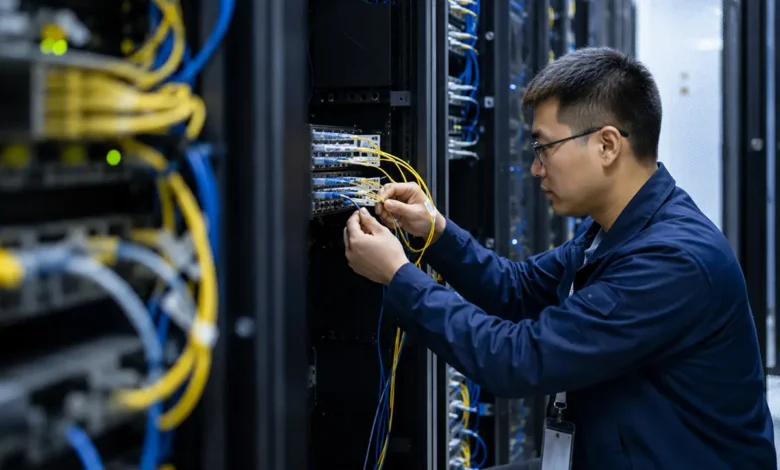
AI Growth Is Changing the Shape of Data Centers
AI is often described through models, chips and software platforms, but its growth is also changing the physical design of data centers. A modern AI facility is not simply a room filled with servers. It is a tightly connected computing environment where accelerators, storage systems, switches and optical modules must move large volumes of information continuously. When the network layer cannot keep pace, expensive compute resources sit idle and the efficiency of the entire facility declines.
This is why the AI boom is becoming a data center infrastructure story. The International Energy Agency’s 2025 Energy and AI report estimated that data centers consumed about 415 TWh of electricity in 2024 and could reach around 945 TWh by 2030. The same report also noted that global data center investment had nearly doubled since 2022. These figures show that AI is not only increasing demand for computing power; it is forcing a new wave of physical infrastructure planning.
Inside that infrastructure, optical connectivity is becoming more important. As AI clusters scale across more racks and larger buildings, data must travel between devices with high bandwidth, low latency and stable signal performance. In that environment, high-density fiber assemblies such as mpo/mtp patch cable products are not just supporting accessories. They are part of the structured cabling layer that helps data centers manage density, speed and future expansion.
The Network Is No Longer a Background System
In conventional enterprise environments, the network often supported applications that could tolerate moderate delay or uneven traffic patterns. AI workloads create a different kind of pressure. Training and inference systems rely on frequent data exchange between accelerators, storage and switching fabrics. The more distributed the compute environment becomes, the more important the physical interconnect layer becomes.
This change is also visible in real estate and infrastructure forecasts. JLL’s 2025 Global Data Center Outlook reported that AI demand is pushing the industry toward larger campuses, higher rack densities and more complex power and network requirements, while estimating that global data center market value could reach about $1 trillion by 2030. At the same time, optical component companies are seeing the interconnect layer expand. Lumentum projected in 2025 that the total addressable market for AI optical interconnects could grow from about $18 billion to $90 billion within five years. These signals point in the same direction: AI infrastructure is making high-speed optical connectivity more strategic.
Copper will not disappear from data centers. It remains useful for short, cost-sensitive connections. However, copper becomes harder to manage as bandwidth, distance and heat increase. Optical fiber offers advantages for longer reach, better signal behavior and high-density network layouts. For AI clusters that must connect many devices across racks, rows and rooms, those advantages become more than technical preferences.
Density Creates a Cabling Challenge
AI data centers are dense environments. They bring together high-power servers, GPUs, switches, storage arrays and cooling systems in layouts where every rack unit and cable path matters. A poorly planned cabling system can create airflow problems, maintenance delays and troubleshooting complexity. Even when the electronics are advanced, the physical layer can become a weak point if connections are difficult to identify or replace.
MPO and MTP-style multi-fiber connectivity helps address this challenge by carrying multiple fibers through a compact connector format. Instead of managing large numbers of individual duplex jumpers across every part of the network, engineers can use trunks, breakout cables and cassettes to organize high-fiber-count pathways. This is especially useful in high-speed data center environments where migration from 40G to 100G, 400G or higher-speed architectures requires both capacity and structure.
The benefit is not only a cleaner rack. A structured fiber layer also supports repeatable deployment. When polarity, fiber count, connector gender, labeling and test results are clearly controlled, installation teams can work faster and with fewer errors. That matters in AI facilities, where thousands of links may need to be installed under tight project schedules.
Optical Cabling Supports Expansion and Migration
AI infrastructure is rarely static. A facility may be designed for one generation of hardware and then upgraded as new accelerators and switches become available. A network may also need to support both training clusters and inference workloads, each with different traffic patterns. Because of this, data center cabling must support not only today’s design but also tomorrow’s expansion.
Optical cabling is well suited to this requirement. Fiber trunks can create organized pathways between distribution areas, racks and equipment rows. Breakout assemblies can adapt high-density backbone links to equipment-side interfaces. MPO-to-LC structures, for example, are often useful when a high-density trunk system must connect to transceivers or switch ports that use LC interfaces. This flexibility helps operators upgrade sections of the network without rebuilding the entire physical layer.
Reliable migration also depends on testing and documentation. High-density optical links should be checked for insertion loss, return loss, end-face condition and polarity. In AI data centers, where a single unstable link may affect a larger compute workflow, those details matter. The physical cable assembly must be treated as part of the performance chain, not as a simple commodity.
The Supply Chain Behind AI Infrastructure Matters
The strategic importance of optical infrastructure is also visible in supply chain activity. Tom’s Hardware reported in May 2026 that Nvidia’s investment in Corning would support new optical fiber manufacturing facilities for AI data center connectivity. The report connected optical fiber and photonics with the bandwidth and latency requirements of large AI deployments. This kind of investment supports the same conclusion as the JLL and Lumentum data: major AI infrastructure companies are thinking beyond processors and software. They are also looking at the materials and components required to deploy large systems reliably.
For data center builders, that lesson is important. The performance of an AI facility depends on many layers working together: power, cooling, compute, switching, optics, cabling and installation quality. A weakness in any one layer can reduce the value of the others. If links are unstable, mislabeled, poorly tested or hard to manage, the network becomes more difficult to operate as the facility grows.
This is why repeatable fiber assembly quality matters. Data center projects need more than a sample that looks good. They need production consistency, clear specifications, reliable testing and packaging that supports large-scale deployment. As AI facilities become larger and denser, the cost of rework becomes higher. Good cabling design reduces avoidable risk before equipment goes live.
Optical Links Are Part of AI Infrastructure Strategy
The next stage of AI infrastructure will not be defined only by faster chips. It will also be defined by how well those chips are connected. As compute spreads across more racks and more facilities, optical links will become a larger part of data center planning. They provide the reach, density and structure needed to move information across complex environments.
MPO/MTP cabling fits this direction because it gives engineers a practical way to organize many fibers in compact spaces. It supports trunk routes, breakout connections, patching areas and migration projects. It also helps create a physical layer that can be documented, tested and expanded as network requirements change.
AI may begin with algorithms, but it becomes real through infrastructure. The data center of the future will rely on efficient power, advanced cooling, high-performance compute and a carefully designed optical network. In that system, fiber connectivity will not be an afterthought. It will be one of the foundations that determines whether AI clusters can scale reliably.
Source Notes
Reference points used in this article include the International Energy Agency’s 2025 Energy and AI report, JLL’s 2025 Global Data Center Outlook on AI-driven data center expansion, Lumentum’s 2025 projection for AI optical interconnect market growth, and Tom’s Hardware’s May 2026 report on Nvidia’s Corning optical fiber investment.