Oseyo: Meaning, Korean Language, Culture, Food, and the Popular Oseyo Brand
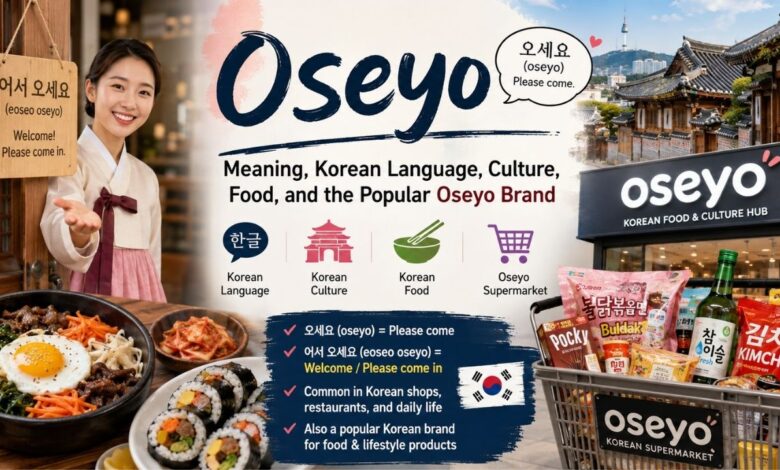
The word oseyo has become increasingly recognizable among people interested in Korean language, Korean culture, food, K-dramas, K-pop, and Korean shopping. Although the word may look simple, oseyo can have different meanings depending on the context in which it appears. In Korean, 오세요 (oseyo) is a polite expression connected to the verb 오다 (oda), meaning “to come.” It can be translated as “please come,” “come,” or, in certain contexts, “please come in.”
The longer expression 어서 오세요 (eoseo oseyo) is especially familiar to visitors of Korean shops and restaurants. It is commonly translated as “welcome” or “welcome, please come in.” The expression is used when receiving guests and by shop employees when greeting customers.
At the same time, Oseyo is also used as the name of businesses, including Korean food establishments and a Korean-focused supermarket retailer in the United Kingdom. This makes the keyword interesting for both language learners and people searching for Korean food, groceries, restaurants, and cultural experiences.
What Does Oseyo Mean?
The Korean word 오세요 is romanized as oseyo. Its basic meaning is related to “come” and is expressed politely. The word is commonly used when asking or inviting someone to come somewhere. For example, a Korean speaker can use 오세요 when politely telling someone to come.
The expression becomes particularly recognizable when it appears as 어서 오세요. In this phrase, 어서 contributes the sense of “quickly” or “come on,” while 오세요 means “please come.” In everyday English, translating the entire phrase literally is less natural than translating it as “welcome” or “please come in.”
This is why people watching Korean dramas or visiting South Korea may frequently hear something that sounds like “eoseo oseyo” when entering a store or restaurant.
Oseyo in Korean Language
Understanding oseyo requires a basic understanding of Korean verb forms. The dictionary form 오다 (oda) means “to come.” The form 오세요 (oseyo) is a polite form used when addressing another person.
The ending -세요 (-seyo) is widely encountered in Korean because it can make expressions more polite and is often used when making polite requests or commands. Consequently, Korean learners will encounter similar constructions in everyday conversations.
For example:
- 오세요 (oseyo) — Please come.
- 어서 오세요 (eoseo oseyo) — Welcome / Please come in.
- 이쪽으로 오세요 (ijjogeuro oseyo) — Please come this way.
- 다시 오세요 (dasi oseyo) — Please come again.
A Korean learning resource gives 이쪽으로 오세요 as an example meaning “Please come this way,” demonstrating how 오세요 can be used naturally in everyday situations.
Oseyo and the Phrase Eoseo Oseyo
One of the most important distinctions for people researching oseyo is the difference between 오세요 and 어서 오세요.
오세요 is the shorter expression and can mean “please come.” 어서 오세요, on the other hand, is a conventional welcoming phrase. It is commonly used when a guest or customer arrives.
The phrase is particularly associated with Korean customer-service environments. When entering a Korean shop, restaurant, or other commercial establishment, visitors may hear staff say 어서 오세요. The phrase is not normally intended as a literal command for the customer to hurry. Instead, it functions as a warm and polite greeting.
This cultural context is essential because a direct word-for-word translation can sometimes make the phrase sound more forceful in English than it actually is.
How to Pronounce Oseyo
Oseyo is written in Hangul as 오세요 and is commonly romanized as “oseyo.” The longer expression 어서 오세요 is romanized as eoseo oseyo.
English speakers may initially find Korean pronunciation unfamiliar because Korean sounds do not always correspond exactly to English spelling. The best way to learn the pronunciation is to listen to native Korean speakers and repeat the phrase.
When learning Korean, it is also useful to learn the Hangul spelling rather than relying entirely on romanization. In this case:
오세요 = oseyo
and
어서 오세요 = eoseo oseyo
Learning both forms makes it easier to recognize the expression when reading Korean signs, menus, subtitles, or storefronts.
Why Oseyo Is Associated With Korean Hospitality
The phrase 어서 오세요 is strongly connected with hospitality. Korean businesses often use it to acknowledge customers when they enter.
For travelers, this can be one of the first Korean expressions they notice. A visitor may hear it repeatedly while shopping, dining, or exploring commercial areas. The phrase communicates that the person has been noticed and welcomed.
This makes oseyo more than just a vocabulary word for many learners. It can represent an everyday aspect of Korean social interaction and customer service.
The phrase is also frequently encountered in Korean-language learning materials because it is practical and immediately useful for travelers. A Korean restaurant lesson, for example, teaches 어서 오세요 as “Welcome!” and 이쪽으로 오세요 as “Please come this way.”
Oseyo in Korean Restaurants
The connection between oseyo and restaurants is particularly strong. Korean restaurants often use welcoming language when customers enter, and 어서 오세요 is a familiar example.
For someone visiting Korea for the first time, hearing 어서 오세요 in a restaurant can be a memorable cultural experience. It is a small but meaningful part of dining etiquette.
The word oseyo has also been adopted directly as a restaurant and food-business name outside Korea. One example is Oseyo Korean Street Food, a Redmond-based business that describes itself as a small team focused on Korean flavors. Its menu features kimbap, rice bowls, sauces, banchan, and other Korean-inspired food.
Oseyo Korean Street Food
Oseyo Korean Street Food is one modern example of the word being used as a commercial brand. Its online menu features a range of Korean dishes, with kimbap being one of its prominent offerings. The menu includes options such as tuna kimbap, pork-based kimbap, spicy pork kimbap, and its signature Oseyo kimbap.
The business describes its approach around fresh ingredients, Korean flavors, community, and shared meals. Its current information identifies the business as being located in Redmond, Washington, and says it accepts online orders.
This example illustrates how oseyo can communicate more than a literal Korean-language meaning. As a brand name, it can evoke Korean hospitality and create an immediate cultural connection.
Oseyo and Korean Food Culture
Another reason the keyword oseyo attracts attention is its association with Korean food culture. Korean cuisine has become increasingly popular internationally, with dishes such as kimchi, kimbap, bibimbap, Korean fried chicken, tteokbokki, japchae, and Korean barbecue becoming familiar to audiences around the world.
A business using the name Oseyo can therefore benefit from the word’s cultural associations. The name sounds distinctly Korean while also being short and memorable for international audiences.
For food lovers, searches involving “oseyo” may therefore relate to restaurant menus, Korean supermarkets, Korean snacks, recipes, or places selling Korean ingredients.
Oseyo as a Korean Supermarket Brand
The keyword oseyo has another important commercial meaning in the United Kingdom. Oseyo is a Korean-focused retail brand associated with Korean and Asian food and culture.
Oseyo’s LinkedIn company profile describes the organization as a Korean food and culture hub and identifies it as a retail company headquartered in London. It says the company focuses on Korean foods as well as products such as toys, stationery, housewares, and electronics.
The Times reported in 2025 that Oseyo was expanding its UK retail presence and described the company as specializing in Korean food. The publication highlighted a London Bridge location and reported that Oseyo had multiple stores in London.
Therefore, someone searching for Oseyo online may not necessarily be looking for the Korean word. They may be searching for the supermarket brand, a nearby branch, products, opening information, or Korean groceries.
What Can You Find at Oseyo Supermarkets?
The Oseyo retail brand is associated with Korean and wider Asian products. Depending on the location, shoppers may encounter Korean food ingredients, snacks, beverages, noodles, sauces, frozen foods, household products, and other items connected with Korean culture.
This type of store can be especially useful for people who want to recreate Korean meals at home. Ingredients that can be difficult to find in ordinary supermarkets may be available through specialist Korean and Asian retailers.
Oseyo’s cultural positioning also means that the shopping experience can be connected with the broader popularity of Korean culture. Korean food, K-pop, K-dramas, beauty products, and lifestyle trends have helped introduce international audiences to more aspects of South Korean culture.
Oseyo and the Growth of Korean Culture
The international popularity of Korean culture has helped increase interest in Korean vocabulary. People who discover Korean dramas, music, food, and travel often begin learning common expressions.
Words such as annyeonghaseyo, kamsahamnida, and oseyo can become familiar to international audiences even before they begin formal Korean study.
In this environment, oseyo has an advantage because it is connected to a phrase people can actually hear in everyday commercial settings. Someone who visits Korea may hear 어서 오세요 in a store or restaurant and later search for its meaning.
Oseyo in Korean Dramas and Travel
Korean dramas frequently portray everyday situations involving restaurants, cafés, shops, offices, and homes. As a result, viewers can encounter common Korean greetings and expressions repeatedly.
어서 오세요 is especially easy to notice because it is associated with the arrival of customers. Viewers who hear it repeatedly may search for “oseyo meaning” to understand what characters or shop workers are saying.
For travelers, learning this phrase before visiting Korea can make everyday interactions easier to understand. Even if a visitor cannot speak Korean fluently, recognizing a phrase such as 어서 오세요 can make the environment feel more familiar.
Common Expressions Related to Oseyo
People learning the word oseyo may benefit from studying related expressions.
Oseyo — 오세요
This is the basic polite expression meaning “please come.”
Eoseo Oseyo — 어서 오세요
This is a common welcoming expression meaning “welcome” or “please come in.” It is frequently used for guests and customers.
Ijjogeuro Oseyo — 이쪽으로 오세요
This means “please come this way.” It is a practical phrase that can be used when guiding someone.
Dasi Oseyo — 다시 오세요
This expression means “please come again.” It can be appropriate when saying goodbye to a customer or guest.
Learning these expressions together helps learners understand how 오세요 works in different contexts.
Is Oseyo a Formal Korean Expression?
The answer depends on how the word is being used. 오세요 is a polite form, making it suitable for many everyday interactions where respect is required.
The longer phrase 어서 오세요 is also a standard welcoming expression. There is an even more formal variant, 어서 오십시오 (eoseo osipsio), which is another way of saying “welcome” or “please come in.”
For beginners, 어서 오세요 is particularly useful because it appears frequently in real-world situations involving customers and guests.
Oseyo vs. Other Korean Greetings
It is important not to treat oseyo as a general replacement for every Korean greeting.
For example, 안녕하세요 (annyeonghaseyo) is a common polite greeting equivalent to “hello.” 오세요 (oseyo) is related specifically to coming, while 어서 오세요 functions as a welcoming expression.
The distinction becomes much clearer when learners consider the situation. If you meet someone on the street, you would not normally replace “hello” with oseyo. If someone is entering a shop and you are welcoming them, 어서 오세요 is appropriate.
Frequently Asked Questions About Oseyo
What does oseyo mean?
Oseyo (오세요) is a polite Korean expression related to “come.” It can mean “please come” and can appear in longer expressions such as 어서 오세요, meaning “welcome” or “please come in.”
What does eoseo oseyo mean?
Eoseo oseyo (어서 오세요) is a common Korean welcoming expression. It is often translated as “welcome” or “please come in.”
Is oseyo the same as welcome?
Not exactly. 오세요 (oseyo) literally means “come.” 어서 오세요 (eoseo oseyo) is the expression commonly used as “welcome” or “please come in.”
Where might I hear oseyo?
You may hear 어서 오세요 in Korean shops, restaurants, and other customer-service environments. It is also common in Korean-language learning materials.
Is Oseyo also a business name?
Yes. Oseyo is used by Korean food businesses and by a Korean-focused retail brand in the United Kingdom. One example of a food business is Oseyo Korean Street Food in Redmond, Washington.
Conclusion
Oseyo is a small but meaningful Korean keyword with connections to language, hospitality, food, retail, and Korean popular culture. In Korean, 오세요 (oseyo) is a polite expression related to “come,” while the familiar phrase 어서 오세요 (eoseo oseyo) is commonly used to welcome guests and customers.
You May Also Read: 1500 E Colfax Food Truck Menu: A Food Truck Haven with Gourmet Tacos, Burgers, and Global Flavors