Robotic welding for structural steel: welding robot for beam welding and fabrication of steel structure
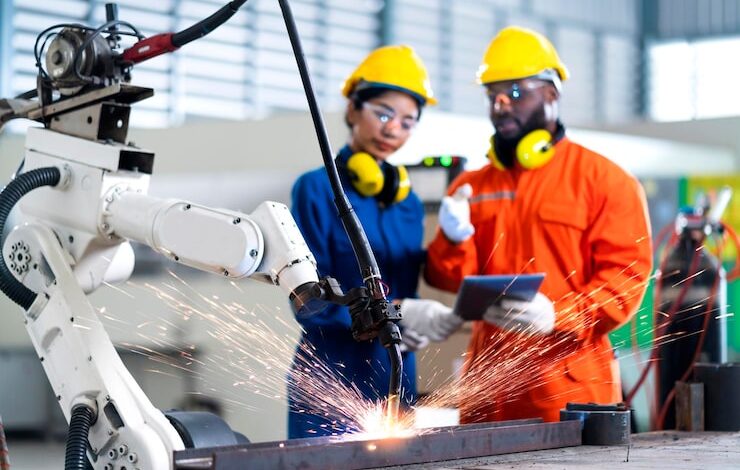
An understanding of robotic welding for structural steel is now essential for fabricators who seek to increase productivity, improve weld consistency, and scale structural steel fabrication. This article examines how a welding robot and associated welding automation systems transform beam welding and related operations in steel structure shops, exploring types of robotic welder systems, return on investment considerations, technical challenges, training needs, and the decision framework for automating beam welding in the structural steel industry.
View China Welding Robot Manufacturer | Steel Structure Welding Robot – Zhouxiang details to get into the details
How does a welding robot improve productivity for structural steel fabricators and beam welding automation?
Robotic weld solutions materially improve productivity for structural steel fabricators by reducing cycle times, minimizing non-value-added handling, and enabling continuous operation with fewer breaks than manual welding crews. A welding robot integrated into a production cell performs repetitive welds on beams, plates, and connections with high speed and consistent weld procedures, which accelerates throughput for beam welding automation. Automation of fitting and welding processes eliminates much of the idle time associated with manual welders repositioning and re-clamping components, while robotics deliver repeatable torch motion profiles and optimized arc welding parameters that maximize deposition rates and travel speeds. For steel fabricators looking to scale output, a robotic system allows the same number of operators to supervise multiple cells or focus on quality inspection and secondary tasks, raising overall shop productivity without proportionally increasing labor costs.
What productivity gains can steel fabricators expect when they automate beam welding?
Productivity gains from automating beam welding vary by weld type, joint complexity, and the degree of upstream part preparation, but typical structural steel fabricators can expect weld time reductions of 30–70% on long, repetitive seams when moving from manual welding to robotic welding. Gains are particularly pronounced for continuous fillet welds along steel beam flanges, full-penetration groove welds with consistent prep, and repetitive bracket attachment work where a robotic welder can execute identical passes at optimized travel speeds. Beyond pure welding speed, additional productivity stems from lower rework rates, reduced consumable waste, and fewer stoppages for operator fatigue, all contributing to higher effective throughput per shift.
How does robotic weld consistency compare to manual welding for structural steel?
Robotic weld consistency typically exceeds manual welding for high-volume, repetitive joints in structural steel because robots follow programmed weld procedures precisely and maintain arc length, travel speed, and wire feed rates within tight tolerances. This consistent application of arc welding parameters reduces variability in penetration, reinforcement, and undercut, which in turn reduces the incidence of weld defects and the need for rework. While highly skilled manual welders can produce excellent results on complex or one-off assemblies, structural steel robotic systems deliver superior repeatability and a narrower distribution of quality outcomes, which is critical for structural steel projects that require predictable performance and simplified inspection regimes.
Which welding processes and robot configurations drive the biggest time savings?
Arc welding processes such as GMAW (MIG/MAG), FCAW, and robotic SMAW variants configured for high-duty-cycle operation are commonly used in structural steel robotic systems and offer substantial time savings. Gas metal arc welding (GMAW) and flux-cored arc welding (FCAW) provide high deposition rates that, when coupled with optimized robot trajectories and oscillation patterns, deliver the largest reductions in arc-on time. Robotic configurations that combine multi-axis industrial robot arms, positioners for indexing heavy steel beams, and integrated seam-tracking sensors achieve the most dramatic time savings by enabling continuous welding of long seams with minimal repositioning. For thick-section groove welds, multi-pass strategies executed by powerful robotic welders with controlled interpass times and heat input monitoring also shorten cycle times compared to manual approaches.
What types of robotic welder systems are specifically for structural steel and steel beam welding?
Structural steel welding robots and systems designed specifically for beam welding vary from dedicated beam welding robots, which are purpose-built with specialized end-effectors and long-reach arms, to general industrial robot cells adapted for structural steel fabrication. Dedicated beam welding robots often include heavy-duty positioners, long-reach six-axis arms, integrated seam tracking, and welding machines tuned for high-deposition arc welding processes. General robotic welding systems for manufacturing can be adapted to structural steel by selecting appropriate robot models with increased payload and reach, integrating robust fixtures, and pairing the robot with welding machines and process controls suitable for heavy-section steel.
What differences exist between dedicated beam welding robots and general welding robots?
Dedicated beam welding robots are engineered specifically for the demands of structural steel, offering greater reach, higher payload capacities, reinforced bases for mounting on track systems, and tooling optimized for long linear seams and large cross-sections of steel beam. They may include integrated dedicated controls for seam-following over long distances and specialized safety enclosures sized for large assemblies. General welding robots, while flexible and capable of addressing a broad range of welding automation tasks, often require external enhancements—such as larger positioners, extended arm options, or custom end-effectors—to match the throughput and robustness of purpose-built beam welding automation. The choice between dedicated and general robots depends on production volume, diversity of part types, and the strategic focus of the fabrication shop.
Which arc welding methods are commonly integrated into structural steel robotic systems?
Common arc welding methods integrated into structural steel robotic systems include gas metal arc welding (GMAW/MIG), flux-cored arc welding (FCAW, including self-shielded), submerged arc welding (SAW) for long straight seams, and in some cases gas tungsten arc welding (GTAW/TIG) for specialized fit-up or controlled root passes. SAW systems paired with robotics are attractive for long, straight steel beam seams where high deposition rates are crucial, while FCAW and GMAW are preferred for field-like bracket welding and flange attachments because of their portability and high deposition rates combined with robot repeatability. The selection of welding process also influences consumable inventory, fume extraction needs, and weld procedures used for qualification.
How do robotics and tooling vary for plate welding vs. fitting and welding of beams?
Robotics and tooling for plate welding focus on flat work heights, smaller positioners, and tooling that efficiently clamps smaller plates and subassemblies, while fitting and welding of beams require heavier duty positioners, beam rotators, or track-mounted robot systems to accommodate long lengths and heavier loads. Beam welding automation often employs longitudinal seam tracking, custom end-effectors for accessing tight web-to-flange intersections, and large fixtures to manage fit-up. Conversely, plate welding cells are often more compact with modular fixtures allowing quick changeover. The tooling for beams must also address part variation and distortion control, necessitating robust clamps, temporary tack welding strategies, and integrated measuring sensors to ensure alignment before full weld passes commence.
How do structural steel fabricators evaluate ROI and cost for welding automation?
Evaluating ROI for welding automation in structural steel fabrication requires a comprehensive analysis that includes capital expenditure for the robotic system and welding machine, integration and tooling costs, training, expected productivity improvements, reduction in labor hours, consumable savings, and lower rework rates. Fabricators should model different scenarios to account for production volume, mix of weld types, and the ramp-up period during which programmers refine weld procedures and optimize cycle times. Many structural steel robotic projects achieve payback in two to five years when including savings from increased throughput, reduced overtime, and lower defect rates, but the specific timeline depends on the shop’s utilization of the robotic system and the alignment of workflow to sustain continuous operation.
What factors affect ROI for automating structural steel fabrication with robots?
Key factors affecting ROI include initial cost of the robotic welding system, the complexity and variability of beam geometries, the percentage of welds that are repetitive and suitable for automation, labor costs in the region, expected increases in throughput, reductions in rework and scrap, and the integration of the robot into existing workflow. Additional influencers are the selection of arc welding process (e.g., SAW vs. FCAW), the cost and lifespan of fixtures and consumables, and whether the fabricator will deploy the robot continuously or for only select production runs. Structural steel fabricators must also factor in maintenance, spare parts, and potential upgrades to welding machines and software that may alter long-term ROI.
How should a fabricator calculate savings from reduced rework and higher throughput?
A fabricator should quantify savings by tracking baseline metrics for manual welding: average weld time per joint, rework rate and cost per rework event, consumable use, and throughput per shift. After implementing a robotic welding system, measure the new average weld times, defect rates, and the number of parts produced per shift. Savings from reduced rework can be calculated as the difference in rework incidents multiplied by the average cost per incident (including labor, materials, and schedule impacts). Throughput gains should be converted to incremental revenue or avoided overtime costs. A conservative model uses phased improvements over an adjustment period while capturing qualitative benefits such as improved schedule reliability and reduced dependency on scarce manual welders.
What are typical investment ranges for a robotic system for beam welding?
Investment ranges for a robotic welding system for beams vary widely depending on system complexity, robotics brand, robot reach and payload, welding process, and fixture requirements; typical turnkey systems for beam welding start in the low six-figure range and can extend into the high six or seven figures for multi-cell, high-capacity lines including heavy positioners, track systems, and advanced sensors. Small to mid-size cells configured for common structural steel tasks with a single industrial robot and basic positioner may be attainable at more modest capital levels, whereas fully automated lines designed to handle varied beam sizes, long lengths, and high throughput require higher investment but deliver correspondingly greater productivity and lower unit costs over time.
What are the main technical challenges in robotic welding for structural steel and how are they solved?
Technical challenges in robotic welding for structural steel include handling part variation and distortion, achieving reliable fixturing for heavy beams, maintaining weld quality across varied joints, integrating seam tracking for long welds, and ensuring robust robot programming for diverse weld geometries. These challenges are solved through comprehensive fixture design, use of adaptive sensors and seam-tracking systems, advanced robot programming techniques, and judicious selection of arc welding parameters and consumables tailored to structural steel weld procedures. Additionally, quality is maintained by implementing in-process monitoring systems and closed-loop controls that adjust parameters in real time to mitigate variation.
How do robots handle fixturing and part variation during fitting and welding?
Robots handle fixturing and part variation by relying on versatile fixtures and clamps that allow quick adjustment, by employing positioners that orient the workpiece for optimal torch access, and by incorporating sensors such as laser scanners and vision systems to detect variation and feed positional offsets into the robot program. Many fabricators use modular fixture plates and adjustable supports to accommodate different beam profiles, while seam-tracking systems compensate for residual misalignment by dynamically modifying the robot path. For long beams, track-mounted robots and distributed support points are used to control sag and maintain consistent torch-to-work distances during welding.
How is weld quality monitored and controlled in structural steel robotic systems?
Weld quality in structural steel robotic systems is monitored using a combination of arc monitoring, weld seam tracking, and post-weld inspection tools. Arc welding power sources with data logging capture parameters such as current, voltage, wire feed speed, and travel speed to verify that the programmed weld procedure was executed within specified limits. Additional sensors such as camera-based seam trackers, laser profilometers, and real-time thermal monitoring can detect deviations and trigger corrective strategies or alarms. Coupled with qualification of weld procedures and routine non-destructive testing, these controls ensure that robotic welds meet structural codes and engineering specifications.
What programming and sensors are used to adapt to warped or inconsistent steel beams?
To adapt to warped or inconsistent beams, robot programming often includes adaptive path generation, offline programming augmented with real-world teach points, and closed-loop feedback from sensors like structured-light scanners, laser triangulation, and camera systems that feed real-time corrections to the robot controller. Advanced robotic welding systems use sensor fusion, combining positional feedback, seam tracking, and arc voltage-based sensing to automatically adjust torch trajectory and maintain consistent penetration despite variation. Offline programming software accelerates the creation of weld programs for varied parts, while in-cell teach tools and parameterized routines enable quick adaptation to new beam geometries and distortion patterns.
What training, robot programming, and integration steps are needed for structural steel welding robots?
Successful deployment of structural steel robotic welding requires structured training, thorough robot programming, and careful integration into shop workflow. Training should cover robot operation, safety protocols, welding process parameters, routine maintenance, and basic troubleshooting. Robot programming for structural steel involves developing robust weld procedures, integrating seam tracking and positioner control, and creating flexible programs capable of handling part variation. Integration steps include layout planning for material flow, fixture design, power and fume extraction provision, and phasing implementation to allow validation of weld procedures and steady ramp-up.
How much robot programming expertise is required to run a robotic weld cell?
Operating a robotic weld cell requires moderate programming expertise: the ability to manage offline programming packages, adjust robot paths, tune welding parameters, and implement seam-tracking feedback. While basic operation can be performed by trained technicians, creating and optimizing efficient programs for diverse structural steel welds benefits from a dedicated robot programmer or integrator support during commissioning. Many fabricators upskill existing staff through supplier training and hands-on practice, enabling technicians to maintain and adapt programs while reserving complex fixture design and process optimization tasks for more experienced programmers or integrators.
What operator training is necessary for maintenance and troubleshooting?
Operator training for maintenance and troubleshooting should encompass routine preventive maintenance on the robotic system and welding machine, replacement of wear items such as contact tips and nozzles, basic electrical and pneumatic checks, interpretation of robot alarms, and weld quality assessment. Training should include procedures for calibrating sensors, validating seam-tracking systems, and executing fallback modes for manual weld repair. Empowering operators with troubleshooting knowledge reduces downtime and ensures that the robotic welding automation continues to deliver consistent structural steel welding performance.
How do integrators work with fabricators to install and commission welding automation?
Integrators collaborate closely with fabricators to design, install, and commission robotic welding systems by conducting floor-space assessments, defining material flow, specifying robot and welding equipment, and engineering fixtures and safety systems tailored to beam welding automation. During commissioning, integrators develop and qualify weld procedures, optimize robot programs, tune sensors for in-process adaptation, and train shop personnel. Post-commissioning support often includes process validation, warranty services, and continuous improvement to increase the throughput and reliability of the structural steel robotic installation.
When should a steel structure shop choose automation over manual welding for beams?
A steel structure shop should choose automation when production volumes, weld repetitiveness, labor availability, and quality requirements align to favor robotic welding. Automation is particularly advantageous when there are long seams, repetitive bracket or stiffener welds, and predictable geometry that allows development of qualified weld procedures. When manual welders are a bottleneck, or when the shop needs to improve schedule reliability and reduce variability, investing in welding automation for structural steel becomes compelling. Safety benefits and the ability to consistently meet certification requirements also influence the decision to adopt robotic weld solutions.
Which production volumes and weld types favor robotic beam welding?
Production volumes that favor robotic beam welding include medium to high runs of identical or similar beams, repetitive fillet welds on flanges and webs, and series production of connection assemblies where the same joint is welded many times. Weld types that are well-suited to automation include long continuous fillet welds, repeated bracket and stiffener attachments, and groove welds with consistent joint preparation. Low-volume, highly customized one-offs or extremely complex fit-ups may remain more economical to perform manually unless the fabricator expects to scale those builds into repeatable lines.
How do safety, quality standards, and certification influence the decision to automate?
Safety regulations, quality standards, and certification requirements often encourage the adoption of automation because robotic systems reduce operator exposure to fume and arc radiation, provide repeatable weld quality that simplifies inspection, and facilitate strict process control necessary for structural certifications. Automation can help fabricators meet EN, AWS, or other national standards by enabling documented, repeatable weld procedures executed within recorded parameters. The need to comply with contractually mandated quality measures or to reduce the risk of critical weld failures frequently makes welding automation an attractive option for structural steel fabricators.
Can small or mid-size structural steel fabricators successfully implement robotic welding?
Small and mid-size structural steel fabricators can successfully implement robotic welding by selecting appropriately scaled robotic systems, leveraging integrator expertise, and focusing automation on the most repetitive, labor-intensive welds. Careful planning to ensure sufficient utilization, flexible fixturing for mixed production, and staged investments allow smaller shops to capture the benefits of automated welding without overcommitting capital. Programs such as shared cells, phased expansion, and collaborating with equipment suppliers who offer training and support can make robotic welding a practical and profitable choice for fabricators of all sizes in the structural steel industry.