The Only Way Down: What Happens When the Alarm Sounds Fourteen Floors Up
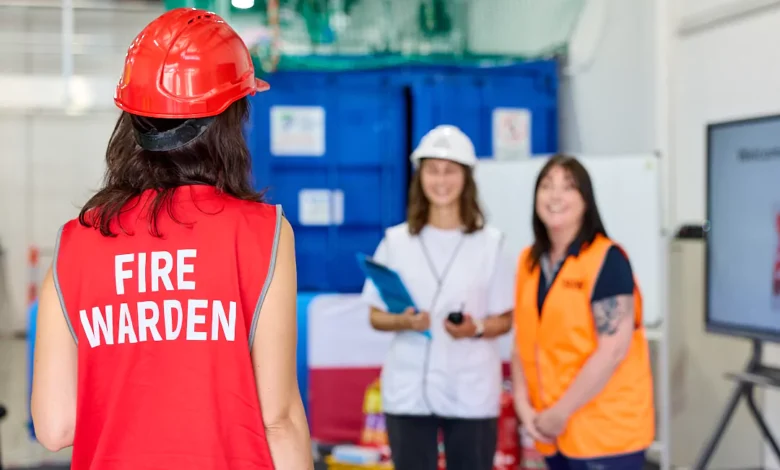
The builder’s hoist on a high-rise construction site in Parramatta is running its usual mid-morning cycle — materials up, empty cage back down — when the site’s emergency alarm cuts through the noise of the job. The hoist operator does not hesitate. The cage descending at that moment is brought to the nearest safe landing, the machine is secured, and within seconds a second worker, a nominated emergency warden for that section of the building, is already directing tradespeople toward the stairwell and confirming who is where.
Fourteen floors up, with no functioning lift shaft yet and a stairwell that will take several minutes to clear on foot, that hoist is not just construction infrastructure. It is one of the few practical ways people and materials move vertically through the building at all — which makes the moment it needs to stop, and stop correctly, one of the most consequential few seconds in the entire emergency response.
The Machine That Controls the Building’s Vertical Movement
A personnel and materials hoist carries a mix of cargo unlike almost any other piece of site plant — sometimes workers, sometimes materials, sometimes both in the same cage, moving continuously between ground level and whatever floor is currently under construction. Operating it safely requires more than familiarity with the controls; it requires a precise understanding of load weights, hazard identification specific to hoist operation, and — critically — exactly what to do if something goes wrong mid-cycle.
That is the ground covered by a hoist ticket, issued under the CPCCLHS3001 unit of competency. The course trains candidates to determine load weights before committing to a lift, identify and control hazards particular to hoist operation, run thorough pre-operational and shutdown checks with close attention to controls, alarms and lockout devices, and carry out an emergency lowering procedure correctly when required. Delivered over two to three days depending on location, it results in a Class HP High Risk Work Licence valid for five years. On a high-rise site, the operator holding that ticket effectively controls the tempo of the entire build — and, in the moments that matter most, the tempo of the response to anything going wrong.
The Plan That Has to Work Without Hesitation
A hoist stopped safely is only the first move in what follows an alarm. Somebody on that floor, and every floor below it, needs to know the muster point layout, recognise which alarm tone means what, account for every worker in their section, and communicate clearly with emergency services once they arrive — all while people are mid-task, some without full awareness yet of what has triggered the response.
That coordination role is what emergency warden training is built around. Delivered under the nationally accredited PUAFER005 unit, the two-hour, hands-on course prepares nominated staff to recognise alarms and initiate the correct response, coordinate an orderly evacuation to the designated assembly point, communicate effectively with arriving emergency services, and complete the headcounts and incident reporting that follow. The course is deliberately compact — the value is not in lengthy theory but in a practised, repeatable sequence a warden can run without hesitation, because a genuine emergency leaves no time to work it out from first principles.
Why High-Rise Sites Cannot Separate These Two Roles
Talk to site managers running vertical construction and a consistent point comes up: on a low-rise site, an emergency response has options — multiple stairwells, short travel distances, people close enough to the ground to self-evacuate quickly. On a high-rise build, especially one where lift infrastructure is not yet complete, those options narrow considerably. The hoist may be the fastest safe route down for anyone above a certain floor, which means the operator running it and the wardens coordinating the response around it are, in practice, working the same emergency from two different positions.
That is why builders working genuinely tall structures increasingly plan hoist licensing and warden training as parts of the same site readiness picture, rather than procurement items handled by unrelated departments. A hoist operator who understands the emergency lowering procedure cold, working alongside wardens who know exactly which floors depend on that hoist to get people down safely, closes a gap that would otherwise sit quietly unaddressed until the day it actually mattered.
Back to the Cage
The all-clear sounds a few minutes later. The hoist operator checks the mechanism, confirms the cage is clear, and resumes the day’s cycle — materials up, empty cage back down — as though nothing had interrupted it. Fourteen floors up, nobody treats the drill as a disruption. On a site where the hoist is, quite literally, the only way down for much of the workforce, that quiet competence is exactly what the plan is designed to produce.