Mycoamaranthus congolensis: A Complete Guide to the Rare African Truffle-Like Fungus
Mycoamaranthus congolensis is one of the most fascinating yet least-known fungi found in tropical Africa. Unlike the familiar mushrooms that grow above the ground with visible caps and stems, this unique species develops as a truffle-like fungus beneath or partially beneath the soil. Although it has attracted mycologists’ attention for decades, it remains relatively unknown to the general public due to its rarity and limited distribution. As interest in fungal biodiversity, forest ecology, and edible wild mushrooms continues to grow, Mycoamaranthus congolensis has become a topic of increasing scientific interest. Researchers study this species because of its unusual appearance, its role in maintaining healthy forest ecosystems, and its close relationship with native African trees. In some regions, it is even recognized as an edible wild fungus by local communities. This comprehensive guide explores everything you need to know about Mycoamaranthus congolensis, including its taxonomy, habitat, physical characteristics, ecological importance, distribution, edibility, conservation status, and fascinating scientific significance.
What is Mycoamaranthus congolensis?
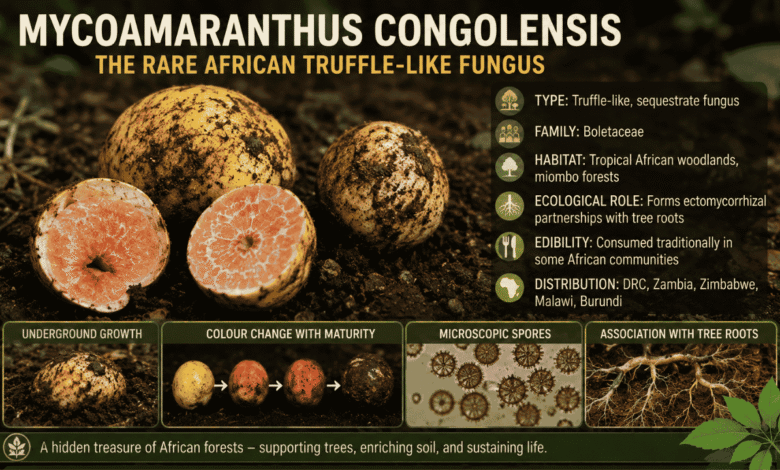
Mycoamaranthus congolensis is a sequestrate, truffle-like fungus belonging to the Boletaceae family. Unlike typical boletes, which produce large caps with pores beneath the cap, this species develops enclosed fruiting bodies that mature underground or partially buried in forest soils.
The fungus belongs to the small genus Mycoamaranthus, which contains only a handful of recognized species worldwide. Members of this genus are primarily found in tropical and subtropical forests where they establish beneficial relationships with trees through underground fungal networks.
Although it resembles true truffles in appearance, Mycoamaranthus congolensis is not closely related to the culinary truffles of Europe. Instead, it represents an unusual evolutionary branch within the bolete family.
Scientific Classification
The scientific classification of Mycoamaranthus congolensis is as follows:
- Kingdom: Fungi
- Phylum: Basidiomycota
- Class: Agaricomycetes
- Order: Boletales
- Family: Boletaceae
- Genus: Mycoamaranthus
- Species: Mycoamaranthus congolensis
Originally described as Dendrogaster congolensis, the species was later transferred to the genus Mycoamaranthus following taxonomic revisions based on morphological studies and subsequent research.
Taxonomic History
The history of Mycoamaranthus congolensis reflects the evolving understanding of fungal classification.
When the fungus was first described during the twentieth century, scientists placed it in the genus Dendrogaster because of its enclosed fruiting body. As additional studies examined microscopic structures such as spores and tissue organization, researchers recognized that it shared stronger characteristics with fungi in the Boletaceae family.
The establishment of the genus Mycoamaranthus allowed scientists to classify this distinctive African fungus more accurately. Modern molecular research continues to support its placement within Boletaceae, highlighting the diversity of truffle-like fungi that evolved from above-ground mushroom ancestors.
Physical Characteristics
One reason Mycoamaranthus congolensis fascinates researchers is its unusual appearance.
Some of its distinguishing features include:
Rounded Fruiting Body
Instead of producing a mushroom cap and stem, the fungus forms a rounded or potato-shaped fruiting body beneath the soil surface.
Size
Most specimens measure approximately 4 to 7 centimeters in diameter, although size can vary depending on growing conditions.
Color Changes
Young fruiting bodies often display a bright yellow outer surface. As they mature, the internal flesh gradually changes from pinkish shades to orange-red, then eventually to brown.
Spore Structure
Under microscopic examination, the spores possess thick walls and ornamental projections that help distinguish the species from related fungi.
Odor
Unlike many truffles that produce strong aromas to attract animals, Mycoamaranthus congolensis generally has only a faint odor.
Natural Habitat
The natural habitat of Mycoamaranthus congolensis is closely linked to tropical African woodland ecosystems.
It commonly occurs in:
- Miombo woodlands
- Tropical forests
- Woodland savannas
- Forests with ectomycorrhizal tree species
These environments provide the ideal combination of soil conditions, moisture, and host trees needed for the fungus to survive.
Unlike saprophytic fungi that feed on dead organic matter, Mycoamaranthus congolensis depends on living trees for much of its nutritional needs.
Geographic Distribution
Current scientific records indicate that Mycoamaranthus congolensis is native to central and southern Africa.
Countries where it has been reported include:
- Democratic Republic of the Congo
- Zambia
- Zimbabwe
- Malawi
- Burundi
The species appears to have a relatively restricted distribution compared with many widespread mushroom species.
Its occurrence is strongly associated with regions containing extensive miombo woodland ecosystems dominated by native African trees.
Ecological Importance
Perhaps the most important feature of Mycoamaranthus congolensis is its ecological role.
It functions as an ectomycorrhizal fungus, forming mutually beneficial partnerships with tree roots.
During this relationship:
- The fungus absorbs water and minerals from the soil.
- Trees receive improved nutrient availability.
- Trees provide sugars produced during photosynthesis.
- Soil health improves through fungal activity.
- Forest biodiversity increases.
Without ectomycorrhizal fungi such as Mycoamaranthus congolensis, many woodland ecosystems would struggle to maintain healthy tree populations.
Relationship with Host Trees
Researchers believe the fungus commonly associates with several African tree genera, including:
- Brachystegia
- Julbernardia
- Uapaca
These trees dominate the famous miombo woodlands that stretch across several African countries.
The underground fungal network effectively expands the root system of host trees, allowing them to access nutrients and water that roots alone could not easily obtain.
Edibility
One frequently asked question is whether Mycoamaranthus congolensis is edible.
Current reports indicate that it has been consumed traditionally in certain African communities.
Local knowledge suggests it is recognized as an edible wild fungus in parts of:
- Burundi
- Malawi
- Zambia
However, scientific information regarding its nutritional value remains limited.
Anyone interested in wild mushroom foraging should remember that proper identification by experts is essential, as many underground fungi can resemble one another while differing significantly in edibility or safety.
Similar Species
Several truffle-like fungi resemble Mycoamaranthus congolensis.
One notable example is Mackintoshia persica, another African sequestrate fungus.
Although the two species appear similar externally, specialists distinguish them by examining:
- Spore ornamentation
- Microscopic structures
- Internal tissue organization
- Genetic characteristics
Because of these similarities, laboratory analysis is often necessary for accurate identification.
Scientific Importance
Although relatively obscure, Mycoamaranthus congolensis contributes significantly to fungal research.
Scientists study the species for several reasons:
Understanding Evolution
It helps researchers understand how underground fungi evolved from mushroom-forming ancestors.
Biodiversity Research
The fungus adds valuable knowledge about Africa’s largely understudied fungal diversity.
Forest Ecology
Its relationship with trees provides insight into nutrient cycling and ecosystem stability.
Mycorrhizal Networks
The species contributes to understanding how underground fungal networks support entire forest communities.
Conservation Status
At present, Mycoamaranthus congolensis has not received a widely recognized global conservation assessment.
Nevertheless, several environmental pressures could affect its long-term survival:
- Deforestation
- Habitat fragmentation
- Agricultural expansion
- Climate change
- Loss of native woodland ecosystems
Because ectomycorrhizal fungi depend upon healthy forests, protecting woodland habitats indirectly protects species such as Mycoamaranthus congolensis.
Continued scientific surveys are likely to improve understanding of its population size and conservation needs.
Why This Rare Fungus Matters
Although it receives far less attention than edible mushrooms or commercially valuable truffles, Mycoamaranthus congolensis plays an essential role in tropical forest ecosystems.
Its underground partnership with trees helps maintain soil fertility, supports woodland biodiversity, and contributes to healthy forest regeneration.
As scientists continue to explore Africa’s remarkable fungal diversity, species like Mycoamaranthus congolensis may yield important insights into ecology, conservation, and fungal evolution.
Interesting Facts About Mycoamaranthus congolensis
- It is a truffle-like fungus rather than a typical mushroom.
- It belongs to the bolete family despite lacking a cap and stem.
- It develops underground or partially underground.
- It forms beneficial relationships with tree roots.
- It is native to tropical Africa.
- The genus Mycoamaranthus contains only a few known species.
- It was originally classified under another genus before taxonomic revision.
- It contributes to nutrient cycling in woodland ecosystems.
- Some African communities recognize it as an edible wild fungus.
- It remains one of Africa’s lesser-known fungal species.
Frequently Asked Questions
Is Mycoamaranthus congolensis edible?
Reports indicate that it is traditionally eaten in some African regions. However, wild mushrooms should never be consumed without expert identification.
Where is Mycoamaranthus congolensis found?
It has been documented in countries including the Democratic Republic of the Congo, Zambia, Zimbabwe, Malawi, and Burundi.
Is it a true truffle?
No. Although it resembles truffles in appearance and underground growth habit, it belongs to the Boletaceae family rather than the true truffle family.
Why is it important?
It forms ectomycorrhizal partnerships with trees, improving nutrient uptake, supporting forest health, and contributing to biodiversity.
Is it common?
No. Mycoamaranthus congolensis is considered a relatively rare and understudied fungal species.
Conclusion
Mycoamaranthus congolensis represents one of Africa’s most intriguing fungal species. Hidden beneath the soil of tropical woodlands, this rare truffle-like fungus plays a vital ecological role by forming mutually beneficial relationships with native trees. Although it remains relatively unknown outside scientific circles, its importance to forest ecosystems cannot be overstated.