Why Membrane Switches Remain Essential in Modern Industrial Design
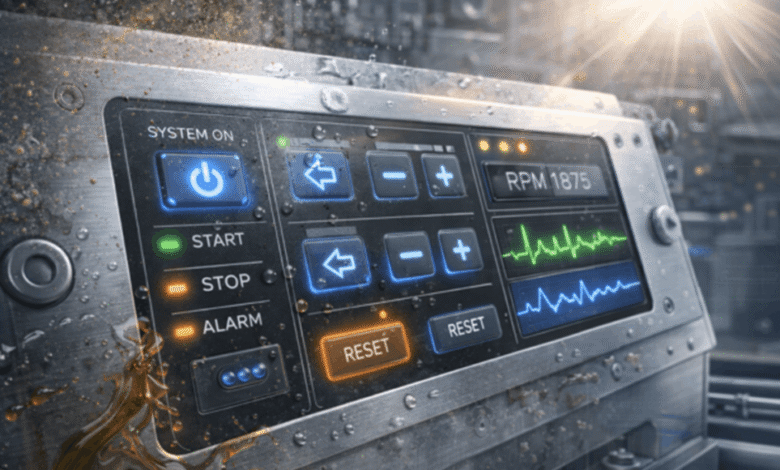
Industrial design prioritizes performance under stress. Equipment must function reliably despite vibration, moisture, dust, chemicals, and temperature fluctuations.
Membrane switches provide:
- Sealed surface construction for environmental protection
- Resistance to dust and moisture intrusion
- Chemical-resistant overlay materials
- High cycle life with minimal mechanical wear
- Low-profile and lightweight integration
Because the interface is sealed, contaminants cannot easily penetrate the system. This makes membrane switches ideal for applications requiring IP-rated protection.
Durability and Environmental Protection
Environmental sealing is one of the strongest advantages of membrane switches.
They can be engineered to withstand:
- Repeated mechanical actuation
- UV exposure
- Humidity and condensation
- Cleaning agents and disinfectants
- Industrial oils and solvents
In industries such as medical manufacturing, food processing, and heavy equipment, surface durability directly affects operational reliability.
Understanding common interface failure risks is also important when designing reliable control systems. This guide explains the common membrane switch design failure points and how to prevent them, including issues related to overlay wear, circuit damage, and environmental stress.
Unlike mechanical pushbuttons that expose internal components, membrane switches create a continuous sealed surface.
Design Flexibility and Customization
Modern industrial design requires both functionality and aesthetic clarity. Membrane switches offer extensive customization options.
Design flexibility includes:
- Custom key layouts
- Backlighting integration
- Embossed tactile feedback
- Transparent windows for displays
- Color matching and branding
- Integrated LEDs
Because the circuit layer is printed, engineers can modify layouts without major mechanical redesign.
This flexibility supports rapid design iteration and integration into compact control panels.
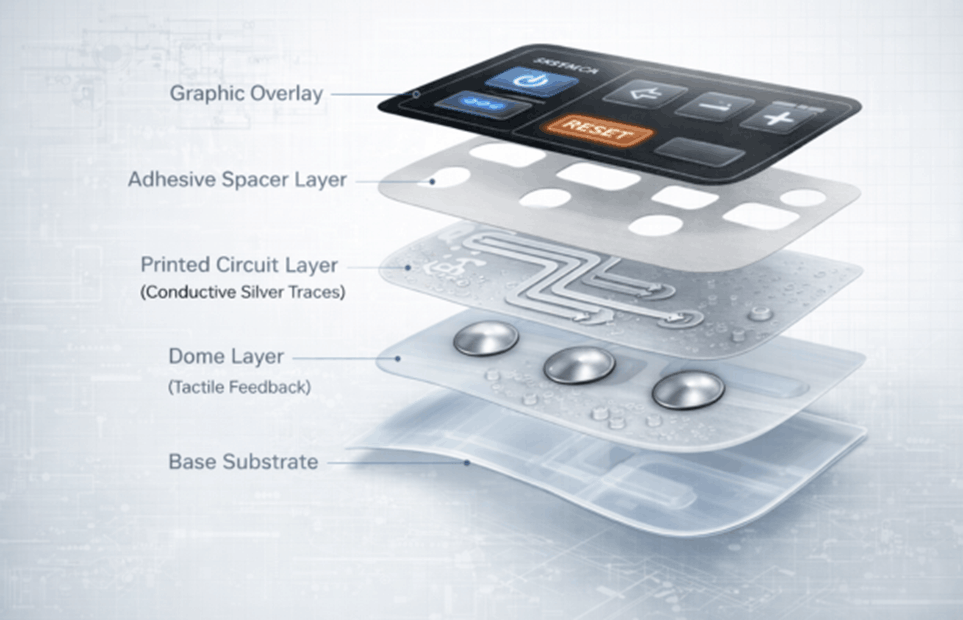
Electrical Reliability and Printed Circuit Integration
Membrane switches rely on printed conductive traces rather than discrete wiring. This printed electronics approach offers advantages in consistency and scalability.
Benefits include:
- Reduced wiring complexity
- Thin profile integration
- Stable electrical performance
- Lower assembly variability
The absence of mechanical contacts reduces the risk of long-term wear.
In modern industrial systems, reliability over millions of cycles is often more important than tactile complexity.
Cost Efficiency in Scalable Production
Industrial equipment manufacturers must balance durability with cost control.
Membrane switches support scalable manufacturing because:
- Printing processes are repeatable
- Tooling costs are manageable
- Assembly processes can be standardized
- Design for manufacturability can be applied early
Compared to mechanical key assemblies, membrane switches reduce part count and assembly labor.
For high-volume production environments, this translates into predictable cost structures and reduced supply chain complexity.
The scalability and manufacturing efficiency of membrane switches are closely tied to advancements in printed electronics technologies, a sector projected to see significant global growth over the next decade.
According to industry analysis, the printed electronics market is expected to expand rapidly as demand for flexible circuits, sensors, and interface technologies continues to increase.
Comparison with Alternative Interface Technologies
While capacitive touchscreens and mechanical keypads serve certain applications well, membrane switches continue to outperform in industrial use cases.
Membrane Switch vs Mechanical Switch
Membrane switches:
- Offer sealed surfaces
- Reduce internal debris entry
- Maintain consistent actuation over time
Mechanical switches:
- Have exposed moving parts
- Require panel cutouts
- They are susceptible to contamination
For a deeper technical comparison of performance, durability, and design considerations, read our detailed guide on membrane vs mechanical switches for your application.
Membrane Switch vs Capacitive Touchscreen
Touchscreens:
- Require power for sensing
- May struggle with gloved hands
- Can be sensitive to environmental interference
Membrane switches:
- Function with gloves
- Operate reliably in harsh environments
- Do not rely on capacitive sensing conditions
For many industrial systems, tactile feedback and environmental resistance outweigh the benefits of glass interfaces.
Applications Across Industries
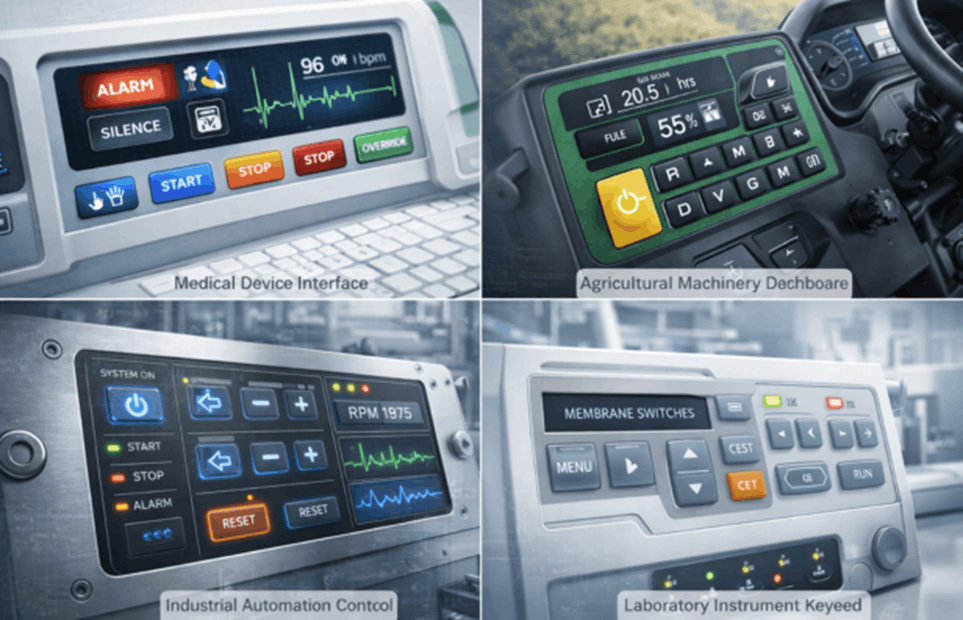
Membrane switches remain essential across multiple industrial sectors.
Common applications include:
- Medical device control panels
- Industrial automation systems
- Agricultural machinery
- Aerospace and avionics interfaces
- Laboratory instrumentation
- Heavy equipment dashboards
In these environments, interface failure can lead to downtime, safety risks, or regulatory concerns. Membrane switches provide predictable, durable input mechanisms.
Engineering Advantages in Modern Industrial Design
Modern industrial design focuses on integration, efficiency, and reliability.
Membrane switches support these goals through:
- Low-profile architecture that enables compact equipment design
- Integrated backlighting for visibility in low-light environments
- Customizable tactile response
- Environmental sealing capabilities
- Compatibility with printed electronics manufacturing
By combining electrical reliability with physical durability, membrane switches bridge the gap between user interface and mechanical system design.
Why They Continue to Remain Relevant
Technology evolves rapidly, but industrial requirements change more slowly. The need for durability, reliability, and environmental resistance remains constant.
Membrane switches remain essential because they:
- Solve environmental challenges effectively
- Offer design flexibility without mechanical complexity
- Support scalable manufacturing
- Maintain cost efficiency
- Integrate seamlessly with printed electronics systems
As industrial equipment becomes more compact and integrated, membrane switches continue to offer a balance of performance and manufacturability that alternative interface technologies often cannot match.
Frequently Asked Questions (FAQs)
Q. What makes membrane switches suitable for industrial use?
Their sealed construction, durability, and resistance to environmental exposure make them ideal for harsh operating conditions.
Q. Are membrane switches durable?
Yes. They are designed to withstand millions of actuations and exposure to moisture, chemicals, and vibration.
Q. Can membrane switches be customized?
Yes. They can be customized in layout, color, tactile feedback, lighting, and circuit design.
Q. Do membrane switches support backlighting?
Yes. LEDs and light diffusion layers can be integrated for visibility.
Q. Are membrane switches better than mechanical switches?
In many industrial applications, they offer better environmental sealing and long-term reliability.