Shopify Plus vs Adobe Commerce: A 2026 Comparison Guide
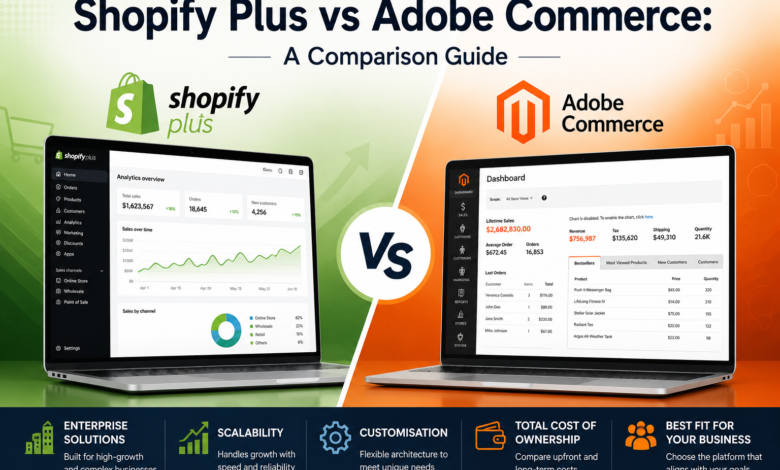
Selecting the right ecommerce platform for 2026 involves weighing aspects such as speed to market, customisability, cost of ownership, and scalability. Shopify Plus and Magento (now Adobe Commerce) are two popular enterprise options suited to different business types; if you favour rapid launches and a strong app ecosystem, working with experienced shopify development partners can accelerate delivery and reduce operational overhead. This guide outlines the features of Shopify Plus and Magento (Adobe Commerce) and compares them in terms of architecture, custom development, integrations, performance, costs and partner ecosystems to help you determine which platform is right for your roadmap.
Why platform choice matters in 2026
Ecommerce has evolved to maturity: Headless architectures, generative-AI personalisation, composable commerce and omnichannel fulfilment is expected of the norm. You need to be able to experiment quickly, implement complex B2B workflows (if required), and integrate seamlessly with future applications without extra expense or development time.
Overview: Shopify Plus
Shopify Plus is the enterprise version of Shopify. It’s about quick launches, reliability and an opinionated stack where you don’t need to worry about the infrastructure. Some of the main benefits consist of ease-of-use, payment and checkout combinations, and a vast app and verified Shopify development partner community.
Overview: Adobe Commerce
Adobe Commerce is better suited to businesses with more complex requirements, deeper customisation needs and more advanced operational workflows. It is particularly strong where unique business logic, custom integrations or advanced B2B functionality are essential. For retailers that need tighter control over catalogue, checkout and fulfilment processes, custom Magento development services are often the preferred route.
1. Architecture and flexibility
Shopify Plus: Closed, opinionated platform with strong defaults. Great for standard ecommerce flows and stores that prioritise speed and low operational overhead. Headless capability exists via Shopify’s Storefront API and Hydrogen, but some constraints remain around checkout customisation.
Adobe Commerce: Open-source core that’s modular. Perfect for highly customized solutions, complex product types and customizable business rules. Developers have deeper access to server side hooks and can customize almost every aspect of the stack—thus making many businesses invest in custom Magento development services.
2. Customisation and development
Shopify Plus: Customisation is mostly done through themes, apps and APIs. If a merchant is looking for something really customisable, they’ll turn to Shopify development partners to add functionality via headless frontends or apps. Deep server-side custom logic is more limited, while rapid iteration is easier.
Adobe Commerce: Built for custom work from tailored checkout logic to complex pricing rules and multi-source inventory. Adobe Commerce partners offer full-stack development and can integrate legacy systems. If your roadmap includes significant custom features, engaging experienced custom Magento development services is often the right choice.
3. Ecosystem and partners
Shopify Plus: A comprehensive Shopify partner ecosystem that includes Shopify development partners, apps and integrations. Partner network makes it easier to locate experts to help with migrations, custom apps and theme work.
Adobe Commerce: Adobe Community of Magento partners and network of agencies that specialise in complex integrations and performance tuning. For those customizations your project needs or major integrations to the backend, you will find an Adobe Commerce partner offers more platform expertise.
4. Performance, hosting and security
Shopify Plus: Fully managed hosting and CDN are included, with automatic scaling for traffic spikes. Security, PCI compliance and uptime are handled by Shopify, which reduces operational risk.
Adobe Commerce: Hosting and security depend on your chosen setup self-managed or hosted via Adobe Commerce Cloud or third-party providers. Self-hosting gives control and potentially better performance for highly optimised stacks, but requires investment in DevOps, security and scaling expertise.
5. Time to market and total cost of ownership (TCO)
Shopify Plus: Quick to set up and steady monthly costs. Decreased maintenance business lowers recurring prices for teams that wish to avoid maintaining infrastructure. But additional fees from third party apps, custom apps, and transaction fees can make the costs increase.
Adobe Commerce: Higher upfront development costs and longer implementation times, especially for custom builds. TCO can be higher due to hosting, maintenance and developer resource needs, but for highly customised or large catalog businesses the ROI can justify the investment.
6. Commerce features and B2B capabilities
Shopify Plus: Enables commerce basics + great D2C, omnichannel retail and headless storefront. While Shopify has enhanced the B2B capabilities, certain complicated corporate purchasing segments, account structure and advanced pricing alternatives may necessitate workarounds or Apps.
Advanced B2B Adobe Commerce: 2.4.x features are either built in or can be added via extensions. Adobe Commerce is chosen for a variety of reasons, including complex pricing rules, customer segmentation, quote systems, and large multi-site setups.Some of the common factors that drive companies to opt for Adobe Commerce include complex pricing rules, customer segmentation, quote systems, and large multi-site setups..
7. Integrations and composability
Shopify Plus: Rich app marketplace and easy APIs mean integrations can go quickly. Fits seamlessly into modern SaaS stacks and is an ideal option for teams seeking plug-and-play composability with minimal engineering overhead.
Adobe Commerce: If you need a significant amount of server-side control, it is an excellent option for deep integrations with your ERP, PIM, OMS and custom third-party services. For enterprise use cases, Adobe Commerce integration partners might provide a custom integration layer.
8. Developer experience and talent
Shopify Plus: Easier onboarding for frontend and full-stack developers focused on speed. Many agencies offer Shopify development partners certified by Shopify, which streamlines hiring and project delivery.
Adobe Commerce: Requires specialised backend developers comfortable with PHP, complex systems and performance optimisation. Recruiting skilled developers or working with experienced Adobe Commerce partners is essential for successful projects.
9. Use cases and recommended buyers
Choose Shopify Plus if:
- You prioritise rapid launches and lower operational overhead.
- Your product catalogue and business rules are straightforward.
- You want reliable, managed hosting and quick scalability.
- You can leverage Shopify development partners to extend functionality.
Choose Magento/Adobe Commerce if:
- You need deep customisation, complex B2B workflows or multi-store setups.
- You have legacy systems that require heavy integration.
- You expect large catalogues, custom product types or bespoke checkout flows.
- You have access to custom Magento development services or Adobe Commerce partners.
10. SEO and content considerations
Both platforms support robust SEO practices. Shopify Plus simplifies schema, redirects and speed optimisation out of the box. Adobe Commerce offers finer control over technical SEO elements and content architecture, which can be crucial for marketplaces or large catalog stores where structured data and custom URL rules are needed.
Final Decision Framework (quick checklist)
- Time to market: Shopify Plus
- Deep customisation & complex B2B: Magento/Adobe Commerce
- Predictable operations & hosting: Shopify Plus
- Full control & large-scale integration: Magento/Adobe Commerce
- Partner availability for standard stores: Shopify development partners
- Partner availability for complex builds: Adobe Commerce partners; seek custom Magento development services
Conclusion
Both platforms remain market leaders in 2026, but they answer different questions. Shopify Plus wins where speed, reliability and a managed experience matter. Magento (Adobe Commerce) wins where control, complex business logic and deep integrations are non-negotiable. Start by mapping your key requirements, custom workflows, expected traffic, integrations and team capability then match those needs to the platform strengths and partner networks. For high customisation, consider engaging custom Magento development services or certified Adobe Commerce partners. For faster launches with rich app ecosystems, work with Shopify development partners.
Author Bio
Pritesh is the Director of Sales for the US, UK and European markets for Magneto IT Solutions. He advises clients on their technology strategy, providing insights into the future of digital commerce for B2C and B2B mid-market and enterprise accounts. He has significant experience in the jewellery and luxury goods industry and enjoys consulting on digital transformation projects. He has over 15 years experience performing various roles from consulting through to delivery.