Why Specialized Metal Fabrication Requires A Highly Controlled Welding Environment
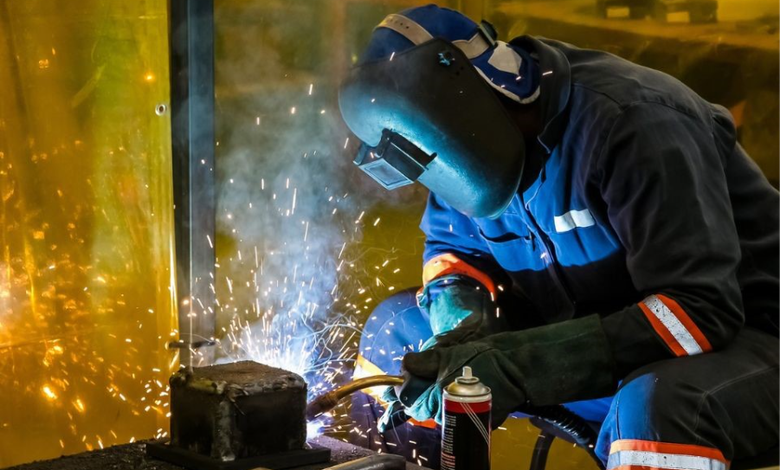
Being a skilled welder is of course important. But what matters more in any highly technical field is controlling the environment in which you’re welding. Too many welders don’t even consider taking this essential step unless they’re welding outside on a windy day and you’d be amazed how many failing grades a weld can get just because of the air.
Weld acceptance criteria don’t leave room for guesswork
When an auditor can pick up a sample coupon, run the numbers, and instantly determine that the relative humidity exceeded the mandated 70% limit on a given day eight weeks ago, you’re no longer in the realm of “eh, it’s close enough.” This level of documentation is a pain to maintain and it drives many skilled workers up the wall. A guy who’s welded stainless for 20 years knows perfectly well how to lay a bead without needing his workshop to have weather station-grade sensors and two digital hygrometers.
Moisture is the defect you can’t see coming
Many people don’t understand how dangerous humidity can be for a TIG weld. No, it doesn’t make the tungsten electrode wear faster, and it’s not going to screw up your gas coverage. But water vapor gets drawn into the arc (or is thermally liberated from damp joints, gases, or filler metal) and compounds into hydrogen. And, unlike other gases that result from contaminants, hydrogen is tiny; it seeps deep into the weld pool and the crystalline structure.
When your argon carries a lot of moisture, it does a lot more than spit and sputter in your arc. That hydrogen is atom-sized and, in welding alloys with enough hardenability (like chrome or nickel content), can blow a hole in a perfectly solid weld bead six months from now. Dew point is about more than smooth arcs and clean lenses. It demonstrates how much moisture your torch is letting through and how much hydrogen is exposing your weld. It’s basically a science-y measure of how watery your welding gas is. This is why checking dew point has become a qualification factor for space industries, food service contractors, auto companies, and most nuclear work. You’re not just sniffing around. You’re managing chemistry.
Airflow you don’t notice is airflow that ruins welds
TIG welding relies on having a shield of gas blanket the weld pool long enough for the metal to cool and solidify without getting contaminated by nitrogen or oxygen in the air. This shield is easily disturbed. It doesn’t take a strong gust.
Just having a bay door open, a fan too close, a shop ventilation system drawing air over the workbench, or even just another worker passing too quickly can strip the shielding gas from the arc for a split second. The welder may not even see it. There’s no bright flash or obvious hiccup. The contamination manifests later as pockmarks or oxidation. By the time an inspector returns the part, it’s often too late – the component might have to be scrapped.
That makes it one of the least satisfying problems to have in high-spec welding: the failure is invisible at the time and you can do everything else right – calibrate the machine, use the right settings, and a good, steady welder – but someone left a door open and let the part blow. It’s right up there with spills, in terms of straight up wasted time.
Different metals demand different levels of environmental discipline
Not all materials are created equal when it comes to atmospheric control, and knowing that hierarchy matters when designing your shop.
Aluminum is the easiest to be permissive with but it still feels the effects when humidity and oxide get out of whack. Moisture in the base metal or filler wire becomes porosity in a hurry, and the oxide is a bigger problem than most people realize: you have to manage it either mechanically (by wire brushing or grinding immediately before welding) or chemically (by using a special oxide-immune gas mix or adding oxide-taming rod additions). When it comes to choosing the right tig welders for these jobs, the atmospheric control requirements should factor into the decision just as much as amperage range. Stainless steel is next on the list but advancing the atmosphere control to back purging and trailing shielding solves the problem. Heat tint itself – the rainbow discoloration caused by oxidation along the weld and HAZ – is a direct visual signal that the shielding environment failed to protect the cooling metal.
Reactive metals like titanium and zirconium oxidize so aggressively at welding temperatures that even standard shielding isn’t quite good enough for them. Back purging is required to shield the root side of the weld from oxidation, and for most zirconium work you’re going to have to back-purge as well. Many titanium fabrication operations run inside fully enclosed, oxygen-monitored chambers because even a brief exposure to atmosphere can embrittle the weld and compromise the part structurally.
Temperature control works on two levels at once
While preheat and interpass temperature are critical to the quality and consistency of your welds, the ambient workshop environment matters too. Cool temperatures combined with warm, humid air create condensation, which leads to porosity. Convection currents can blow shielding gas away, and they can also move contaminants from rags, dirty gloves, or other sources right onto surfaces about to be welded. Cool temperatures also help water condense out of the air and onto materials you don’t want to weld into a structure – like the secret crevices of a chain sling, where you won’t discover it until you’re doing an expensive X-ray evaluation of the structure.
Contamination doesn’t stop at the air
A controlled environment involves more than just gas and temperature. It also restricts what can be present around the work. Dust and airborne particulates can settle in the weld pool. Any oil or cutting fluid residue will be burned in the arc, introducing carbon and hydrocarbons that effectively act like moisture in the heat. Cleaning solvents, especially chlorinated solvents, easily break down in the arc’s heat and the resulting compounds are both weld contaminants and extremely dangerous to any welders near the fume plume.
Fabrication shops that work with reactive metals or medical-grade work often have cleanroom or containment enclosures because the kind of trace contamination that would be invisible on a structural steel job will show up as a rejected weld on a titanium or stainless part. The rule is that the room’s air quality standard has to match the material’s tolerance, not the other way around.
Equipment only performs as well as the room it sits in
While some of this flexibility has arrived at a consumer price point in the last decade, a lot of the extra features on a high-end machine are going to be wasted on all but the most advanced welders or weirdest jobs. On the other hand, a machine that can’t produce a stable arc at the 25 to 50 amps you’ll use for many thin-work applications isn’t “less welder” in the way that “we need to buy more welder” sounds like an upsell. It’s a machine that will fight you on the work you’re doing, and thus, a machine that’s not actually appropriate for the work you’re doing.
It’s really easy to determine how much welder you need, though: rent a top-end machine suitable for the kind of work you plan on doing in the environment you have available. If the results are better than what your workforce can manage with standard settings, humidity, airflow, or contamination are still an issue, not the welder. If welders aren’t producing adequate results, it’s time to invest in either training welders or in a machine that will.
The economics only make sense with both in place
Manufacturing uses expensive materials and any failure during fabrication can be costly. For example, titanium and high-nickel alloys are expensive materials, and so are the tools, inserts, and machine costs associated with their machining. The more expensive heat treatment processes that are used to relieve machined-in stress, such as solution heat treating and annealing in dry hydrogen furnaces, are also heating the part for subsequent welding. Nondestructive testing (NDT) doesn’t come cheap, and neither does any of the hardware or documentation that goes into a fully validated part.
It’s not just the cost of the failed part if you need to scrap or rework it; it’s the labor and inspection that has already been invested in the piece that failed, and the schedule overrun that will occur while you wait for a replacement part to be made. This issue is compounded in long-lead-time projects when the replacement part may end up delaying an entire assembly and the subsequent parts of which it is an element.
Skill and environment are the same investment
If a shop pays up for great welders, and shops well for excellent welding machines, while at the same time leaving the bay doors open and humidity uncontrolled, it’s paying twice for a result it’s actively undermining. The room isn’t a supporting factor sitting behind the real work. It’s part of the process, documented in the WPS, tested in the PQR, and paid for in scrap rates when it’s ignored. Get the room right, and the skill and the equipment finally get to do the job they were bought for.