Automatic Bagging Systems vs. Manual Packaging: Which One Saves More Money in 2026?
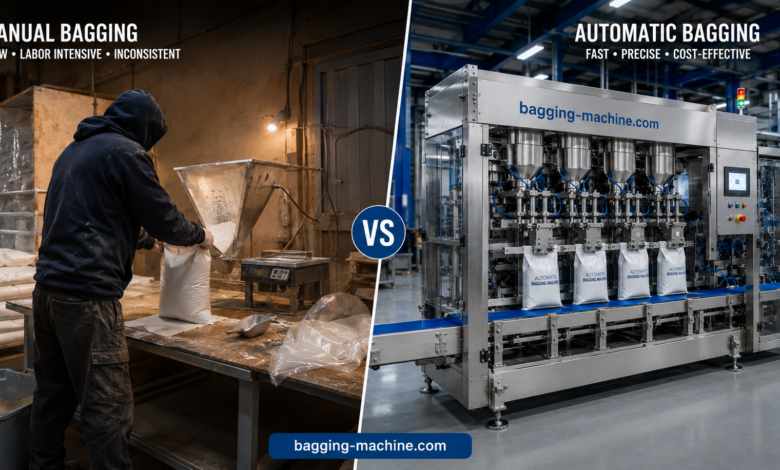
There is a quiet financial drain running through thousands of manufacturing facilities right now — and most operators know exactly where it is. It is the packaging line.
In 2026, labor costs have climbed steadily across every major manufacturing region. Minimum wage floors have risen. Worker turnover in repetitive roles like manual bagging has hit record highs in many industries. At the same time, customers expect faster delivery, more consistent packaging, and fewer errors.
Manual packaging was the default for decades because it was flexible, required no capital investment, and was easy to scale up by simply hiring more people. But that equation is changing fast.
Automatic bagging systems have dropped in price, improved in reliability, and become accessible to mid-sized and even small manufacturers who once considered automation out of reach.
So the question every operations manager is asking in 2026 is straightforward: which option actually saves more money — sticking with manual packaging or investing in an automatic bagging system?
This article breaks that question down with real numbers, honest comparisons, and a clear framework to help you decide.
The True Cost of Manual Bagging: Labor, Errors, Downtime, and Compliance Risks
Most manufacturers who calculate the cost of manual bagging only look at wages. That is the first mistake. The real cost of manual packaging is significantly higher once you account for everything it actually involves.
Direct Labor Costs
A manual bagging line typically requires 2 to 4 workers per shift depending on the product and bag size. At an average fully-loaded labor cost (wages + benefits + employer taxes + insurance) of $18 to $28 per hour in North America, or £14 to £22 in the UK, a two-worker line running one 8-hour shift costs between $288 and $448 per day — before you account for overtime, absenteeism cover, or recruitment costs.
Scale that to 250 working days per year and you are spending between $72,000 and $112,000 annually on direct labor alone for a single two-worker manual line. Facilities running multiple shifts multiply that figure accordingly.
Errors and Product Giveaway
Manual filling is inconsistent. Even experienced packers vary their fill weights by 2% to 5% per bag. On a 1 kg product, a 3% overfill costs 30 grams per bag. That sounds trivial — until you multiply it by 500 bags per day, 250 days per year. That is 3,750 kg of product given away free every year on a single manual line.
For a product worth $2 per kg, that overfill costs $7,500 annually. For higher-value products — specialty food, pharmaceuticals, chemicals — the number climbs dramatically.
Rework and Rejection Costs
Bags that are underfilled, incorrectly sealed, or mislabeled must be reworked or discarded. In regulated industries, rejected batches trigger compliance reporting, potential audits, and reputational risk with buyers. The average rework cost per incident — including labor, materials, and downtime — ranges from $50 to several hundred dollars depending on the product.
Downtime and Absenteeism
Manual lines stop when workers are absent. With average absenteeism rates running at 5% to 8% in manufacturing environments, a two-worker line loses between 25 and 32 worker-days per year to unplanned absences — before accounting for holidays, sick leave, and turnover-related gaps.
Compliance and Liability Risk
In food, agriculture, and pharmaceutical packaging, weight compliance is not optional. Short-weight bags expose manufacturers to regulatory penalties, retailer chargebacks, and customer claims. Manual lines are far more vulnerable to compliance failures than automated systems with integrated checkweighers.
When you add all of these costs together — direct labor, product giveaway, rework, downtime, and compliance risk — the true annual cost of a manual bagging line is typically 40% to 70% higher than the wage bill alone suggests.
How Automatic Bagging Systems Cut Operational Costs (ROI Breakdown)
Automatic bagging systems replace the variable, error-prone costs of manual packaging with a fixed, predictable cost structure. Here is where the savings come from and how they compound over time.
Labor Reduction
A fully automatic bagging system typically requires one operator to oversee the line, monitor the control panel, and handle material replenishment. That replaces a team of 2 to 4 manual packers. On a two-shift operation, the labor saving alone can reach $80,000 to $150,000 per year depending on your local labor market.
Fill Accuracy and Waste Elimination
Modern automatic bagging systems achieve fill accuracy of ±0.1% to ±0.5% depending on the weighing technology used. Compared to the 2% to 5% overfill variance common in manual operations, this directly eliminates product giveaway. On a high-volume line, this saving alone can offset a significant portion of the machine’s purchase price within the first year.
Throughput Increase Without Proportional Cost Increase
A mid-range automatic bagging system runs at 8 to 20 bags per minute. A two-person manual line typically manages 6 to 14 bags per minute combined, and only under ideal conditions. The automated system maintains its rated speed consistently across the entire shift — no fatigue, no pace variation, no slowdown after lunch.
To match the output of a 15 bags-per-minute automatic system manually, you would need 4 to 5 workers running continuously. The labor cost difference is stark.
Reduced Rework and Waste
Automatic systems with integrated checkweighers and rejection gates remove underweight or overweight bags from the line automatically. This eliminates the downstream cost of reworking non-compliant product and reduces customer complaints and chargebacks substantially.
ROI Timeline
A mid-range automatic bagging system costs between $25,000 and $80,000 depending on specification, throughput, and bag format. For a manufacturer currently spending $90,000 per year on a two-worker manual bagging line (fully loaded), the payback period on a $50,000 automated system — accounting for labor savings, accuracy improvements, and reduced waste — typically falls between 8 and 18 months.
After payback, the system continues generating savings for its operational life, which for a quality-built automatic bagging system is typically 10 to 15 years with regular maintenance.
When a Semi-Automatic Bagging Machine Is the Smarter Middle Ground
Full automation is not always the right first step. For many manufacturers, a semi automatic bagging machine delivers the majority of the financial benefit at a fraction of the capital cost — and it is the pragmatic choice in several specific situations.
A semi-automatic bagging machine automates the filling and sealing steps while retaining an operator to place and position each bag. This reduces labor from 3–4 workers to 1–2, cuts fill errors significantly, and improves throughput — without requiring the capital expenditure or integration complexity of a fully automatic line.
Choose semi-automatic when:
Your production volume is moderate. If you are producing between 2 and 8 bags per minute, a semi-automatic system matches your throughput without buying speed you do not need. A fully automatic system running at 40% capacity for years is poor capital allocation.
You run frequent product changeovers. Semi-automatic machines are faster and simpler to reconfigure between different bag sizes or product types. If you handle 10 or 15 different SKUs and switch between them regularly, the flexibility of a semi-automatic line is a genuine advantage.
Your capital budget is limited but labor savings are still a priority. Semi-automatic bagging machines typically cost between $5,000 and $25,000 — a fraction of a fully automatic system. For a small manufacturer, this is a realistic investment with a payback period of 6 to 12 months.
You want to automate gradually. Many manufacturers start with a semi-automatic bagging machine, train their team on the technology, measure the savings, and then upgrade to a fully automatic system 2 to 3 years later once volume justifies it. This phased approach de-risks the automation journey significantly.
The semi-automatic route is not a compromise — it is a strategic step for businesses that are not yet at the production volume where full automation pays off immediately.
Speed, Throughput, and Accuracy: Head-to-Head Comparison
Here is a direct comparison across the three main approaches to help you see the differences clearly:
Output Rate
- Manual packaging: 3–8 bags per minute (per worker)
- Semi-automatic bagging machine: 4–10 bags per minute
- Fully automatic bagging system: 8–60+ bags per minute
Fill Accuracy
- Manual packaging: ±2% to ±5% typical variance
- Semi-automatic: ±0.5% to ±1.5% (machine-controlled fill)
- Fully automatic: ±0.1% to ±0.5% (gravimetric weighing)
Labor Required Per Shift
- Manual packaging: 2–5 workers
- Semi-automatic: 1–2 workers
- Fully automatic: 1 operator (monitoring role)
Consistency Over Time
- Manual packaging: Degrades with fatigue, turnover, and absenteeism
- Semi-automatic: Consistent fill and seal; human element limited to bag placement
- Fully automatic: Consistent throughout the full shift with no human variability
Setup and Changeover
- Manual packaging: Minimal setup; very flexible
- Semi-automatic: 10–30 minutes for product changeover
- Fully automatic: 20–60 minutes; some formats require tooling changes
Capital Cost
- Manual packaging: Low (basic tools, heat sealers) — $500 to $5,000
- Semi-automatic: Moderate — $5,000 to $25,000
- Fully automatic: Higher — $25,000 to $150,000+
Annual Operating Cost (2-shift operation)
- Manual packaging: $120,000–$200,000+ (fully loaded labor)
- Semi-automatic: $40,000–$80,000 (reduced labor + machine maintenance)
- Fully automatic: $15,000–$40,000 (single operator + maintenance)
The numbers make the case clearly: for any manufacturer running more than one shift or producing above 5 bags per minute consistently, automatic bagging systems deliver a lower total operating cost within 12 to 24 months of installation.
Scalability: How a Bagging Machine Grows With Your Production Volume
One of the most undervalued arguments for investing in a bagging machine early is scalability — the ability to increase output without proportionally increasing cost.
With manual packaging, scaling up means hiring more people. Every 20% increase in output requires a near-proportional increase in headcount. More workers means more recruitment cost, more training time, more management overhead, more floor space, and more variability introduced into your packaging quality.
With an automatic bagging system, scaling up often means adjusting a parameter on the control panel, adding a shift for the single operator, or upgrading to a higher-speed model when volume genuinely justifies it. The infrastructure — conveyors, checkweighers, downstream equipment — is already in place.
Many automatic bagging systems are also modular by design. You can start with a base machine and add:
- An automatic bag magazine to eliminate manual bag loading
- An integrated checkweigher and rejection gate for compliance
- A label applicator for downstream branding or traceability
- A palletizer to automate the end of the line
Each module adds capability without requiring a full system replacement. This modular scalability means your initial investment grows with your business rather than becoming obsolete when your volume increases.
Consider a manufacturer currently producing 200 bags per hour manually with 3 workers. If demand doubles, they need 6 workers to match output — with all the recruitment, training, and management cost that entails. The same manufacturer with an automatic bagging system simply extends the run time or adjusts the throughput setting. The marginal cost of producing the next 200 bags is dramatically lower.
This is the compounding advantage of automation: the cost per bag decreases as volume increases, while the cost per bag in a manual operation stays relatively flat or even rises as workers become harder to find and retain.
5 Questions to Ask Before Switching to an Automated Bagging System
If you are leaning toward automation after reading this far, use these five questions to validate your decision and define the right next step:
1. What is my current fully-loaded cost per bag? Calculate your total annual packaging labor cost (including benefits, recruitment, and absenteeism cover) and divide by your annual bag output. This is your baseline. Now calculate the projected cost per bag with an automated system (machine amortization + one operator). The gap is your annual saving.
2. What is my minimum required throughput? Do not buy more speed than you need for the next 2 to 3 years. Over-specifying a machine wastes capital. Under-specifying means you outgrow it before payback is complete.
3. Have I run my product through a machine trial? No reputable supplier should expect you to commit without a live trial using your actual product. If they do, that is a warning sign.
4. What is the total cost of ownership over five years? Purchase price, installation, training, spare parts, maintenance contracts, and expected downtime costs all belong in this calculation. A $30,000 machine with poor support infrastructure can cost more over five years than a $45,000 machine with strong local service.
5. Am I ready for the process change? Automation changes how your team works, not just the machine on the floor. Operators need training. Maintenance schedules need to be established. Changeover procedures need to be documented. Factor in the organizational change, not just the technical installation.
Summary: Which One Actually Saves More Money?
The honest answer is: for the vast majority of manufacturers running consistent production volumes above 3 to 5 bags per minute, automatic bagging systems save significantly more money than manual packaging — typically within 12 to 18 months of installation, and compounding year over year after that.
Manual packaging retains a cost advantage only in very low-volume situations, highly variable product runs where flexibility outweighs automation benefits, or startup operations where capital preservation is the priority above all else.
For everyone else, the math has shifted decisively in favor of automation in 2026. Labor is more expensive, machines are more affordable, and the gap in total operating cost between manual and automated packaging lines has never been wider.
The question is no longer really whether to automate. It is which level of automation — semi-automatic or fully automatic — fits your current volume, budget, and growth trajectory, and how quickly you can get there.